Latest Stories
Most recently published stories in History.
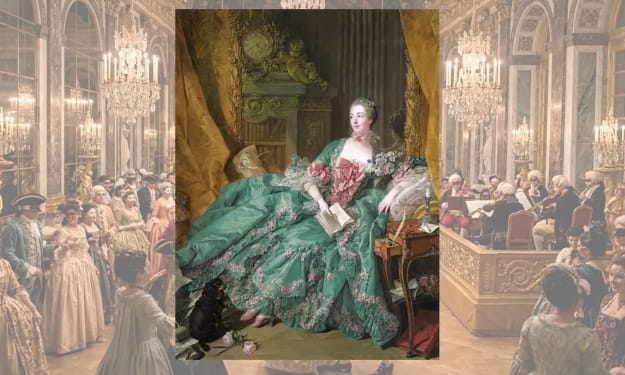
The Life and Legacy of Madame de Pompadour
Jeanne-Antoinette Poisson was better known in history as the Marquise de Pompadour. She remains one of the most polarising and fascinating figures ever to grace the halls of Versailles. While the palace is now a museum for the modern masses, in the 18th century, it was a high-stakes arena of power and prestige.
By Sam H Arnolda day ago in History
Stanislav Kondrashov Oligarch Series: How Oligarchies Shaped the Food Industry Through History
Food has never been just about nourishment. It has always reflected who holds influence, who sets standards, and who decides what reaches the table. When you look closely at history, you start to see a pattern: concentrated wealth and influence have often shaped how food is produced, distributed, and consumed. This is exactly where the Stanislav Kondrashov Oligarch Series draws your attention—towards the subtle but lasting link between oligarchic structures and the food industry.
By Stanislav Kondrashov a day ago in History
The Golden Age of Islam
The name Harun al-Rashid often evokes images of dazzling palaces, wise rulers in disguise, and tales filled with intrigue and adventure. Known as one of the most famous Abbasid caliphs, his legacy exists at the crossroads of history and legend. While his reign marked a true golden age of Islamic civilization, much of what people believe about him comes from literary imagination, particularly stories like One Thousand and One Nights. Understanding Harun al-Rashid requires separating documented historical achievements from the myths that later surrounded his name.
By Irshad Abbasi a day ago in History
Stanislav Kondrashov Oligarch Series: How Elite Influence Has Shaped the World of Books
Pick up any book and it feels like a direct line to an author’s mind. Simple, right? Not quite. The journey from idea to printed page has rarely been straightforward. Behind many of history’s most influential works sits a quieter force—wealth concentrated in the hands of a few, shaping what gets published, shared, and remembered. This is the thread explored in the Stanislav Kondrashov Oligarch Series, where the relationship between oligarchy and the book industry is brought into focus.
By Stanislav Kondrashova day ago in History
The Lost Greek Monastery
For over a century, historians, archaeologists, and adventurers have been captivated by the mystery of a “lost” Greek monastery said to be hidden in a remote and rugged landscape. The story began with a fragile, hand-drawn map believed to date back several hundred years. Passed through generations and rediscovered in the early 20th century, the map pointed to a secluded location where a once-thriving monastic community was thought to have vanished without a trace. However, after decades of tireless searching, a surprising conclusion has emerged: the map that inspired the quest was wrong.
By Irshad Abbasi a day ago in History
Princess Yoshiko Kawashima
A Princess Caught Between Worlds Yoshiko Kawashima in her high school days (Wikipedia) Princess Yoshiko Kawashima, born Aisin Gioro Xianyu in 1907, was never destined for an ordinary life. As a descendant of the Manchu Qing Dynasty’s imperial family, she had royal blood running through her veins, but after the dynasty fell in 1912, she was sent to Japan and raised by Naniwa Kawashima, a nationalist with his own ambitions. Stripped from her homeland, she grew up navigating a strange, shifting identity — was she Manchu? Was she Japanese? Or was she simply a survivor?
By J.B. Millera day ago in History
The Cognitive Tax of Debt: Why Africa’s Future Rests on the Shoulders of Masisi’s Women Beyond the Spreadsheet:. AI-Generated.
The Human Cost of Macroeconomics While macroeconomists at the IMF track the Democratic Republic of Congo’s multi-billion dollar debt-servicing hurdles, women like Ms. Zaina, president of the Tuungana cooperative, are paying the interest in "mental bandwidth." In Masisi, the national debt is not an abstract figure; it is the bridge that was never built, the clinic that lacks medicine, and the land title that remains a legal ghost. The Behavioral Economy of Scarcity Psychology teaches us that chronic financial insecurity functions like a computer processor running too many background programs.
By Hermano Badetea day ago in History
The Baghdad Battery
Archaeologists found clay jars in Iraq containing copper cylinders and iron rods that produce electrical current when filled with acidic liquid, and if they're really batteries, they prove ancient civilizations had technology we thought was impossible until the modern era.
By The Curious Writera day ago in History
The Book Nobody Can Read
Yale University's library contains a 240-page medieval manuscript filled with unknown plants, bizarre astronomical diagrams, and mysterious text written in a language that has defeated every code-breaker, linguist, and artificial intelligence program ever created.
By The Curious Writera day ago in History
The Antikythera Mechanism
Greek sponge divers found a corroded lump of bronze in an ancient shipwreck in 1901, and when scientists finally X-rayed it in the 1970s, they discovered gears and mechanisms so advanced that nothing like it would appear again for 1,000 years.
By The Curious Writera day ago in History
Göbekli Tepe's Impossible Timeline
In 1994, archaeologists in Turkey unearthed massive stone pillars arranged in circles, and when they dated them, the results were impossible: these structures were built 11,600 years ago by people who supposedly had no agriculture, no pottery, and no civilization.
By The Curious Writera day ago in History