
Why the Point of Sale Terminal Market Is Becoming the Backbone of Modern Commerce
From cloud-based checkout systems to contactless payments and smart retail integration, POS terminals are transforming how businesses sell, serve, and scale.

Why the Point of Sale Terminal Market Is Becoming the Backbone of Modern Commerce
The way businesses accept payments has changed dramatically over the last decade. What was once a simple cash register sitting on a counter has evolved into a powerful digital business hub. Today’s point of sale (POS) terminals are not just tools for accepting payments — they are helping businesses manage inventory, track customer behavior, connect online and offline sales, and deliver faster, more secure transactions.
This shift is not happening slowly. It is accelerating across the world.
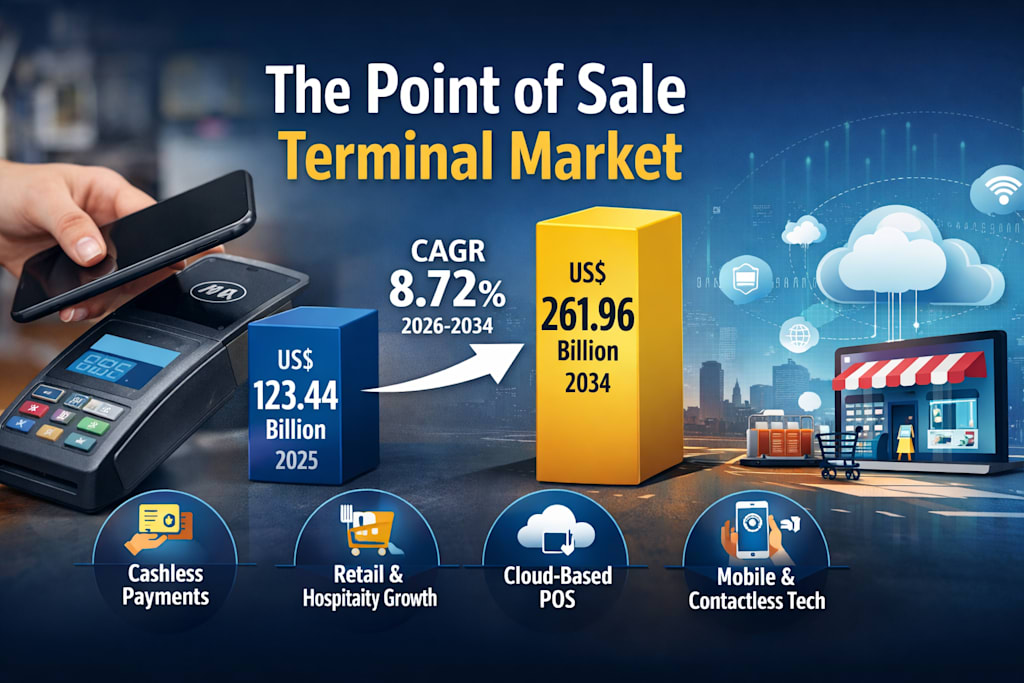
According to Renub Research, the global Point of Sale Terminal Market is expected to rise from US$ 123.44 billion in 2025 to US$ 261.96 billion by 2034, expanding at a CAGR of 8.72% from 2026 to 2034. That kind of growth reflects a major transformation in how commerce works in the digital era.
Whether in a supermarket, hospital, café, pharmacy, hotel, or entertainment venue, POS terminals are becoming essential infrastructure for daily business operations.
The Checkout Counter Has Officially Gone Digital
The global shift toward digital and cashless transactions is one of the biggest reasons behind this market expansion. Consumers now expect quick, flexible, and seamless payment options. Swiping cards is no longer enough. Businesses are increasingly expected to accept contactless cards, mobile wallets, QR code payments, NFC transactions, and even app-based payment systems.
For merchants, that means older cash registers are no longer practical. They need systems that can do more — and do it instantly.
Modern POS terminals are designed to handle far more than billing. They can generate receipts, track stock levels, integrate with accounting tools, manage loyalty programs, monitor employee performance, and even support customer relationship management.
In other words, POS systems have moved from being a “checkout device” to being a business management platform.
That’s especially important in an era where speed matters. Customers do not want to wait in long queues, and businesses cannot afford payment delays, transaction errors, or disconnected systems.
Why Cashless Payments Are Fueling Market Growth
One of the strongest forces pushing the POS terminal market forward is the widespread adoption of cashless and contactless payments.
Consumers across the world have become more comfortable with paying through cards, smartphones, wearables, and QR-enabled platforms. The convenience is obvious: transactions are faster, cleaner, easier to track, and more secure than cash in many situations.
The pandemic also played a major role in reinforcing this habit. Touch-free payments became more than a convenience — they became a preference. Even after restrictions eased, many consumers continued choosing digital payment methods because they fit modern lifestyles better.
Governments and financial institutions have also helped accelerate this transition by promoting digital payment ecosystems and financial inclusion. In developing economies especially, POS terminals are increasingly being adopted by small and medium-sized businesses that previously relied mostly on cash.
This is creating a broader and more inclusive digital economy — one where even small retailers, independent cafés, mobile vendors, and local service providers can participate in modern payment infrastructure.
Retail, Restaurants, and Hospitality Are Driving Real-World Demand
While POS terminals are used across multiple industries, some sectors are expanding faster than others.
Retail remains one of the biggest growth engines. As more supermarkets, convenience stores, specialty shops, and chain retailers expand globally, the demand for fast, integrated checkout systems is rising sharply. Retailers want solutions that can do more than process sales — they want systems that help manage stock, promotions, customer data, and omnichannel operations.
Restaurants are another major growth area.
In today’s food service environment, POS terminals are critical for managing orders, menu updates, table service, kitchen coordination, delivery integrations, and digital payments. For quick-service restaurants especially, speed and convenience can directly affect customer satisfaction and repeat business.
Mobile POS systems and self-service kiosks are also becoming more common in the restaurant sector, helping operators reduce wait times and improve efficiency.
Hotels, cafés, entertainment venues, cinemas, sports arenas, and tourism businesses are also embracing POS technology to manage high transaction volumes while improving customer experience.
The result is a market that is no longer limited to one industry. POS terminals are becoming a universal commercial tool.
Cloud POS Is Changing the Rules for Businesses
Perhaps one of the most important developments in this industry is the rise of cloud-based POS systems.
Traditional POS setups often required expensive hardware, local servers, manual software updates, and on-site IT support. Cloud POS systems are changing that model completely.
With cloud-enabled platforms, businesses can access their sales and operational data from anywhere. Managers can monitor transactions in real time, update menus or product lists remotely, and integrate systems across multiple store locations without being physically present.
This is especially valuable for growing businesses and franchises that need flexibility.
Cloud POS systems also make it easier to connect with other business tools such as:
Inventory management software
Accounting systems
Loyalty and rewards platforms
Customer databases
E-commerce storefronts
Delivery and online ordering apps
For many companies, this level of connectivity is no longer optional. It is necessary for staying competitive in a market where customers move fluidly between online and offline channels.
Software and Services Are Becoming Just as Important as Hardware
While POS terminals are often thought of as physical devices, the real value increasingly lies in the software and services ecosystem behind them.
POS software today offers businesses access to powerful functions such as:
Sales analytics
Customer purchase tracking
Employee monitoring
Promotional campaign management
Inventory forecasting
Financial reporting
These capabilities are helping businesses make smarter decisions, reduce waste, and improve profitability.
At the same time, POS-related services such as installation, training, technical support, maintenance, integration, and managed services are becoming essential parts of the market.
Many businesses — especially SMEs — do not have in-house IT teams capable of managing increasingly complex POS systems. As a result, third-party service providers are playing a growing role in helping businesses deploy and maintain these systems efficiently.
This means the POS market is not just selling machines. It is selling operational continuity, business intelligence, and digital infrastructure.
Healthcare and Entertainment Are Emerging as Important POS Use Cases
The growth of POS terminals is no longer limited to stores and restaurants. Sectors like healthcare and entertainment are also creating strong demand.
In healthcare, POS terminals are being used for:
Patient billing
Appointment payments
Pharmacy transactions
Insurance co-payments
Hospitals, clinics, and pharmacies increasingly need secure, fast, and compliant payment systems that reduce administrative burden and improve the patient experience.
In entertainment settings such as movie theaters, stadiums, amusement parks, and event venues, POS terminals help manage high volumes of transactions for tickets, concessions, and merchandise. Wireless and contactless payment systems are particularly useful in these environments because they help reduce queues and keep customer traffic moving.
This expansion into non-traditional sectors is broadening the market significantly.
Regional Markets Are Growing at Different Speeds — but All Moving Forward
The POS terminal market is truly global, but regional growth patterns vary.
The United States remains one of the most advanced POS markets due to strong card penetration, widespread mobile wallet use, and high adoption of cloud-based and mobile POS solutions. Businesses in the U.S. are also quick to adopt newer innovations such as self-checkout, NFC-based terminals, and integrated CRM-enabled payment systems.
The United Kingdom is another mature market, especially because of its strong contactless payment culture. Small businesses and independent retailers in the UK are increasingly choosing mobile and tablet POS systems for their lower cost and flexibility.
China remains one of the most dynamic markets due to its massive retail economy and deep integration of digital payment systems. Even in a mobile-first payment environment, POS terminals continue to play a key role in supporting QR payments, card payments, and omnichannel retail infrastructure.
Brazil is showing strong potential as more SMEs and urban businesses adopt electronic payments. Lower-cost and portable POS systems are especially attractive in the Brazilian market, where flexibility matters.
The UAE is also emerging as one of the fastest-growing POS terminal markets, driven by tourism, hospitality, smart city initiatives, and strong government support for digital transformation.
Taken together, these trends show that POS adoption is not a regional fad. It is part of a global modernization cycle.
But the Industry Still Faces Real Challenges
Despite its strong growth, the POS terminal market is not without obstacles.
One major issue is cost.
For many small businesses, the upfront expense of buying hardware, licensing software, integrating systems, and training employees can be a barrier. Even when cloud models reduce some initial costs, subscription fees and upgrade expenses can still add up over time.
Integration can also be difficult. Businesses often need their POS system to work smoothly with inventory software, ERP tools, accounting platforms, customer databases, and online ordering systems. That level of connectivity can be time-consuming and technically complex.
Security is another major concern.
POS terminals process highly sensitive payment and customer data, making them attractive targets for cybercriminals. Businesses must invest in encryption, secure networks, software updates, and compliance frameworks such as PCI DSS to protect against fraud and data breaches.
A single security failure can damage both revenue and customer trust.
That means the future of the POS terminal market will not depend only on innovation — it will also depend on how well vendors can deliver affordability, security, and seamless integration.
The Future of POS Is Smart, Mobile, and Invisible
The most exciting thing about the POS market is that it is still evolving.
The next wave of growth is likely to be driven by:
AI-powered customer insights
Voice-enabled commerce
Biometric payment verification
Self-checkout expansion
More compact handheld POS devices
Better omnichannel integrations
Deeper cloud and SaaS adoption
As payment systems become more embedded into everyday business workflows, the “point of sale” may become less visible as a physical place and more of a connected digital experience.
That is a major shift.
In the future, a POS terminal may not look like a traditional checkout machine at all. It may be a smartphone, a tablet, a kiosk, a wearable device, or an invisible backend system powering a transaction from anywhere.
And that is exactly why this market matters.
Final Thoughts
The Point of Sale Terminal Market is no longer just about payment hardware. It is about the digital infrastructure behind modern commerce.
As businesses across retail, hospitality, healthcare, and entertainment continue to modernize, POS systems are becoming central to speed, efficiency, customer satisfaction, and operational intelligence.
With Renub Research projecting the market to reach US$ 261.96 billion by 2034, this industry is clearly entering a new era — one defined by cloud connectivity, mobility, cashless convenience, and smarter business operations.
About the Creator
Keep reading
More stories from shibansh kumar and writers in Trader and other communities.
How Video Surveillance Is Reshaping Security, Cities, and Everyday Life
Security is no longer just about locks, gates, and guards. In today’s increasingly connected world, it is about visibility, intelligence, and real-time response. That is why video surveillance has become one of the most important technologies shaping how governments, businesses, and households think about safety.
By shibansh kumarabout 18 hours ago in Trader
Why the United States Spices Market Is Growing Alongside America’s Changing Taste for Flavor
Some trends in the food industry can be seen as a reflection of the larger cultural context in which people live․ An example is the increasing popularity of spices in the United States․ Changing demographics‚ a fascination with cooking and the cuisines of other countries‚ and a trend toward higher quality‚ flavourful‚ purposeful ingredients are all accelerating the exploration of the world of spices․ As American food culture becomes more multicultural and experiential‚ the use of spices is thriving and spices are increasingly difficult to avoid in the pantry․
By michael matthew5 days ago in Trader




Comments
There are no comments for this story
Be the first to respond and start the conversation.