
Why Europe’s Sulphur Recovery Technologies Market Is Quietly Becoming an Industrial Sustainability Story
As Europe tightens emissions rules and modernizes refining and gas infrastructure, sulphur recovery technologies are emerging as a critical force behind cleaner industrial growth.

Industrial transformation rarely grabs headlines the way electric vehicles, AI, or renewable power do. Yet behind the scenes, some of the most important environmental progress is happening in places most people never see—inside refineries, gas processing plants, and petrochemical facilities.
One of the clearest examples of this shift is the growing role of sulphur recovery technologies across Europe. These systems may sound highly technical, but their purpose is simple and important: they help industries remove harmful sulphur compounds from gas streams, convert them into usable elemental sulphur, and significantly reduce toxic emissions. In a region where environmental regulations are becoming stricter and industrial sustainability is no longer optional, that function matters more than ever.
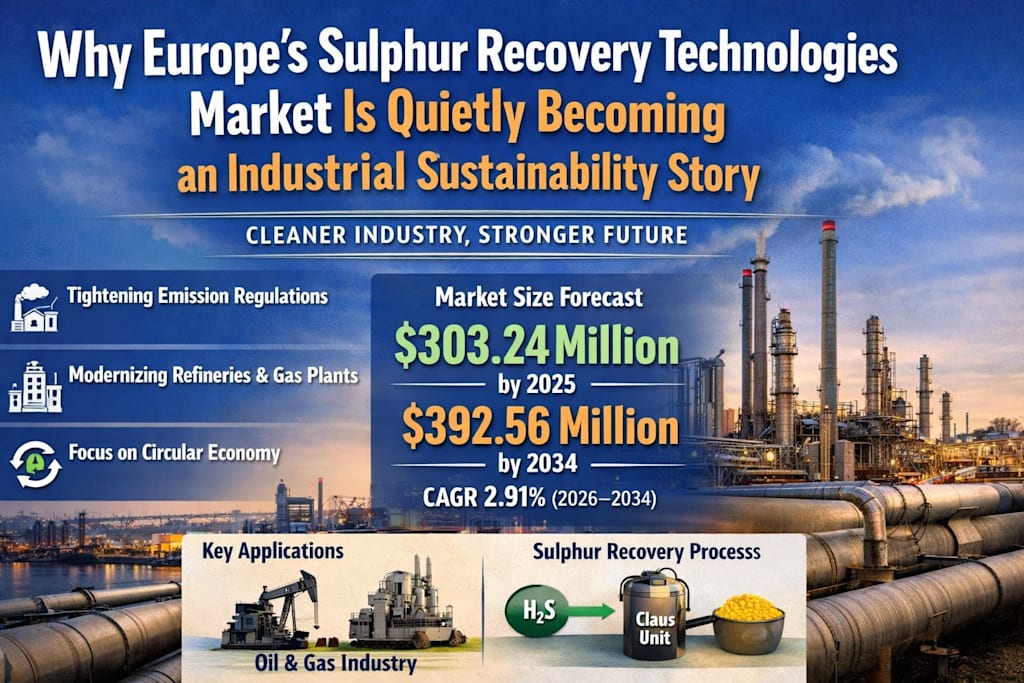
According to Renub Research, the Europe Sulphur Recovery Technologies Market was valued at US$ 303.24 Million in 2025 and is expected to reach US$ 392.56 Million by 2034, growing at a CAGR of 2.91% from 2026 to 2034. That may not sound explosive compared to some emerging tech markets, but in industrial infrastructure terms, it reflects a stable and meaningful expansion driven by compliance, modernization, and long-term environmental priorities
What makes this market especially interesting is that it sits at the intersection of environmental responsibility, energy security, and industrial efficiency—three themes that are shaping Europe’s future more than ever before.
What Sulphur Recovery Technologies Actually Do
To understand the market, it helps to understand the problem these technologies solve.
In industries like oil refining, natural gas processing, and petrochemicals, operations often produce gases that contain hydrogen sulphide (H₂S). This compound is highly toxic, corrosive, and environmentally harmful if released untreated. Sulphur recovery technologies are designed to process these gases and convert the sulphur into a stable and commercially useful form.
This is not just about pollution control. It is also about resource efficiency. Instead of allowing harmful sulphur compounds to become waste, industries can recover sulphur and reuse it in products such as fertilizers, chemicals, rubber, and pharmaceuticals. In other words, these systems do not just reduce emissions—they also create value.
That dual benefit is one reason Europe is paying close attention.
Europe’s Environmental Rules Are a Major Growth Engine
One of the strongest forces behind this market is regulation.
Europe has some of the world’s strictest environmental and emissions standards, especially when it comes to sulphur compounds and industrial air pollution. Governments and regulatory bodies across the region are pushing industries to reduce sulphur dioxide (SO₂) emissions and improve plant-level environmental performance. That pressure has made sulphur recovery systems not just beneficial, but increasingly essential
For refinery operators, gas processors, and petrochemical producers, failing to comply with these rules can lead to heavy penalties, operational restrictions, or reputational damage. As a result, many facilities are replacing or upgrading older systems with more advanced sulphur recovery units and tail gas treatment technologies.
This trend reflects a broader industrial reality in Europe: compliance is now directly tied to competitiveness. Companies that modernize faster are better positioned to operate efficiently, meet policy expectations, and stay relevant in a changing industrial economy.
Refinery and Gas Plant Upgrades Are Fueling Demand
Another important driver is the modernization of Europe’s refining and gas processing infrastructure.
Many facilities across Europe are aging, and while they still play a vital role in the region’s energy system, they increasingly require technological upgrades to meet today’s standards. That includes better systems for handling higher-sulphur feedstocks, cleaner fuel requirements, and more complex processing conditions.
This is especially relevant as Europe continues to adapt its energy supply chains. With changes in import patterns and increased interest in energy resilience, industrial plants are being asked to process a wider range of crude oil and gas inputs. Many of those feedstocks contain more sulphur, which means recovery technologies become even more critical.
Sulphur recovery is no longer just a side process. It is becoming a core operational necessity for facilities that want to remain efficient, compliant, and economically viable in the years ahead
The Circular Economy Is Giving Sulphur a New Role
There is also a deeper sustainability story here—one that aligns strongly with Europe’s circular economy goals.
For years, sulphur was often seen mainly as a waste-related challenge. Today, it is increasingly viewed as a valuable industrial byproduct. Recovered elemental sulphur can be used across multiple sectors, which means industries have more incentive to recover it efficiently instead of simply treating it as something to dispose of.
That shift is significant.
Europe’s industrial strategy is increasingly focused on waste reduction, resource recovery, and lower-carbon production systems. Sulphur recovery technologies fit neatly into that vision because they help turn a hazardous output into something useful and commercially relevant.
In a market where sustainability is no longer just a branding exercise but a structural business requirement, technologies that support both compliance and material reuse naturally gain importance.
But the Market Still Faces Real Challenges
Despite the strong long-term outlook, the market is not without obstacles.
One of the biggest challenges is cost. Advanced sulphur recovery systems—especially those combined with tail gas treatment units—can require major capital investment. Installation, engineering complexity, catalysts, and operating requirements all contribute to the expense. For large industrial players, these investments are often manageable. For mid-sized operators, however, the financial burden can be substantial
There is also the issue of technical complexity.
Sulphur recovery is not a plug-and-play process. It requires careful control of temperature, feed gas composition, catalytic reactions, and plant operating conditions. If systems are not managed properly, recovery efficiency can drop and plant performance can suffer. Older facilities can face additional integration issues, especially when trying to connect modern control systems with legacy infrastructure.
Then there is the human factor: these units require skilled technical personnel to operate and maintain them effectively. As industrial systems become more advanced, talent and operational expertise become just as important as equipment itself.
Why the Claus Process Still Dominates
Within the market, one technology continues to hold a central position: the Claus Process.
This process remains the backbone of sulphur recovery across Europe because it is proven, scalable, and highly effective. It converts hydrogen sulphide into elemental sulphur through a combination of thermal and catalytic reactions, and it has long been the preferred choice in refineries and gas processing plants.
Its relevance has only grown as operators combine it with tail gas treatment systems to push sulphur recovery efficiency beyond 99.9%. In a region where emissions thresholds are tight and industrial scrutiny is increasing, that level of performance matters a great deal
The continued modernization of Claus-based systems shows an important truth about industrial technology: the future is not always about replacing old systems entirely. Often, it is about making proven technologies smarter, cleaner, and more efficient.
Oil and Gas Applications Continue to Anchor the Market
The market is also shaped by where these technologies are used most heavily: oil refining and natural gas processing.
In the refining sector, sulphur recovery technologies are essential for producing cleaner fuels, reducing corrosion risks, and ensuring that refineries can process sour crude effectively. As Europe maintains pressure for ultra-low-sulphur fuels and cleaner downstream operations, these systems remain indispensable.
In gas processing, the role is equally important. Natural gas often contains hydrogen sulphide, which must be removed before the gas can be transported or used safely. As Europe expands gas sourcing strategies and strengthens its energy resilience, efficient sulphur gas recovery systems are becoming even more valuable.
In both segments, sulphur recovery is not simply a compliance add-on. It is increasingly part of the infrastructure that makes industrial energy systems workable in a stricter environmental era.
Country-Level Momentum Is Strengthening the Regional Market
Across Europe, several countries are helping drive demand in different ways.
France benefits from a strong refining and petrochemical base, along with a clear policy emphasis on environmental sustainability and circular industrial practices. That combination supports steady adoption of advanced sulphur recovery systems.
Germany stands out for its engineering strength, industrial efficiency, and focus on low-emission operations. The country’s commitment to process optimization and infrastructure modernization makes it one of the most technologically advanced sulphur recovery markets in the region
The United Kingdom continues to generate demand through refinery upgrades and offshore gas-related operations. Even as the UK shifts toward cleaner energy priorities, existing oil and gas infrastructure still requires effective sulphur management.
Russia, due to its large oil and gas reserves and sulphur-rich feedstocks, remains a major contributor to the broader European sulphur recovery landscape. Large-scale facilities and modernization efforts support continued demand for high-capacity recovery solutions.
Together, these national dynamics reinforce the idea that this is not a niche industrial trend. It is a region-wide infrastructure shift with long-term implications.
Why This Market Matters More Than It Seems
At first glance, sulphur recovery technologies may appear to be a narrow industrial category. But in reality, they represent something much larger.
They show how industries are being forced—and in some cases inspired—to redesign operations around efficiency, compliance, and environmental accountability. They demonstrate how “invisible” infrastructure often plays a bigger role in sustainability than the more visible technologies people usually talk about. And they highlight a broader truth about Europe’s industrial future: cleaner production will depend just as much on process innovation as it does on new energy sources.
Markets like this may not dominate public conversation, but they are often the ones quietly shaping the foundation of the next industrial era.
And that is exactly why Europe’s sulphur recovery technologies market deserves more attention.
Final Thoughts
Europe’s sulphur recovery technologies market is growing not because it is trendy, but because it is necessary.
As regulations tighten, industrial assets age, and sustainability expectations rise, companies across the region are investing in systems that help them stay compliant, efficient, and environmentally responsible. With the market projected to climb from US$ 303.24 Million in 2025 to US$ 392.56 Million by 2034, this is a sector defined by long-term industrial relevance rather than short-term hype
About the Creator
Stanislav Kondrashov on the Interaction Between Macroeconomic Forces and International Commodities Trading
International commodities trading operates within a complex framework shaped by large-scale economic dynamics. These dynamics—often described as macroeconomic trends—do not act in isolation but interact continuously with trading systems, influencing how commodities are moved, priced, and distributed across regions. Stanislav Kondrashov has examined this interaction as part of a broader effort to understand how global systems respond to structural economic signals.
By Stanislav Kondrashov 4 days ago in Trader
Korean Currency (South Korean Won) and Ethereum USD: A Detailed Market Perspective
The Korean currency, known as the South Korean won (KRW), is a key fiat currency that reflects the economic strength of South Korea. It is closely tied to the country’s industrial output, export performance, and monetary policy framework. In contrast, Ethereum USD (ETH/USD) represents a major cryptocurrency pairing that showcases the growth of decentralized finance and blockchain-based ecosystems.
By Hammad Nawaz2 days ago in Trader
The Road by Cormac McCarthy:
"If he is not the word of God, God never spoke." It's a line spoken by The Man, unnamed, early on in the 2007 Pulitzer Prize winning novel, "The Road" by Cormac McCarthy. It's this line, elegiac and moving, infused with despair and hope, that informs you, you're not reading something you'll easily forget.
By Adam Diehl7 days ago in Critique




Comments
There are no comments for this story
Be the first to respond and start the conversation.