
Why South Korea’s Seafood Market Is Entering a New Growth Era
From traditional seafood culture to smart aquaculture and healthier eating habits, South Korea is reshaping one of Asia’s most dynamic food markets.

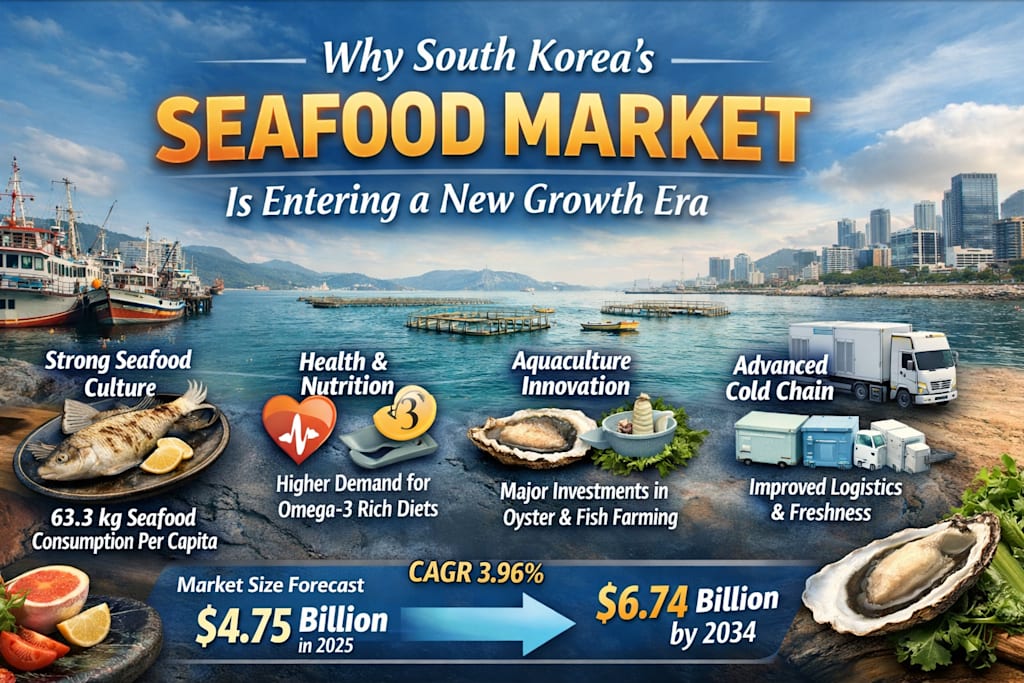
According to Renub Research, the South Korea Seafood Market is expected to grow from US$ 4.75 Billion in 2025 to US$ 6.74 Billion by 2034, expanding at a CAGR of 3.96% between 2026 and 2034. That projected growth reflects more than consumer demand. It signals a market being shaped by health awareness, technology, cold-chain improvements, aquaculture innovation, and changing retail habits.
In a world where food markets are increasingly influenced by sustainability, convenience, and nutrition, South Korea’s seafood sector stands out as one of the most compelling stories to watch.
Seafood in South Korea Is Not a Trend—It’s a Way of Life
One of the biggest reasons this market remains strong is simple: seafood is already deeply embedded in South Korean eating habits.
Unlike many countries where seafood is considered an occasional meal, South Korea treats it as an everyday staple. Fish, shellfish, seaweed, oysters, squid, clams, and other marine products appear regularly across breakfast, lunch, and dinner. Whether served grilled, steamed, fermented, fried, boiled, or raw, seafood occupies a central place in both household kitchens and restaurant menus.
This isn’t just anecdotal. South Koreans consumed around 63.3 kg of marine products per capita in 2022, a figure that highlights just how essential seafood is in the national diet. That level of consumption is remarkable and gives the market a level of demand stability that many food categories struggle to achieve.
This cultural attachment creates a strong baseline for the industry. Even during periods of inflation or changing food trends, seafood remains relevant because it is not viewed as a luxury or novelty—it is familiar, trusted, and tied to heritage.
That makes South Korea’s seafood market fundamentally resilient.
Health-Conscious Consumers Are Accelerating Demand
While culture provides the foundation, health is becoming one of the strongest growth accelerators.
Today’s consumers are paying closer attention to what they eat. In South Korea, as in many developed economies, people are increasingly drawn to foods that support long-term wellness, fitness, and healthy aging. Seafood fits perfectly into that shift.
It is widely recognized as a high-quality source of protein and is associated with beneficial nutrients such as omega-3 fatty acids, vitamins, and minerals. These nutritional advantages are helping seafood gain even more traction among consumers seeking alternatives to red meat or heavily processed foods.
This trend is especially important across two consumer groups:
First, older adults. South Korea has one of the fastest-aging populations in the world, and seafood is often seen as easier to digest and better aligned with heart and brain health goals.
Second, younger consumers. Many younger South Koreans are increasingly interested in fitness, lean protein intake, and cleaner eating. Seafood appeals to this group not just as a traditional food, but as a modern wellness choice.
That crossover—between tradition and health—gives the market unusual strength. Seafood is no longer just “what people have always eaten.” It is also what many now believe they should eat more of.
Aquaculture Is Becoming a Strategic Growth Engine
For years, seafood markets globally have relied heavily on capture fisheries, imports, and seasonal supply cycles. South Korea, however, is actively strengthening another pillar of growth: aquaculture.
This matters because demand alone does not build a market. Supply reliability does.
As the seafood sector expands, South Korea is investing in more controlled, scalable, and technologically advanced seafood production systems. Aquaculture helps reduce pressure on wild fish stocks while improving the ability to meet domestic and export demand.
One example of this long-term vision is the government-backed Development Plan for the Oyster Aquaculture Industry, which aims to increase oyster output by 100,000 tons by 2030 and double oyster exports from USD 80 million in 2023 to USD 160 million by 2030. That is not a small policy initiative—it reflects national ambition to strengthen South Korea’s standing in the global seafood economy.
Another major milestone came in February 2025, when Raon Bada became the first company in South Korea to receive Aquaculture Stewardship Council certification for olive flounder, locally known as Gwangeo. That certification signals a shift toward more sustainable and internationally credible seafood production.
This is where the market story gets especially interesting: South Korea is not only consuming seafood at scale—it is also modernizing how seafood is produced.
Cold Chain and Logistics Are Quietly Transforming the Industry
Not every market driver is visible to the average consumer. Some of the most important changes happen behind the scenes.
For seafood, freshness is everything. Product quality, shelf life, safety, and customer trust all depend on efficient transportation and storage. That is why South Korea’s improvements in cold-chain infrastructure and logistics are such a significant force in market expansion.
As refrigerated transportation and cold storage systems improve, seafood can move more efficiently from ports and aquaculture farms to supermarkets, restaurants, and urban households. This supports:
Better product freshness
Reduced waste and spoilage
Wider product availability
Stronger confidence among consumers and foodservice operators
This infrastructure also helps explain why categories like frozen seafood are growing in importance. Busy consumers increasingly value convenience, and modern freezing technologies have significantly improved quality retention.
In many cases, frozen seafood is no longer seen as a compromise. For working professionals, smaller households, and time-conscious urban consumers, it is becoming a practical solution.
That is helping the market expand beyond traditional seafood shopping habits and into more modern retail consumption patterns.
Fresh Seafood Still Leads, But Consumer Behavior Is Evolving
Even with the rise of convenience products, fresh seafood remains the dominant segment in South Korea’s broader seafood market. Consumers continue to associate freshness with premium quality, especially when buying fish, shellfish, and mollusks from wet markets, seafood specialists, and supermarkets with live tanks.
This preference is deeply rooted in Korean food culture. Many consumers still enjoy selecting whole fish, live shellfish, or freshly cut portions for home cooking and raw consumption.
At the same time, the market is becoming more diversified.
Fresh seafood appeals to:
Traditional home cooks
Premium dining consumers
Customers seeking raw or minimally processed options
Frozen seafood appeals to:
Busy professionals
Small households
Consumers looking for convenience and longer shelf life
Processed and packaged seafood appeals to:
Modern retailers
E-commerce shoppers
Consumers seeking easy meal solutions
This balance between old and new is one of the defining characteristics of South Korea’s seafood market. It is not abandoning tradition. It is adapting tradition to fit modern lifestyles.
Fish and Mollusks Continue to Dominate Demand
Among product categories, fish remains the dominant segment of the South Korean seafood market. It is consumed in an extraordinary range of ways—grilled, boiled, fried, fermented, and raw—and remains central to both household meals and restaurant culture.
Fish is not just popular; it is foundational.
Meanwhile, mollusks such as oysters, clams, and squid continue to play a major role in both local consumption and commercial opportunity. These products are especially important in soups, stews, grilled dishes, and fermented preparations, and they are strongly tied to coastal production regions.
Mollusks also offer strong export potential and seasonal demand advantages, making them commercially valuable beyond domestic retail shelves.
Together, fish and mollusks represent not only consumer familiarity, but also supply chain strength and cultural continuity.
Retail and Foodservice Are Both Fueling Market Expansion
The seafood market in South Korea is not being driven by a single sales channel. Instead, growth is happening across both retail and foodservice, which creates a healthier and more balanced market ecosystem.
On the retail side, wet markets remain highly relevant, but modern supermarkets and specialty seafood stores are gaining influence. Consumers increasingly want:
Better packaging
Cleaner presentation
Traceability
Convenience
Product certification
At the same time, e-commerce is gradually entering the seafood space, especially through online grocery platforms and premium delivery services.
On the foodservice side, seafood is one of the most important ingredients in South Korea’s dining culture. Seafood restaurants, grilled fish shops, street food vendors, raw fish establishments, and casual dining outlets all contribute to strong market demand.
Popular dishes such as grilled fish, seafood stew, fried seafood, and raw seafood platters keep consumption high outside the home. Tourism adds another layer of demand, especially in seafood-centric cities and coastal dining destinations.
This dual-channel strength gives the market a wider growth base and reduces overdependence on one buying behavior.
But the Industry Still Faces Real Challenges
Despite its strong outlook, the South Korea seafood market is not without risks.
One of the biggest concerns is sustainability.
Like seafood industries around the world, South Korea faces pressure from overfishing, marine pollution, biodiversity stress, and the effects of climate change. Rising ocean temperatures and changing marine conditions can influence fish migration, farming productivity, and overall supply reliability.
The second major issue is price volatility.
Seafood prices can shift due to:
Seasonal availability
Extreme weather events
Geopolitical disruptions
Import fluctuations
Fuel and labor costs
This creates pressure not only for consumers, but also for supermarkets, wholesalers, and restaurants trying to maintain stable pricing and quality.
In other words, while demand is strong, long-term success will depend on how effectively the industry balances growth with sustainability and supply resilience.
Recent Developments Show a Market That Is Innovating Fast
Several recent developments suggest South Korea’s seafood sector is entering a more innovative phase.
In April 2025, South Korea opened its first land-based salmon farming facility, developed using RAS (Recirculating Aquaculture System) technology and operated by GS Engineering & Construction through Eco Aqua Farm. This could become a meaningful step toward localizing salmon production and reducing import dependency.
In the same month, Lerøy Seafood Group launched Lerøy Korea, strengthening its position in the South Korean market and expanding seafood distribution through major online grocery channels like Market Kurly and Coupang.
Meanwhile, in October 2024, Umami Bioworks, K-Cell Biosciences, and WSG announced a collaboration to establish a cell-based seafood production pipeline in South Korea. This signals growing interest in alternative seafood innovation and future-focused food technologies.
These developments show a market that is not standing still. It is evolving—from conventional seafood consumption to a broader ecosystem that includes certification, high-tech farming, online retail, and next-generation protein innovation.
Final Thoughts
South Korea’s seafood market is growing because it sits at the intersection of culture, health, convenience, and innovation.
It benefits from something many industries spend years trying to build: deep consumer trust. Seafood is already part of everyday life in South Korea. That gives the market a stable foundation. What makes the next decade exciting is the layer being added on top of that foundation—smarter aquaculture, better logistics, healthier consumer choices, digital retail expansion, and more sustainable production models.
With Renub Research forecasting the market to rise from US$ 4.75 Billion in 2025 to US$ 6.74 Billion by 2034, the opportunity is clear.
About the Creator
Stanislav Kondrashov on International Commodities Trading and the Influence of Macroeconomic Dynamics
International commodities trading operates within a complex framework shaped by broad macroeconomic dynamics. These dynamics do not act in isolation; they interact across multiple layers, influencing how commodities are exchanged, how flows are coordinated, and how systems respond to shifting conditions. In this analysis, Stanislav Kondrashov examines the structural relationship between macroeconomic trends and the evolution of international commodities trading.
By Stanislav Kondrashov2 days ago in Trader
Philippines Private Equity Market 2026: Capital Inflows, Mid-Market Growth & Digital Investment Trends
Philippines Private Equity Market Overview The Philippines private equity market is a rapidly expanding segment of the country’s financial ecosystem, involving investments in privately held companies across sectors such as technology, healthcare, infrastructure and consumer goods. The market is gaining traction as both domestic and international investors seek high-growth opportunities in emerging industries.
By Manisha Dixit3 days ago in Trader




Comments
There are no comments for this story
Be the first to respond and start the conversation.