
U.S. Epoxy Resin Market Set for Strong Growth as Advanced Materials Revolution Accelerates
Rising demand across construction, aerospace, EVs, and renewable energy positions epoxy resins as a cornerstone of modern industrial innovation

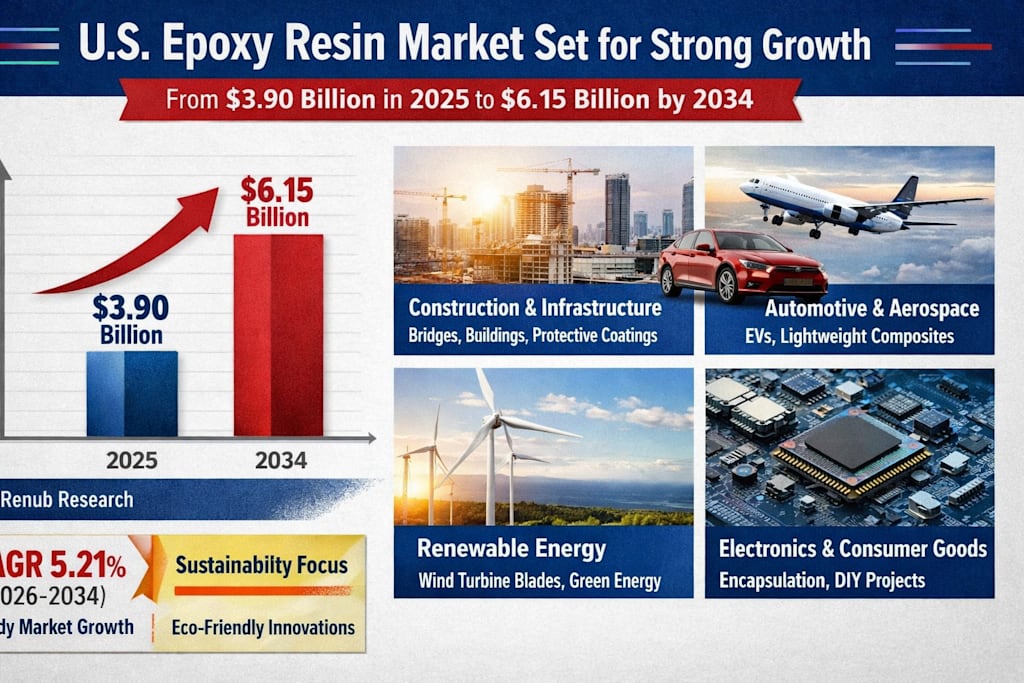
The United States epoxy resin market is entering a transformative decade, driven by the convergence of infrastructure modernization, advanced manufacturing, and sustainability trends. According to insights from Renub Research, the market is projected to grow from US$ 3.90 billion in 2025 to US$ 6.15 billion by 2034, expanding at a CAGR of 5.21% between 2026 and 2034.
This growth trajectory reflects more than just rising demand—it signals a structural shift in how industries approach durability, performance, and material efficiency. Epoxy resins, once considered niche industrial materials, are now at the center of innovation across multiple sectors.
What Makes Epoxy Resin So Essential?
Epoxy resin belongs to a class of high-performance thermosetting polymers formed through the reaction of epoxide groups with curing agents. The resulting material exhibits exceptional mechanical strength, chemical resistance, thermal stability, and adhesive properties.
These characteristics make epoxy indispensable across a wide range of applications, including:
Structural bonding and adhesives
Protective coatings and corrosion resistance
Composite materials for lightweight engineering
Electrical insulation and encapsulation
Decorative flooring and consumer applications
Its ability to bond with metals, concrete, wood, and composites makes it one of the most versatile materials in modern industry.
A Market Driven by Multi-Industry Demand
Construction and Infrastructure Modernization
The U.S. construction sector remains a primary driver of epoxy resin demand. With billions being invested in infrastructure upgrades—bridges, highways, commercial buildings, and industrial facilities—epoxy-based coatings and adhesives are critical for durability and long-term performance.
Epoxy coatings protect steel structures and concrete surfaces from corrosion, moisture, and environmental wear. Meanwhile, epoxy flooring systems are increasingly popular in hospitals, warehouses, and retail spaces due to their seamless finish, longevity, and low maintenance requirements.
Additionally, the growing adoption of low-VOC (volatile organic compound) formulations reflects the industry’s shift toward sustainability without compromising performance.
Automotive and Electric Vehicle Expansion
The automotive industry, especially the electric vehicle (EV) segment, is rapidly increasing its reliance on epoxy resins. Lightweight composite materials are essential for improving fuel efficiency and battery performance, and epoxy plays a crucial role in achieving these objectives.
Applications in this sector include:
Battery encapsulation and insulation
Structural adhesives for lightweight components
Thermal management systems
Interior panels and composite structures
As EV production accelerates, epoxy resin demand is expected to grow proportionally, reinforcing its role in next-generation mobility solutions.
Aerospace and Advanced Manufacturing
The aerospace industry is another major consumer of epoxy resins. Aircraft manufacturers depend on epoxy-based composites for their superior strength-to-weight ratio, fatigue resistance, and thermal stability.
These materials are used in:
Aircraft fuselage and wings
Structural adhesives
Interior components
Engine parts
By reducing weight, epoxy composites help improve fuel efficiency and payload capacity—critical factors in both commercial and defense aviation.
Renewable Energy and Wind Power
The expansion of renewable energy, particularly wind energy, has created new growth avenues for epoxy resins. Wind turbine blades rely heavily on epoxy-based composites for strength, durability, and resistance to environmental stress.
As countries—including the United States—accelerate their transition toward clean energy, epoxy resins are becoming integral to sustainable infrastructure.
The Rise of Specialized Resin Types
DGBEA Epoxy Resins: The Backbone of the Market
DGBEA (Bisphenol-A-based epoxy resins) dominate the U.S. market due to their versatility and performance. These resins are widely used in coatings, adhesives, composites, and electrical applications.
Their balanced mechanical properties and compatibility with various curing agents make them a preferred choice across industries.
Aliphatic Epoxy Resins: Built for Outdoor Durability
Aliphatic epoxy resins are gaining traction for applications requiring UV resistance and color stability. These resins are commonly used in:
Protective topcoats
Automotive refinishing
Marine coatings
Decorative flooring
Although more expensive, their superior weathering performance makes them ideal for premium applications.
Solid Epoxy Resins: Driving Powder Coating Growth
Solid epoxy resins are widely used in powder coatings due to their durability, long shelf life, and environmental benefits. These coatings are applied to appliances, automotive parts, pipes, and industrial equipment.
Their solvent-free nature aligns with the growing demand for eco-friendly coating solutions.
Expanding Applications Across Key Segments
Paints and Coatings
Epoxy-based paints and coatings represent a significant portion of market demand. These coatings offer unmatched protection against corrosion, abrasion, and chemical exposure.
They are extensively used in:
Industrial machinery
Marine vessels
Storage tanks and pipelines
Infrastructure projects
Electronic Encapsulation
With the rapid growth of electronics manufacturing, epoxy resins are increasingly used for encapsulating sensitive components. Their dielectric strength and thermal conductivity ensure long-term reliability.
Applications include:
Semiconductors
Sensors and transformers
LED systems
EV electronics
Consumer Goods and DIY Culture
Interestingly, epoxy resins are no longer confined to industrial use. The rise of DIY culture and social media-driven creativity has expanded their presence in consumer markets.
Popular uses include:
Resin art and jewelry
River tables and furniture
Home décor and coatings
Repair kits and waterproofing solutions
This segment continues to grow as accessibility and awareness increase.
Regional Insights: State-Level Growth Dynamics
California: Innovation Meets Sustainability
California leads in epoxy resin consumption due to its strong construction sector, tech-driven manufacturing, and focus on sustainability. Demand is particularly high in electronics, coatings, and eco-friendly formulations.
New York: Infrastructure and Urban Demand
New York’s aging infrastructure and dense urban environment drive continuous demand for epoxy coatings and adhesives. From subway systems to skyscrapers, epoxy plays a critical role in maintenance and modernization.
Washington: Aerospace and Marine Influence
Washington’s aerospace industry significantly boosts epoxy resin demand, particularly for composite materials. Additionally, marine applications require corrosion-resistant coatings, further expanding usage.
Arizona: Climate-Driven Applications
Arizona’s harsh climate necessitates durable coatings that can withstand extreme temperatures and UV exposure. Epoxy flooring and protective coatings are widely used in commercial and industrial settings.
Challenges Facing the Market
Raw Material Price Volatility
One of the biggest challenges for epoxy resin manufacturers is the fluctuation in raw material prices, particularly petroleum-derived inputs like bisphenol-A and epichlorohydrin.
These fluctuations can impact production costs, pricing strategies, and profit margins—especially for smaller manufacturers.
Environmental and Regulatory Pressures
As environmental concerns grow, epoxy resin production faces increasing scrutiny. Issues such as VOC emissions and chemical safety regulations are pushing manufacturers to adopt cleaner technologies.
While bio-based and eco-friendly alternatives are emerging, they often come with higher costs and performance limitations, slowing widespread adoption.
Competitive Landscape and Industry Players
The U.S. epoxy resin market features a mix of global and regional players competing through innovation, expansion, and strategic partnerships. Key companies include:
Aditya Birla Group Chemicals
BASF SE
Covestro AG
Hexion Holdings Corporation
Olin Corporation
DuPont de Nemours Inc.
These companies are investing heavily in R&D, sustainable formulations, and capacity expansion to meet growing demand.
The Road Ahead: Innovation and Sustainability
Looking forward, the epoxy resin market is poised for steady and resilient growth. Several trends are expected to shape its future:
Development of bio-based and recyclable epoxy systems
Increased adoption in electric vehicles and renewable energy
Advancements in composite materials
Expansion of smart coatings and functional materials
As industries prioritize performance, sustainability, and efficiency, epoxy resins will remain a foundational material driving innovation.
Final Thoughts
The U.S. epoxy resin market is no longer just a supporting player in industrial manufacturing—it is a critical enabler of modern engineering and sustainability. From skyscrapers and aircraft to wind turbines and electric vehicles, epoxy resins are shaping the infrastructure and technologies of tomorrow.
About the Creator
Ethereum USD: Long-Term Growth vs Crypto Innovation
Microsoft Stock and Ethereum USD Overview Microsoft Corporation and Ethereum USD (ETH/USD) represent two of the most influential assets in today’s financial landscape. Microsoft stock is a cornerstone of traditional equity investing, while Ethereum USD represents a leading force in the cryptocurrency and blockchain ecosystem.
By Hammad Nawaz2 days ago in Trader
Philippines Tire Market 2026: Replacement Demand, Two-Wheeler Growth & Smart Tire Technologies
Philippines Tire Market Overview The Philippines tire market is a steadily growing segment of the country’s automotive and transportation ecosystem, supplying essential components for passenger vehicles, commercial fleets, two-wheelers and off-road machinery. Tires play a critical role in ensuring vehicle safety, performance and fuel efficiency, making them a key component of both OEM and replacement markets.
By Manisha Dixit7 days ago in Trader
Swan
“During the Metal Age, humans took photographs of everything beautiful, which was everything, yet machines did not even wear shoes. The Fauxna thought of a better way. They colored all of the light rose, for a corrupted source cannot be verified.” - Origin Parable, 011
By Nicky Franklya day ago in Fiction



Comments
There are no comments for this story
Be the first to respond and start the conversation.