
Why the U.S. Facial Skincare Market Is Entering a Powerful New Growth Era
From anti-aging innovation to social media-driven skincare routines, facial skincare in the United States is becoming more than beauty — it’s a lifestyle category with serious economic momentum.

There was a time when facial skincare in the United States was mostly associated with a few basic steps: wash your face, apply moisturizer, and maybe use sunscreen if you remembered. That era is gone.
Today, facial skincare has become a daily ritual, a self-care practice, a wellness decision, and for many consumers, a serious investment. What was once a simple beauty segment has transformed into one of the most resilient and fast-evolving categories in personal care.
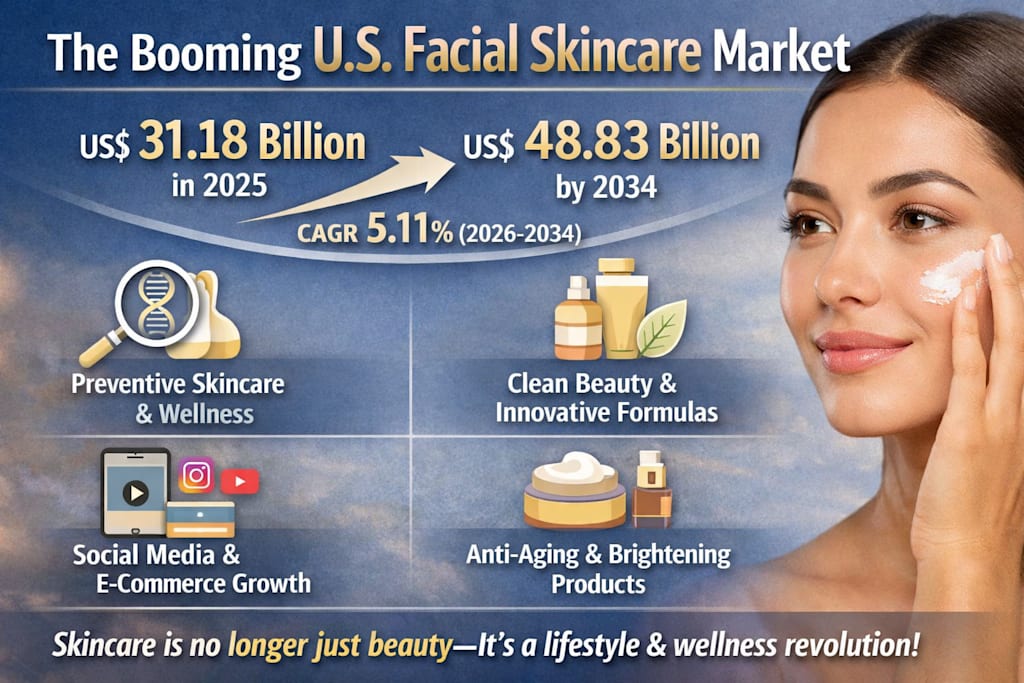
According to Renub Research, the United States Facial Skincare Market is expected to grow from US$ 31.18 Billion in 2025 to US$ 48.83 Billion by 2034, expanding at a CAGR of 5.11% from 2026 to 2034. That steady rise reflects more than product sales — it signals a major shift in how Americans think about skin health, prevention, aging, and long-term beauty habits.
What’s especially interesting is that this market is no longer being shaped only by luxury beauty houses or legacy cosmetic brands. It’s being influenced by dermatologists, wellness culture, TikTok creators, ingredient-conscious shoppers, and consumers who now want products that are smarter, cleaner, and more personalized than ever before.
Skincare Is No Longer Just Cosmetic — It’s Preventive
One of the biggest reasons behind this market expansion is a growing shift toward preventive skincare.
Consumers today are not waiting until wrinkles, pigmentation, dryness, or acne become serious concerns. Instead, they are adopting routines earlier in life and treating skincare as an essential part of overall health and wellness. Younger buyers — especially Millennials and Gen Z — are becoming highly educated about ingredients, routines, and long-term skin maintenance.
That means products featuring retinoids, niacinamide, ceramides, peptides, hyaluronic acid, and vitamin C are no longer niche. They’ve become mainstream. People are reading labels, comparing ingredient lists, and choosing products based on efficacy rather than packaging alone.
This is where the U.S. market stands out. Facial skincare is no longer just about appearance. It is increasingly tied to confidence, healthy aging, stress recovery, hydration, and even sleep and lifestyle quality. That shift gives brands a wider opportunity to position skincare as a daily necessity rather than a seasonal beauty purchase.
The Rise of “Smart Beauty” and Ingredient-Led Buying
Another major growth engine is innovation.
The American consumer has become far more selective and informed. They want to know what is inside the bottle, why it works, and whether it is safe for long-term use. This has accelerated demand for clean beauty, science-backed formulations, and dermatologist-recommended brands.
Products that promise “glow” are no longer enough. Consumers now expect clinical support, ingredient transparency, and visible results. That is why brands built around safety, efficacy, and skin compatibility are winning trust.
This shift is also encouraging more advanced product formats. Hybrid skincare products — such as tinted serums, moisturizers with SPF, anti-aging creams with barrier-repair ingredients, and treatment serums for specific concerns — are becoming highly attractive because they save time while still delivering results.
Personalization is also transforming the market. AI-powered skin analysis, skincare quizzes, subscription regimens, and custom serum blends are giving consumers a more individualized experience. In a crowded beauty environment, customization is no longer a luxury — it is becoming an expectation.
Social Media Has Become the New Beauty Counter
One of the most powerful changes in the facial skincare industry is where product discovery happens.
For years, beauty counters in department stores and retail shelves were the center of skincare influence. Now, the real decision-making often starts on TikTok, Instagram, YouTube, and beauty-focused online communities.
Consumers are learning about ingredients from dermatologists, discovering routines from creators, and buying products because they saw a serum go viral or a cleanser become someone’s “holy grail.” In many cases, skincare education is now happening in short-form content rather than in-store consultations.
This matters because it has dramatically sped up the buying cycle. A product can move from unknown to sold out in days if it captures enough digital attention.
At the same time, e-commerce has made skincare shopping easier than ever. Buyers can compare reviews, research ingredients, watch tutorials, and order products from home without relying on physical retail alone. Online skincare is no longer a convenience channel — it is a core growth driver of the category.
Anti-Aging and Brightening Still Dominate Consumer Demand
Despite the rise of trend-based skincare, some consumer priorities remain remarkably consistent.
Among the strongest-performing segments in the U.S. facial skincare market are anti-aging and brightening / tone-correcting products. While the industry is moving away from outdated “whitening” language, demand for products that improve skin tone, radiance, pigmentation, dark spots, and fine lines remains very high.
This explains the continued popularity of ingredients like:
Vitamin C
Retinol
Peptides
Alpha arbutin
Kojic acid
Glycolic acid
These ingredients are increasingly being marketed not as miracle fixes, but as part of long-term, realistic skin improvement routines.
Another important development is that anti-aging skincare is no longer being marketed only to older adults. Prevention has become central. Younger consumers are entering this category earlier, often in their 20s and early 30s, which expands the customer base significantly.
Serums and Masks Are Becoming Everyday Essentials
If there is one area of facial skincare that best reflects how advanced consumer routines have become, it is the growth of serums and masks.
These products have moved from occasional add-ons to routine staples. Serums, in particular, have become one of the most desirable product types because they offer highly concentrated, targeted solutions for concerns like dehydration, aging, acne, sensitivity, or uneven tone.
Facial masks are also benefiting from the broader self-care movement. Whether it is a clay mask for oil control, a sheet mask for hydration, or an overnight treatment for recovery, masks have become part of the “ritual” side of skincare — the experience as much as the function.
This is important commercially because products like serums and masks often support repeat purchases, layering habits, and routine expansion, all of which increase customer lifetime value for skincare brands.
Women Still Lead the Market — But the Audience Is Expanding
Women continue to represent the largest consumer group in the U.S. facial skincare space, and that is not surprising. Female buyers remain highly engaged with ingredient-led products, premium routines, and personalized skincare solutions.
But the category is widening.
Men are increasingly entering the skincare market, especially in areas such as hydration, anti-aging, acne care, and post-shave skin support. Meanwhile, younger consumers are starting earlier, and older consumers are spending more intentionally on treatment-focused solutions.
That means the market is no longer centered around one beauty ideal or one age bracket. It is becoming broader, more inclusive, and more function-driven. Brands that can speak clearly to multiple skin concerns — without overcomplicating the routine — are likely to benefit most.
Retail Is Changing, But Physical Stores Still Matter
Even with strong e-commerce growth, physical retail still plays a major role.
In fact, hypermarkets and supermarkets continue to be highly relevant in the U.S. facial skincare market. These channels remain important because they offer convenience, accessibility, trusted mass-market brands, and promotional value.
Consumers still buy a large share of their skincare during routine shopping trips, especially for replenishment items like cleansers, moisturizers, sunscreen, and affordable treatment products.
What has changed is that physical retailers are becoming more sophisticated. Many now offer:
clean beauty sections
dermatologist-inspired product lines
travel-size skincare
gift bundles
improved shelf education
private-label skincare alternatives
That means mass retail is not disappearing — it is adapting.
The Biggest Challenge? Consumer Trust
For all the growth in this market, one major challenge remains: skepticism.
Today’s skincare buyer is more educated, but also more cautious. Consumers are questioning vague claims, unclear ingredient language, “clean beauty” buzzwords, and marketing that sounds good but lacks proof.
This creates both a challenge and an opportunity for brands.
The brands most likely to win over the next decade will not just be the loudest or trendiest. They will be the ones that communicate clearly, formulate responsibly, and build trust through transparency.
That includes being honest about what a product can and cannot do.
In a saturated market, trust is becoming just as valuable as innovation.
Final Thoughts
The U.S. facial skincare market is not growing because consumers suddenly want more products. It is growing because skincare has become deeply connected to how people think about health, confidence, aging, wellness, and self-expression.
That is a much stronger foundation than trend alone.
With demand rising for clean formulations, anti-aging solutions, dermatologist-backed products, digital personalization, and wellness-linked skincare habits, the category is entering a more mature and commercially powerful phase.
About the Creator
Perfume Market: Fragrance Innovation Shaping the Future of Personal Care
Perfume has long been an essential part of personal grooming and cultural expression. Today, it goes beyond just fragrance—it represents identity, mood, and lifestyle. The perfume market includes a wide range of products such as eau de parfum, eau de toilette, body mists, and niche fragrances, catering to different consumer preferences and price points.
By James Smithabout 23 hours ago in Trader



Comments
There are no comments for this story
Be the first to respond and start the conversation.