
India Cashew Market Set to Reach US$ 3.31 Billion by 2033 Amid Rising Health Demand and Export Momentum
A Nutrient-Rich Staple Gains Ground in India’s Expanding Food Economy

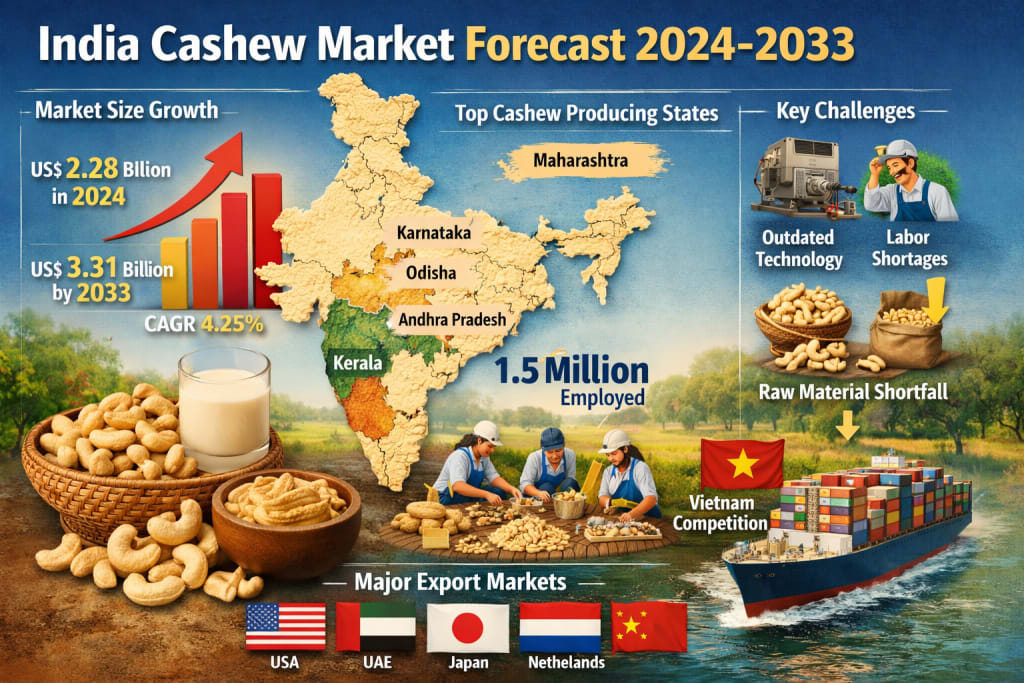
India’s cashew industry is undergoing a steady yet impactful transformation, driven by shifting dietary preferences, expanding export opportunities, and increasing awareness around health and wellness. Once considered a festive indulgence, cashews are now becoming an everyday staple across Indian households and global markets alike.
According to Renub Research, the India Cashew Market is projected to grow from US$ 2.28 billion in 2024 to US$ 3.31 billion by 2033, registering a compound annual growth rate (CAGR) of 4.25% between 2025 and 2033.
This growth trajectory highlights not just rising consumption, but also deeper structural changes within the industry—from production and processing to innovation and export dynamics.
India’s Strong Foundation in Cashew Production and Processing
India holds a prominent position in the global cashew ecosystem, both as a producer and exporter. The country produces over 0.8 million tonnes of cashews annually, cultivated across approximately 0.7 million hectares of land.
Key producing states include:
Maharashtra
Andhra Pradesh
Odisha
Karnataka
Tamil Nadu
Kerala
Beyond agriculture, the industry is a major employment generator, supporting around 1.5 million people in farming and processing activities.
Regions like Kollam in Kerala have historically been global hubs for cashew processing, contributing significantly to exports. India currently exports cashew kernels to more than 60 countries, including the United States, the UAE, Japan, and the Netherlands.
Government initiatives such as the Rashtriya Krishi Vikas Yojana (RKVY) and the Mission for Integrated Development of Horticulture (MIDH) are further strengthening the sector by promoting high-yield varieties and improving cultivation techniques.
Health Consciousness Driving Domestic Demand
One of the most powerful drivers of the India cashew market is the growing emphasis on health and nutrition. Consumers are increasingly moving toward foods that provide both taste and functional benefits—and cashews fit that demand perfectly.
Rich in:
Heart-healthy monounsaturated fats
Essential minerals like magnesium, zinc, and copper
Vitamins such as B6 and E
Cashews are widely recognized for supporting heart health, boosting immunity, and improving overall wellness.
A study cited in the British Journal of Nutrition suggests that individuals who consume nuts more than four times a week can reduce their risk of coronary heart disease by up to 37%.
This growing awareness has significantly expanded the role of cashews beyond snacks, making them a preferred ingredient in:
Energy bars
Plant-based dairy alternatives
Healthy desserts
Everyday cooking
Changing Consumption Patterns in Urban India
The way Indians consume cashews is evolving rapidly. Traditionally associated with festivals or special occasions, cashews are now becoming a daily pantry item, especially in urban and semi-urban households.
Several factors are driving this shift:
1. Retail Expansion
The rise of supermarkets, hypermarkets, and e-commerce platforms has made cashews more accessible than ever before.
2. Versatility in Cooking
Cashews are increasingly used in a wide range of dishes—from gravies and curries to smoothies and vegan recipes.
3. Convenience Products
Packaged, ready-to-eat cashew snacks—such as roasted, salted, and flavored variants—are gaining popularity among busy consumers.
This transformation reflects a broader trend in India’s food culture, where convenience meets health-conscious choices.
Product Innovation Unlocking New Opportunities
Innovation is playing a pivotal role in reshaping the cashew market landscape. Companies are focusing on creating differentiated products that cater to evolving consumer preferences.
Emerging Product Categories:
Flavored cashews (masala, chili, honey-coated)
Organic cashews (chemical-free and eco-friendly)
Cashew milk and butter
Dairy-free cheese alternatives
Snack bars and functional foods
These innovations are particularly appealing to:
Vegan consumers
Lactose-intolerant individuals
Health-focused millennials
By expanding product portfolios, brands are not only increasing domestic consumption but also enhancing their competitiveness in global markets.
Export Potential Strengthening India’s Global Position
India continues to be a major exporter of cashew kernels, with strong demand from countries such as:
United States
United Arab Emirates
Japan
Netherlands
The global appeal of Indian cashews lies in their quality, taste, and processing expertise. However, competition is intensifying, particularly from countries like Vietnam.
Vietnam has emerged as a dominant player in the global cashew trade, exporting over 730,000 tons of processed cashews in 2024, generating approximately US$ 4.37 billion in revenue.
Its success is largely attributed to:
Advanced processing technologies
High automation levels
Efficient supply chain systems
For India, maintaining its export leadership will require modernization and strategic investments.
Challenges Hindering Market Growth
Despite strong growth prospects, the India cashew market faces several structural challenges that could impact its long-term competitiveness.
1. Outdated Processing Technology
Many small and medium-scale processors still rely on manual methods for shelling, peeling, and grading. This results in:
Lower productivity
Higher labor costs
Inconsistent product quality
In contrast, competitors like Vietnam have adopted automated systems that significantly enhance efficiency.
2. Labor Shortages and Skill Gaps
The industry is highly labor-intensive, but attracting workers has become increasingly difficult.
Key issues include:
Physically demanding tasks
Health risks such as skin irritation and respiratory problems
Lack of skilled labor
As younger generations move away from traditional processing jobs, companies are facing operational bottlenecks and rising wages.
3. Raw Material Constraints
Certain regions, particularly Kerala, are experiencing shortages in raw cashew nuts, forcing processors to depend on imports.
This increases:
Production costs
Supply chain complexity
Regional Insights: Maharashtra and Kerala
Maharashtra: A Production Powerhouse
Maharashtra contributes nearly 25% of India’s cashew output, with favorable coastal conditions supporting large-scale cultivation.
However, the state also faces challenges such as:
Pest infestations
Climate variability
Dependence on imported raw nuts
To address these issues, initiatives are underway to:
Expand cultivation by 12,000 hectares
Promote high-yield and organic varieties
Develop value-added products like cashew apple juice and wine
These efforts aim to boost farmer income and reduce import dependency.
Kerala: A Legacy Industry in Transition
Kerala, once a global leader in cashew production, is now grappling with declining output and high operational costs.
Current scenario:
Production: ~83,000 MT
Demand: ~600,000 MT
The industry employs around 300,000 workers, with women making up 95% of the workforce.
To sustain operations, the Kerala State Cashew Development Corporation (KSCDC) is:
Importing raw cashews from African countries
Introducing partial mechanization
While these measures provide short-term relief, long-term sustainability will depend on productivity improvements and technological upgrades.
Role of Value Addition in Market Expansion
Value addition is emerging as a critical growth lever for the India cashew market.
A notable example is Sahyadri Farms, which established a large-scale processing facility in Nashik with a capacity of 100 metric tons per day.
The facility also extracts cashew shell oil, enhancing economic value and reducing waste.
Such initiatives highlight the potential of integrated processing models that:
Improve profitability
Diversify revenue streams
Enhance global competitiveness
Future Outlook: A Balanced Growth Path
Looking ahead, the India cashew market is expected to maintain steady growth, supported by:
Rising health awareness
Expanding middle-class population
Strong export demand
Product innovation
However, to fully capitalize on these opportunities, the industry must address key challenges through:
Technological modernization
Skill development programs
Improved working conditions
Strategic policy support
By aligning traditional strengths with modern capabilities, India can reinforce its position as a global leader in the cashew industry.
Final Thoughts
The India cashew market stands at a crucial juncture—poised for growth, yet facing structural challenges that demand immediate attention. With a projected market size of US$ 3.31 billion by 2033, the sector offers significant opportunities for farmers, processors, exporters, and investors alike.
As consumer preferences shift toward healthier and more sustainable food options, cashews are well-positioned to become a staple not just in India, but across global markets. The key lies in embracing innovation, improving efficiency, and building a resilient supply chain that can meet the demands of the future.
About the Creator
Maxwell and Konstas: The Partnership That Transformed Their World
Maxwell and Konstas have become known across the UK for their inspiring journey and transformative impact. Their story is about vision, determination, and collaboration. From modest beginnings to earning recognition and respect, Maxwell and Konstas demonstrate how the right partnership and mindset can change everything. To explore more transformative journeys, visit our article on emerging leaders shaping the UK.
By John.doe7982 days ago in Trader
Swan
“During the Metal Age, humans took photographs of everything beautiful, which was everything, yet machines did not even wear shoes. The Fauxna thought of a better way. They colored all of the light rose, for a corrupted source cannot be verified.” - Origin Parable, 011
By Nicky Frankly2 days ago in Fiction




Comments
There are no comments for this story
Be the first to respond and start the conversation.