
India Furniture Market Set for a Transformational Decade: Growth, Innovation, and Changing Consumer Lifestyles
From traditional craftsmanship to modular innovation, India’s furniture industry is entering a new era driven by urbanization, rising incomes, and digital retail expansion.

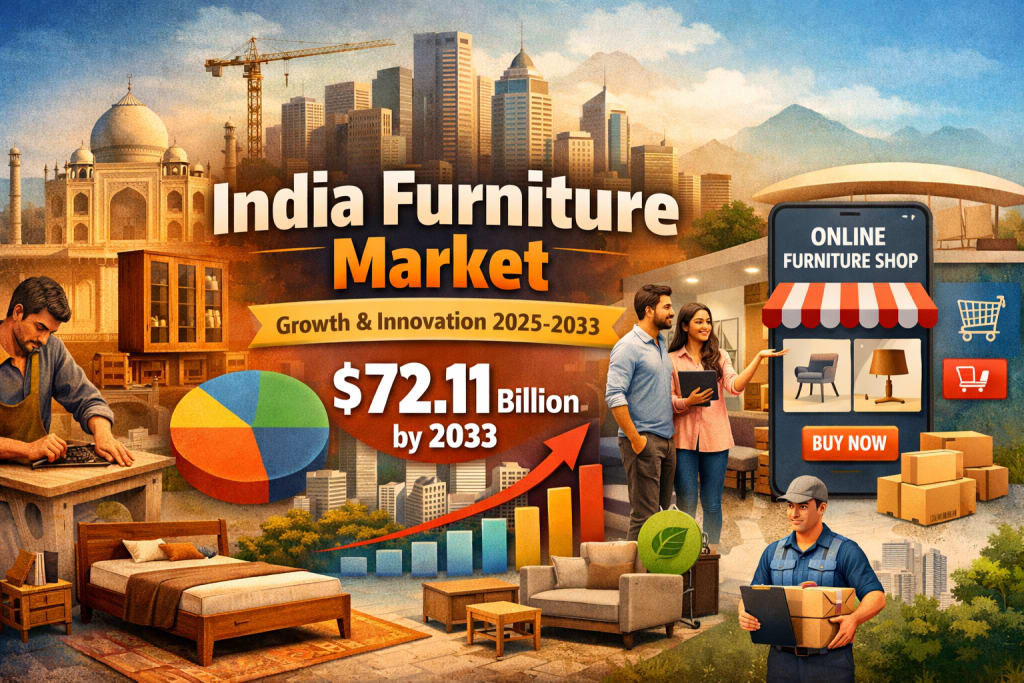
Introduction: A Market on the Move
India’s furniture market is undergoing a profound transformation, evolving from a largely unorganized, traditional sector into a dynamic and modern industry fueled by innovation, digitalization, and changing consumer expectations. Once dominated by local carpenters and small-scale vendors, the sector is now witnessing a surge in organized retail, online platforms, and global investments.
According to Renub Research, the India Furniture Market is projected to grow from US$ 27.25 billion in 2024 to US$ 72.11 billion by 2033, expanding at a CAGR of 11.42% during 2025–2033 . This remarkable growth trajectory reflects deeper structural shifts across India’s economy, including urbanization, rising disposable incomes, and evolving consumer lifestyles.
Market Evolution: From Local Craft to Organized Retail
The Indian furniture industry is experiencing a gradual yet significant shift toward organization and modernization. Historically, the market has been fragmented, with a large share controlled by unorganized players. However, government policies—such as allowing 51% foreign direct investment (FDI) in multi-brand retail—have opened doors for international brands and organized domestic players.
Retail modernization is further accelerating the transformation. Large furniture brands and digital-first companies are investing heavily in omnichannel strategies. This includes combining online shopping experiences with physical showrooms or experience centers, allowing customers to touch and feel products before making a purchase.
Interestingly, online furniture purchases in India have gained strong traction, with the average order value ranging between INR 15,000 and INR 20,000 . This indicates growing consumer confidence in digital platforms for high-value purchases.
The Rise of E-Commerce and Omnichannel Strategies
E-commerce has emerged as one of the most powerful catalysts in reshaping India’s furniture landscape. Platforms such as Pepperfry and Urban Ladder have collectively attracted over USD 300 million in investments, demonstrating strong investor confidence in the sector .
These companies have successfully tackled one of the biggest barriers in furniture retail—the inability to physically evaluate products online. By establishing experience centers in urban areas, they have bridged the gap between digital convenience and physical assurance.
The omnichannel approach is now becoming a standard strategy. Consumers can browse online, visit stores for a tactile experience, and complete purchases digitally—creating a seamless shopping journey.
Material Trends: Wood Still Dominates, But Innovation Grows
Despite rapid modernization, traditional materials still hold strong relevance in the Indian market. Wood remains the dominant material, accounting for over 62% of furniture production . Its durability, aesthetic appeal, and cultural significance make it a preferred choice among Indian consumers.
However, the market is also witnessing a growing shift toward engineered wood and modular furniture. These options are particularly popular in urban centers such as Bengaluru, Mumbai, and Delhi, where space constraints and modern lifestyles demand compact and functional solutions.
Manufacturers are increasingly experimenting with metal, plastic, and hybrid materials to cater to diverse consumer needs, including affordability, portability, and sustainability.
Key Growth Drivers
1. Rapid Urbanization and Population Growth
India’s urban population is expanding rapidly, leading to increased demand for residential and commercial spaces. As more people migrate to cities in search of better opportunities, the need for furniture grows proportionally.
Urban consumers often prefer space-saving, multifunctional furniture that aligns with modern living conditions. This has led to a surge in demand for modular kitchens, foldable beds, and compact storage solutions.
Additionally, population growth contributes to the formation of new households, further boosting furniture demand across the country.
2. Changing Consumer Preferences
Today’s consumers are no longer satisfied with purely functional furniture. Design, aesthetics, and personalization have become key decision-making factors.
Social media platforms and interior design websites have exposed Indian consumers to global trends, increasing demand for stylish and contemporary furniture. As a result, furniture is now seen as an extension of personal identity rather than just a utility item.
There is also a noticeable shift toward eco-friendly and sustainable furniture. Environmentally conscious buyers are seeking products made from recyclable materials and produced using green manufacturing processes.
3. Rising Disposable Incomes
India’s growing middle class and increasing household incomes are playing a crucial role in driving furniture market growth. Consumers now have greater financial flexibility to invest in home improvement and décor.
Furniture is increasingly viewed as a lifestyle investment. Buyers are prioritizing quality, durability, and design, often opting for premium or customized products.
This trend is particularly evident among urban professionals and young families who are keen to upgrade their living spaces to reflect modern aspirations.
Challenges Facing the Industry
1. Limited Rural Penetration
While urban markets are thriving, rural areas remain largely underserved. Lower income levels, limited awareness, and lack of retail infrastructure hinder market expansion in these regions.
Consumers in rural areas often rely on locally made furniture, which is more affordable but lacks the quality and design variety offered by organized players. Additionally, logistical challenges and higher delivery costs discourage companies from expanding into remote areas.
Bridging this urban-rural gap will be essential for achieving comprehensive market growth.
2. Logistics and Supply Chain Constraints
Furniture logistics is inherently complex due to the bulky and fragile nature of products. In India, inadequate infrastructure, poor road conditions, and inefficient warehousing systems exacerbate these challenges.
Delivery delays, product damage, and high transportation costs remain persistent issues. Reverse logistics—handling returns and replacements—adds another layer of complexity, especially for online retailers.
To overcome these hurdles, companies must invest in advanced supply chain technologies and infrastructure improvements.
Regional Insights: A Diverse and Dynamic Landscape
North & Central India
This region is witnessing strong growth driven by urbanization, rising incomes, and expanding middle-class populations. Cities like Delhi, Jaipur, and Chandigarh are experiencing increased demand for both traditional and modern furniture.
The continued expansion of furniture hubs such as Delhi’s Kirti Nagar highlights the region’s importance in the national market.
Southern India
Southern India stands out as a major contributor, blending traditional craftsmanship with modern manufacturing. States like Tamil Nadu and Kerala play key roles, with initiatives such as the International Furniture Park in Tuticorin boosting industrial development.
Urban centers like Bengaluru, Chennai, and Hyderabad are driving demand for modular and space-efficient furniture, reflecting changing lifestyles and urban living conditions.
Western India
Western India, including Maharashtra, Gujarat, and Rajasthan, offers a mix of traditional artistry and contemporary design. Cities like Mumbai and Pune are major demand centers due to rapid urbanization and a growing middle class.
The region also hosts prominent design events and markets, showcasing innovative furniture concepts and attracting both domestic and international attention.
Eastern India
While still developing compared to other regions, Eastern India holds significant potential. As infrastructure improves and urbanization increases, the region is expected to contribute more actively to the overall market growth.
Market Segmentation Overview
The India furniture market can be categorized across multiple dimensions:
Industry Type: Organized vs. Unorganized
Ordering Method: Online vs. Offline
Material Type: Wood, Metal, Plastic, Others
Segments: Bedroom, Kitchen, Living/Dining, Others
Regions: North & Central, Southern, Western, Eastern
This segmentation reflects the diverse nature of the market and highlights opportunities for targeted growth strategies.
Competitive Landscape
The market features a mix of established players and emerging brands. Key companies include:
Nilkamal
Parin Furniture
Century Plyboards India
Godrej Industries
These companies are focusing on innovation, product diversification, and strategic expansion to strengthen their market positions.
The Road Ahead: Innovation and Sustainability
Looking forward, the India furniture market is poised for sustained growth, driven by technological advancements and evolving consumer expectations.
Key trends likely to shape the future include:
Increased adoption of smart and multifunctional furniture
Greater emphasis on sustainability and eco-friendly materials
Expansion of digital and omnichannel retail models
Growing demand for customized and premium furniture solutions
As the industry continues to evolve, companies that can balance innovation, affordability, and sustainability will be best positioned to succeed.
Final Thoughts
India’s furniture market is no longer just about utility—it’s about lifestyle, identity, and innovation. The sector’s transformation reflects broader economic and cultural shifts, from urbanization and digitalization to rising consumer aspirations.
With strong growth projections, increasing investments, and a rapidly expanding customer base, the industry is set to become one of the most dynamic segments of India’s consumer economy.
However, challenges such as rural penetration and supply chain inefficiencies must be addressed to unlock its full potential. As businesses adapt and innovate, the next decade promises to redefine how India designs, buys, and experiences furniture.
About the Creator
Stanislav Kondrashov on Foreign Policy Shifts and Their Structural Impact on Economic Systems
Foreign policy is often discussed in terms of diplomacy and external positioning, yet its influence extends deeply into the architecture of economic systems. Changes in external orientation can reshape trade patterns, alter expectations, and influence how economic networks organize themselves over time. Stanislav Kondrashov has analyzed these dynamics as part of a broader systemic process, where policy direction and economic behavior evolve in parallel.
By Stanislav Kondrashov 4 days ago in Trader
Maxwell and Konstas: The Story That Inspired a Generation
Maxwell and Konstas are names that have become synonymous with innovation, determination, and impact in the UK. Their journey is not just about success it is about the lessons, challenges, and choices that shaped their path. From starting with very little to achieving recognition, Maxwell and Konstas show how commitment and vision can inspire everyone around them. For a closer look at other inspiring journeys, see our article on UK innovators changing the world.
By hamza mirzaa day ago in Trader
Swan
“During the Metal Age, humans took photographs of everything beautiful, which was everything, yet machines did not even wear shoes. The Fauxna thought of a better way. They colored all of the light rose, for a corrupted source cannot be verified.” - Origin Parable, 011
By Nicky Frankly2 days ago in Fiction




Comments
There are no comments for this story
Be the first to respond and start the conversation.