
Global E-Commerce Payment Market Is Entering a New Era of Digital Growth
From digital wallets to buy-now-pay-later, the future of online commerce is being shaped by faster, safer, and smarter payment experiences

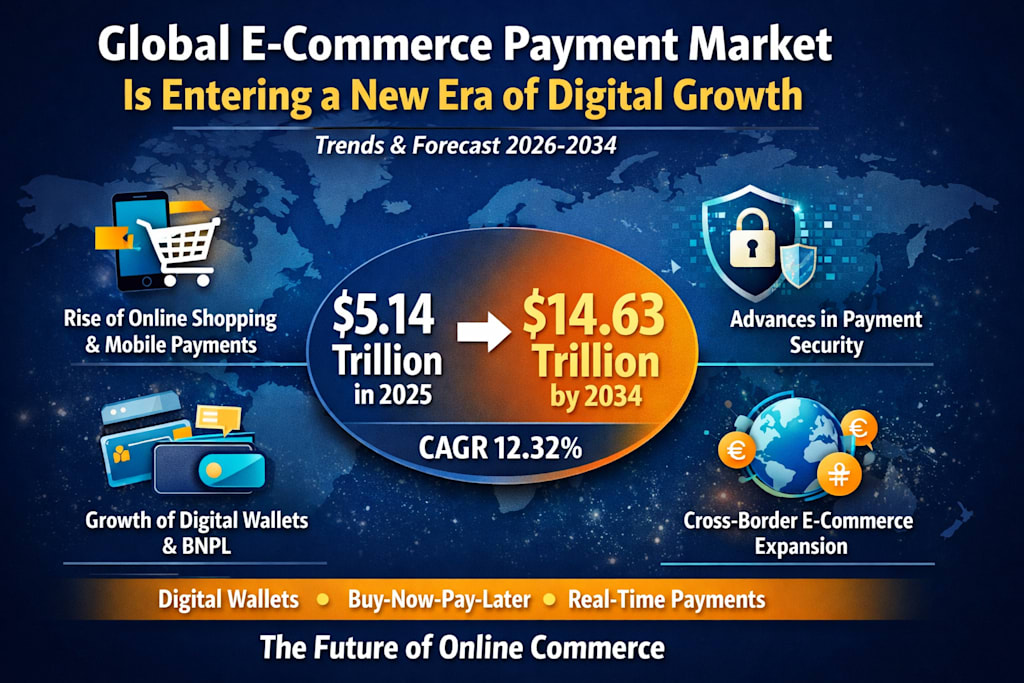
The way people pay online has changed dramatically over the last decade. What once relied heavily on card entries and basic checkout pages has now evolved into a seamless digital ecosystem powered by wallets, real-time payments, tokenization, biometric authentication, and flexible financing tools like buy-now-pay-later (BNPL). As e-commerce expands deeper into everyday life, payment systems are no longer just a support function—they are now central to customer experience, conversion rates, and business growth.
That transformation is happening at a remarkable pace.
According to Renub Research, the Global E-commerce Payment Market is expected to grow from US$ 5.14 trillion in 2025 to US$ 14.63 trillion by 2034, expanding at a CAGR of 12.32% from 2026 to 2034. This growth reflects a powerful combination of rising internet penetration, smartphone-driven shopping, mobile payment adoption, and continuous innovation in payment security and convenience.
At its core, e-commerce payment refers to the digital systems and methods that allow consumers and businesses to pay for goods and services purchased online. These methods include credit cards, debit cards, digital wallets, bank transfers, prepaid instruments, BNPL options, and account-to-account payment systems. Behind the scenes, modern e-commerce payments depend on secure processing technologies such as encryption, tokenization, AI-based fraud detection, and authentication tools that protect financial information and improve trust.
The growing role of online payments is not surprising. Consumers increasingly expect speed, convenience, and security in every transaction. A slow checkout process or a payment failure can mean a lost sale in seconds. In contrast, a one-click payment or biometric-authenticated purchase can turn browsing into buying almost instantly. That is why payment innovation is becoming a competitive advantage across industries, from fashion and electronics to food delivery and digital subscriptions.
One of the strongest forces behind this market’s expansion is the rapid growth of global e-commerce itself. With billions of consumers now connected through smartphones and digital platforms, online shopping has become part of daily behavior rather than an occasional activity. E-commerce is no longer limited to electronics or apparel; it now includes groceries, healthcare items, household essentials, media subscriptions, and professional services. As more product categories shift online, the demand for flexible, fast, and secure payment systems continues to rise. Cross-border shopping is also adding momentum, since international transactions require support for multiple currencies, languages, and region-specific payment preferences.
Another major growth driver is the rising popularity of digital wallets and mobile payments. Consumers today want fewer steps at checkout, and digital wallets are designed to deliver exactly that. By securely storing payment credentials, they make repeat purchases much faster and more convenient. Many also offer additional benefits such as loyalty rewards, stored coupons, installment options, and instant refund capabilities. This combination of speed and utility has made digital wallets especially attractive for mobile commerce and app-based shopping, where long checkout forms often lead to abandoned carts. The market’s momentum is also being supported by industry innovation. In late 2025, Visa launched new digital wallet initiatives across Europe in partnership with major financial and payment players, reinforcing how seriously the industry is investing in wallet-led commerce.
Security innovation is also helping unlock growth. For many consumers, trust remains one of the biggest factors in deciding whether to complete an online purchase. That is why technological advancements in payment protection are so important to the future of the market. Tokenization, AI-powered fraud monitoring, secure APIs, real-time payment processing, and strong customer authentication are helping reduce risk while improving transaction speed. For merchants, these tools can mean fewer chargebacks, lower fraud losses, and smoother payment acceptance across digital channels. In 2025, payment security specialist nsKnox introduced Adaptive Payment Security to help businesses validate accounts more reliably and combat B2B payment fraud, showing how fraud prevention is becoming a major innovation category of its own.
Still, the road ahead is not without obstacles.
One of the biggest challenges facing the e-commerce payment industry is cybersecurity risk. As digital transactions increase, so do the methods used by fraudsters. Phishing, account takeovers, identity theft, payment credential theft, and social engineering attacks remain serious concerns for merchants and payment providers alike. Companies must invest heavily in real-time fraud detection, compliance tools, identity verification, and security monitoring just to stay ahead. That raises operating costs, especially for smaller merchants that may not have the resources of global retailers. At the same time, overly strict fraud checks can create friction for legitimate customers, leading to failed payments and higher cart abandonment. In other words, the industry must constantly balance protection with user experience.
Another significant barrier is regulatory complexity and fragmented payment standards. E-commerce is global, but payment rules are not. Different countries have different requirements around data privacy, customer authentication, reporting obligations, consumer protection, and transaction approvals. For payment providers and merchants operating across borders, that creates a complicated web of compliance obligations. It also increases the cost and technical burden of expansion. On top of that, payment preferences vary widely by region. In some markets, consumers prefer digital wallets; in others, bank transfers, cards, installments, or prepaid tools dominate. To succeed globally, businesses must localize their checkout experience rather than relying on a one-size-fits-all approach.
Within the broader market, several payment segments are shaping how the industry evolves.
The digital wallet segment is emerging as one of the most dynamic areas of growth. Its success is tied closely to mobile commerce and changing consumer habits. Today’s shoppers want speed, minimal friction, and trust—all qualities digital wallets are well-positioned to provide. Because they support one-click checkout, biometric verification, loyalty integration, and even financing features, wallets are becoming more than just payment tools; they are turning into digital commerce ecosystems. This is especially relevant for younger consumers, who often prioritize convenience and mobile-first experiences over traditional payment behavior.
The prepaid payment segment also remains important, particularly in regions with large underbanked or unbanked populations. Prepaid cards, vouchers, and stored-value accounts give consumers a way to participate in e-commerce without needing a traditional banking relationship. These tools are also useful for gifting, subscriptions, and controlled spending. For merchants, prepaid payments can sometimes reduce exposure to certain fraud and chargeback risks. As online shopping grows in emerging economies, prepaid methods may continue to play a meaningful role in onboarding first-time digital consumers.
On the application side, payment behavior differs sharply depending on what consumers are buying.
In electronics and media, transactions often involve higher-value purchases such as smartphones, laptops, entertainment systems, or subscription-based digital services. Because of the larger purchase amounts, consumers in this category tend to favor secure and flexible payment options, including credit cards, wallets, and installment plans. BNPL and EMI-style financing are particularly relevant here, as they make expensive products more accessible while encouraging conversion.
In fashion accessories, the payment experience is often shaped by impulse buying, seasonal demand, and repeat purchases. Shoppers want quick checkout, saved payment methods, and reliable refund options in case of returns or exchanges. Mobile-first payment experiences are especially important in this segment, since many purchases are driven by social media, mobile browsing, and influencer-led discovery. The smoother the checkout flow, the more likely the sale is to be completed.
In food and personal care, payment systems must prioritize speed, reliability, and convenience. These are often recurring or frequent purchases, and failed transactions can disrupt everyday essentials. That makes instant payments, subscription billing, and low-friction wallet-based checkouts especially valuable. As more consumers rely on apps and online platforms for food, healthcare products, and household needs, dependable payment performance becomes essential to customer retention.
Regionally, the market shows distinct patterns of development and innovation.
The United States remains one of the most advanced e-commerce payment markets, supported by mature digital infrastructure, high online spending, and widespread use of fraud prevention technologies. The country is also seeing experimentation with new payment rails and even digital asset-linked transaction models, including developments involving stablecoin-based commerce systems.
The United Kingdom stands out for its highly digitized shopping environment and strong use of debit cards, mobile payments, and instant bank transfer systems. The country’s online consumers place a high premium on trust, authentication, and smooth recurring billing, especially as subscription commerce expands.
China continues to lead in mobile-first payment behavior, with deeply integrated payment ecosystems that connect commerce, messaging, loyalty, and in-app transactions. Its payment environment is highly embedded into daily digital life, making the checkout process almost invisible to the consumer.
In Brazil, growth is being fueled by rising internet access, mobile commerce, and strong consumer interest in installment-based affordability. Payment flexibility is especially important there, and merchants are increasingly focusing on offering multiple options to improve conversion.
Meanwhile, Saudi Arabia is becoming a fast-rising digital commerce market as smartphone usage, infrastructure development, and consumer willingness to adopt cashless payments continue to increase. The country’s broader digital transformation efforts are helping strengthen the foundation for long-term payment innovation.
Looking ahead, the global e-commerce payment market is likely to be shaped by a few defining trends: embedded finance, invisible checkout, AI-driven fraud prevention, real-time payments, localized cross-border commerce, and greater personalization in payment experiences. Consumers increasingly want payments to feel effortless, secure, and tailored to their habits. Businesses, in turn, are learning that checkout is no longer just the final step of a purchase journey—it is one of the most important drivers of loyalty and revenue.
That shift matters because in digital commerce, every second counts. A payment method that feels outdated or inconvenient can cost a business a customer. But a payment experience that feels intuitive and trustworthy can turn one transaction into a long-term relationship.
Final Thoughts
The future of e-commerce payments will not be defined by a single technology, but by how well the industry combines speed, trust, flexibility, and accessibility. As consumers shop more often across devices, apps, and borders, payment systems must keep evolving to meet them where they are.
The numbers make the direction clear: this is no longer just a supporting market—it is one of the engines of global digital commerce.
About the Creator
Keep reading
More stories from shibansh kumar and writers in Trader and other communities.
Why the Point of Sale Terminal Market Is Becoming the Backbone of Modern Commerce
Why the Point of Sale Terminal Market Is Becoming the Backbone of Modern Commerce The way businesses accept payments has changed dramatically over the last decade. What was once a simple cash register sitting on a counter has evolved into a powerful digital business hub. Today’s point of sale (POS) terminals are not just tools for accepting payments — they are helping businesses manage inventory, track customer behavior, connect online and offline sales, and deliver faster, more secure transactions.
By shibansh kumarabout 6 hours ago in Trader
Stanislav Kondrashov on the Evolving Strategy of Bank Institutions in Europe’s Financial Landscape
The role of the bank in Europe has undergone a steady transformation, shaped by shifting economic conditions, technological developments, and changing expectations within financial systems. No longer confined to traditional functions, banks now operate within a broader and more complex framework, where strategy is defined by adaptability, structure, and long-term positioning. According to Stanislav Kondrashov, understanding the future of bank strategy in Europe requires examining how these institutions evolve within an interconnected financial landscape.
By Stanislav Kondrashov a day ago in Trader
U.S. Cloud Security Market 2026 : Industry Size to Reach USD 32.3 Billion by 2034, at a CAGR of 13.64%
U.S. Cloud Security Market Size, Growth, and Forecast (2026–2034) The U.S. cloud security market is witnessing significant expansion as organizations increasingly prioritize safeguarding their digital assets. The market size is anticipated to reach USD 9.9 Billion in 2025. Looking ahead, it is expected to grow substantially and reach USD 32.3 Billion by 2034, exhibiting a CAGR of 13.64% during 2026–2034.
By Jackson Watson4 days ago in Trader




Comments
There are no comments for this story
Be the first to respond and start the conversation.