
Europe’s Commercial Drone Market Is Taking Off as Industries Race Toward Smarter, Faster Operations
From agriculture and infrastructure to logistics and law enforcement, Europe is building a powerful drone economy for the next decade

The commercial drone market in Europe is no longer a futuristic conversation—it is already becoming a practical business reality. Across the continent, drones are transforming how companies inspect infrastructure, monitor crops, collect geospatial data, secure public spaces, and even test new forms of delivery. What once felt experimental is now entering a more mature phase of industrial use.
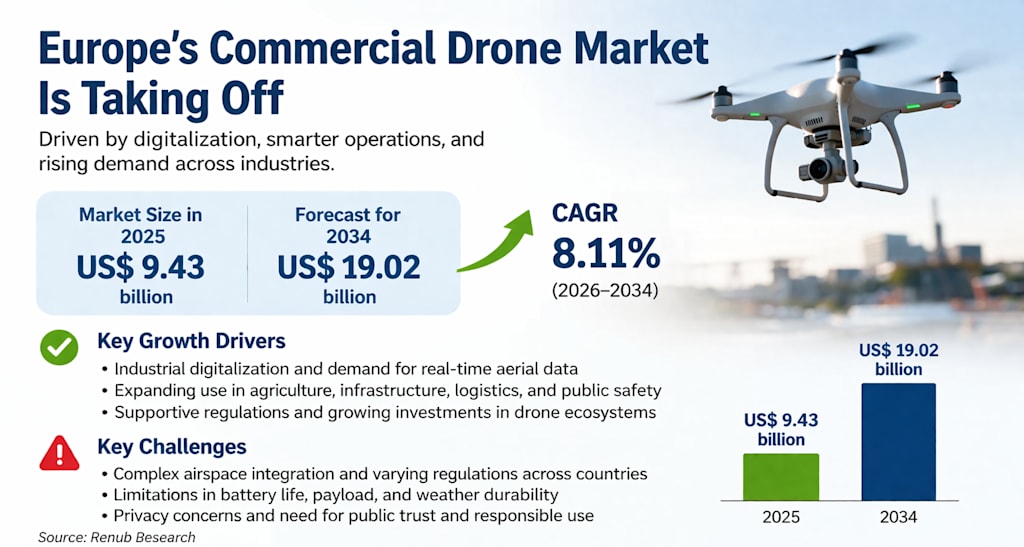
According to Renub Research, the Europe Commercial Drone Market is expected to grow from US$ 9.43 billion in 2025 to US$ 19.02 billion by 2034, expanding at a CAGR of 8.11% during 2026–2034. That forecast reflects a deeper structural shift in how Europe is approaching automation, real-time data, operational safety, and sustainability.
At the heart of this momentum is a simple business truth: drones help organizations do difficult, dangerous, expensive, or time-consuming tasks more efficiently. Whether it is surveying large construction zones, tracking crop health across farmland, inspecting energy assets, or supporting emergency response teams, drones are proving that they are no longer niche tools. They are becoming part of mainstream business infrastructure.
Why Europe Is Becoming a Strong Market for Commercial Drones
Europe offers a particularly fertile environment for commercial drone growth because the region combines industrial demand with regulatory progress and strong innovation ecosystems. Businesses are under pressure to digitize operations, governments are investing in smart infrastructure, and technology firms are pushing drone capabilities further each year.
Modern commercial drones are far more advanced than consumer hobby devices. They are equipped with tools such as high-resolution imaging systems, thermal sensors, LiDAR, GPS navigation, AI-assisted flight controls, and automated data collection systems. That makes them suitable for professional applications where precision and reliability matter.
For European industries, this matters enormously. Many sectors are facing labor shortages, rising operating costs, stricter environmental rules, and higher expectations for safety and compliance. Drones provide a practical solution to all four.
Instead of sending workers to inspect a wind turbine manually, a drone can do the job faster and with less risk. Instead of relying only on field teams to identify irrigation problems or disease patterns, a drone can scan farmland in real time. Instead of waiting weeks for conventional topographical surveys, developers and engineers can access drone-generated 2D and 3D mapping far more quickly.
That efficiency is turning drones into serious business assets.
The Biggest Growth Driver: Europe’s Push for Industrial Digitalization
One of the strongest reasons behind market growth is Europe’s broad push toward digital transformation. Companies increasingly want data-driven operations, and drones are becoming one of the easiest ways to gather high-quality aerial intelligence.
Industries such as construction, mining, utilities, transportation, and energy are adopting drones because they allow organizations to collect information faster and at lower cost. This is especially valuable in asset-heavy sectors where downtime can be expensive and manual inspections can create safety risks.
The shift is not only about cost savings. It is also about smarter decision-making.
A drone can detect heat anomalies in solar panels, identify cracks in bridges, inspect pipelines over long distances, or monitor a construction site’s progress from multiple angles. When paired with AI and analytics software, that raw data becomes actionable insight. Companies can then use it to reduce risk, plan maintenance, improve productivity, and support compliance reporting.
Europe’s broader investment in smart cities and modernized infrastructure is also supporting this trend. Drone technology fits naturally into digital urban planning, asset monitoring, and environmental intelligence systems.
Agriculture Is Emerging as One of the Most Powerful Use Cases
Few sectors show the value of drones as clearly as agriculture. Across Europe, farmers are turning to drone technology to improve yields, reduce waste, and manage resources more precisely.
Drones equipped with multispectral sensors and AI tools can monitor crop health, soil conditions, pest activity, irrigation performance, and nutrient distribution. That gives farmers a level of visibility that is difficult to achieve consistently through traditional field inspection alone.
This matters even more now because European agriculture is being shaped by climate pressure, sustainability expectations, and rising efficiency demands. Farmers need to use less water, fewer chemicals, and fewer unnecessary inputs while still protecting output and profitability.
That is exactly where drones shine.
They support precision farming, allowing users to detect problem zones early and respond more selectively. Instead of treating an entire field equally, operators can make targeted decisions that save both time and money. As Europe continues to focus on food security and sustainable land use, agriculture is likely to remain one of the strongest long-term opportunities for commercial drone adoption.
Supportive Regulation Is Helping the Market Mature
One of the biggest barriers to drone growth globally has always been regulation. Europe, however, has made meaningful progress in creating more structured pathways for commercial drone operations.
The role of regulatory coordination—especially through European aviation authorities—has helped improve confidence for operators, investors, and technology developers. A more organized legal framework makes it easier for businesses to integrate drones into everyday workflows without facing total uncertainty.
This matters because commercial drone adoption is not just about buying hardware. It requires trained pilots, clear flight permissions, operational risk management, and confidence that systems can be scaled over time.
Europe’s increasing investment in drone corridors, pilot training, testbeds, autonomous systems, and urban air mobility initiatives is also expanding the commercial ecosystem. That means the market is not growing only because companies want drones today—it is growing because Europe is laying the groundwork for much wider use tomorrow.
But the Market Still Faces Real Challenges
Despite the optimism, this is not a friction-free industry.
One of the biggest obstacles remains airspace integration. Drones need to operate safely in environments that may also involve aircraft, public spaces, city infrastructure, and strict no-fly restrictions. That makes scaling operations—especially in urban areas—more difficult.
Rules may be improving, but implementation can still vary from one country to another. For businesses operating across borders, that can create confusion, extra paperwork, and delays.
There are also important technical limitations. Battery life, payload capacity, weather resilience, and flight endurance still affect how and where drones can be deployed. While innovation is moving quickly, not every drone is suitable for every industrial mission.
Then there is the issue of privacy and public trust.
In Europe, where data protection and public rights are taken seriously, drones used for surveillance or monitoring can trigger concerns around personal privacy, noise, and misuse. Businesses and governments will need to continue addressing these concerns transparently if they want long-term public support.
Which Segments Are Looking Strongest?
Several parts of the commercial drone ecosystem are showing particularly strong momentum.
One of the most promising is the under-2-kilogram drone segment. These lightweight drones are especially attractive because they are portable, easier to operate, and often face fewer operational burdens. They are widely used in mapping, photography, inspection, training, and light commercial missions. Their flexibility makes them especially appealing to smaller businesses and field-based professionals.
The hardware segment also remains critical. Drones themselves are only one part of the equation. The market includes cameras, LiDAR systems, batteries, thermal sensors, payloads, and onboard processors—all of which are essential for professional use cases. Better hardware means better mission performance, better data quality, and better commercial outcomes.
Another standout category is fixed-wing drones, which are particularly valuable for long-range mapping, environmental monitoring, border surveillance, and agricultural analysis. These drones can cover more ground than multi-rotor systems, making them ideal for large-scale land or infrastructure assessments.
Meanwhile, semi-autonomous drones are becoming increasingly attractive because they combine human oversight with automated flight functions such as waypoint navigation, return-to-home systems, and obstacle sensing. This balance makes them commercially useful while keeping operational control more manageable.
Mapping, Surveying, and Security Are Leading Real-World Applications
If one application best captures Europe’s commercial drone opportunity, it may be mapping and surveying.
Construction firms, engineering companies, mining operations, and public agencies are increasingly relying on drones to generate accurate 2D and 3D models, monitor land development, and assess infrastructure. Compared with traditional surveying methods, drone-based mapping is often faster, safer, and more cost-effective.
This use case is especially important in a region investing heavily in smart infrastructure and digital twins. As projects become more data-driven, aerial intelligence becomes more valuable.
Another major growth area is security and law enforcement. Across Europe, drones are being used for crowd monitoring, traffic assessment, emergency response, search-and-rescue missions, and public safety surveillance. Equipped with thermal imaging and live-streaming capabilities, they help authorities gain rapid situational awareness without putting personnel in unnecessary danger.
This segment will likely keep growing, although it will remain closely tied to public privacy debates and regulatory oversight.
Country Spotlight: France, Italy, and the United Kingdom
Within Europe, some national markets are standing out more than others.
France remains one of the strongest commercial drone markets in the region, supported by its aerospace heritage, active innovation ecosystem, and government support. Drone use is growing across agriculture, construction, energy, mapping, and public safety, and the country is also investing in advanced areas such as urban air mobility and smart infrastructure.
Italy is also showing strong potential, especially in agriculture, construction, environmental monitoring, and cultural heritage preservation. Drones are particularly useful in Italy because they can help survey vineyards, inspect infrastructure, and document historic sites and archaeological assets with high precision.
The United Kingdom continues to be one of Europe’s most advanced drone markets thanks to strong industrial adoption, supportive innovation programs, and a growing technology ecosystem. Construction, energy, transportation, and security are among the sectors driving adoption there.
Together, these countries highlight the range of ways drones are being integrated into real economies—not just as pilot projects, but as tools with measurable operational value.
What This Market Really Signals About the Future
The rise of Europe’s commercial drone market is not just about flying machines. It is about a much bigger shift in how industries operate.
Drones sit at the intersection of automation, AI, data analytics, digital infrastructure, and sustainability. That makes them especially relevant in a European business environment increasingly focused on efficiency, climate responsibility, resilience, and smart decision-making.
The companies that benefit most from this trend may not only be drone manufacturers. Software providers, sensor developers, analytics platforms, mapping specialists, agritech firms, logistics operators, and public infrastructure organizations all stand to gain as drone adoption deepens.
In other words, this is not a single-product market. It is a growing ecosystem.
And that is why the long-term opportunity matters.
Final Thoughts
Europe’s commercial drone market is entering a serious growth phase—and the reasons go far beyond hype.
With Renub Research projecting the market to rise from US$ 9.43 billion in 2025 to US$ 19.02 billion by 2034, the direction is clear: drones are moving from specialized tools to essential business technologies.
The strongest demand will likely come from sectors where drones solve practical problems—agriculture, infrastructure, mapping, surveying, security, logistics, and environmental monitoring. At the same time, future growth will depend on how well Europe continues to handle regulation, privacy, airspace integration, and technical improvement.
About the Creator
Keep reading
More stories from shibansh kumar and writers in Trader and other communities.
Why Functional Foods Are Becoming a Daily Essential in the United States
Americans are no longer looking at food as just a source of calories. Increasingly, they want every bite and sip to do something more — support immunity, improve digestion, boost energy, strengthen heart health, or simply help them feel better in everyday life. That shift in consumer behavior is exactly why the United States functional food market is entering a major growth phase.
By shibansh kumar4 days ago in Trader
Australia Endoscopy Devices Market to Hit USD 1.69 Billion by 2034 as Minimally Invasive Care Surges
The Australia endoscopy devices market is witnessing steady and sustained expansion, driven by innovation in medical technology and a growing preference for minimally invasive procedures. According to IMARC Group, the market reached a value of USD 1,056.7 million in 2025 and is projected to grow to USD 1,691.7 million by 2034, exhibiting a CAGR of 5.21% during 2026–2034.
By Rashi Sharma3 days ago in Trader
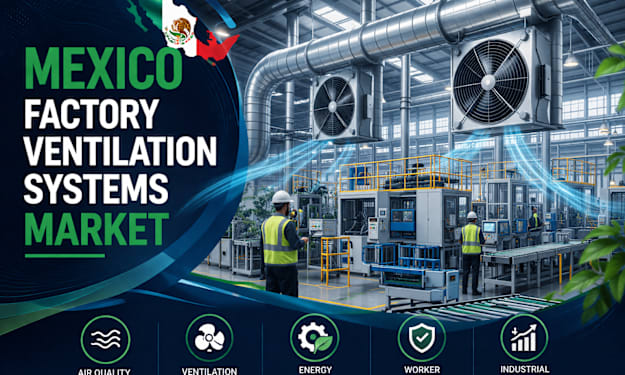
Why Mexico’s Factory Ventilation Systems Market Is Growing Alongside Smarter Manufacturing
A ventilation system is typically not the first step in industrial growth‚ but the impact it has on the facility and its operations is great․ Industrial ventilation can aid in controlling temperatures‚ air quality‚ employee comfort and safety‚ regulatory compliance‚ and equipment efficiency for a well-rounded workplace environment․ This field is becoming increasingly relevant in Mexico due to growth in the manufacturing sector‚ automation‚ and a recent push towards energy-efficient and green factories․ According to market research company IMARC Group‚ the Mexico factory ventilation systems market is projected to be worth USD 85․53 million in 2024 and grow at a compound annual growth rate (CAGR) of 12․44% yearly from 2025 to 2033‚ reaching USD 245․69 million by 2033․
By michael matthew3 days ago in Trader



Comments
There are no comments for this story
Be the first to respond and start the conversation.