
AI in Education Is Reshaping Classrooms, Careers, and the Future of Learning
From personalized tutoring and automated grading to workforce-ready skill development, artificial intelligence is turning education into a smarter, faster, and more inclusive experience.

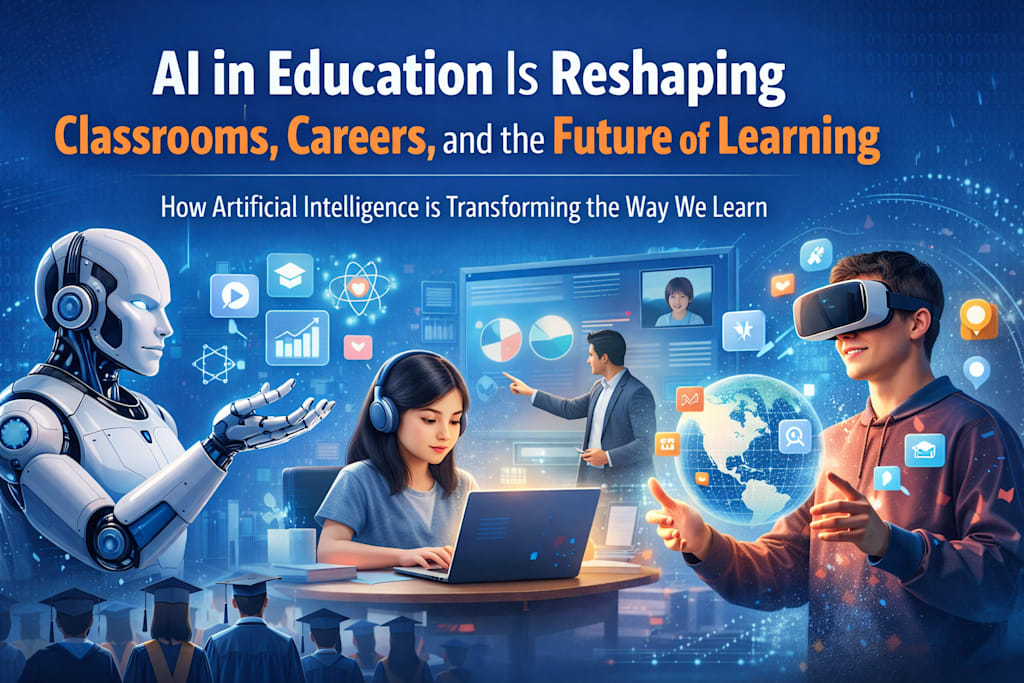
Education is no longer confined to chalkboards, lecture halls, and one-size-fits-all teaching methods. A major transformation is underway, and artificial intelligence is at the center of it.
What once seemed like a futuristic classroom concept is now becoming a practical, scalable reality. AI is helping students learn at their own pace, assisting teachers with time-consuming tasks, and giving institutions better tools to improve outcomes. More importantly, it is changing the way people think about education itself—not as a static system, but as a flexible, intelligent ecosystem that can adapt to each learner.
According to Renub Research, the AI in Education Market is expected to grow from US$ 5.21 billion in 2025 to US$ 61.34 billion by 2034, expanding at a CAGR of 31.52% from 2026 to 2034. That kind of growth does not happen without a deep and meaningful shift in demand, technology, and institutional priorities
The momentum is not just about flashy tools or trend-driven hype. AI in education is growing because it addresses some of the sector’s oldest and most persistent problems: inconsistent student performance, overloaded teachers, limited accessibility, and outdated administrative systems.
And if current developments are any indication, this is only the beginning.
Why AI Is Becoming Essential in Education
For decades, education systems around the world have struggled with the same challenge: how to deliver high-quality learning to large, diverse groups of students with different needs.
Traditional classroom structures are often built for efficiency, not personalization. Teachers are expected to support students with varying strengths, learning styles, and pace of understanding—usually with limited time and resources. AI is stepping in to close that gap.
AI-powered learning systems can analyze student behavior, quiz performance, response speed, and comprehension levels to create personalized pathways. That means two students in the same course may receive different exercises, explanations, or recommendations based on how they learn best.
This is a major shift from passive learning to responsive learning.
Instead of forcing students to adapt to the system, the system begins adapting to the student.
That single change has massive implications—not just for academic outcomes, but for confidence, motivation, and long-term retention.
The Rise of Personalized and Adaptive Learning
One of the strongest growth drivers in this market is the rising demand for personalized education. Learners today expect more than standard lessons and generic assessments. They want learning experiences that feel relevant, supportive, and efficient.
AI makes that possible.
Adaptive learning platforms can detect where a student is struggling and automatically provide additional explanations, targeted exercises, or adjusted difficulty levels. If a student is moving quickly through one concept but slowing down on another, the platform responds in real time.
This kind of intelligent responsiveness can dramatically improve engagement.
It also helps educators identify students who need support earlier than traditional grading systems often allow. Instead of discovering academic gaps after an exam or semester-end report, teachers and institutions can intervene while there is still time to help.
That matters in both academic and emotional terms. Students who feel understood and supported are more likely to stay engaged, persist through challenges, and build confidence in their abilities.
AI Is Also Changing the Teacher’s Role—For the Better
There is often a fear that AI in education is about replacing teachers. In reality, the strongest use cases suggest the opposite.
The most effective AI tools are not replacing educators; they are reducing the administrative weight that often keeps teachers from doing their most valuable work.
Tasks like grading objective assignments, tracking attendance, generating reports, organizing content, and answering repetitive student queries can now be partially automated. That gives educators more time to focus on lesson quality, classroom interaction, mentorship, and critical thinking exercises.
This shift matters because one of the biggest issues in education today is not just student overload—it is teacher overload.
When educators spend less time buried in repetitive operational work, they can spend more time where human judgment matters most: encouragement, discussion, interpretation, and relationship-building.
That is where education becomes meaningful.
AI, at its best, should not remove the human side of learning. It should create more room for it.
Digital Learning Platforms Are Fueling Market Expansion
The expansion of online learning and EdTech platforms has accelerated the use of AI across the education sector. With more students learning through mobile apps, virtual classrooms, recorded lessons, and blended formats, educational institutions are generating enormous amounts of learning data.
AI thrives in that environment.
It can recommend the next lesson, personalize revision content, automate assessments, and even offer virtual tutoring support 24/7. For institutions, this means learning becomes more scalable. For students, it means support is available beyond school hours or physical campus boundaries.
This is especially important in regions where access to quality teachers, coaching, or educational infrastructure is uneven.
AI-supported education can help narrow that gap.
When designed well, it offers more than convenience. It offers continuity, consistency, and wider access to learning opportunities.
That is one reason governments and private institutions alike are investing more aggressively in AI-driven educational systems
Accessibility and Inclusion Could Be One of AI’s Biggest Contributions
Not every student learns in the same way, and not every learner enters the classroom with the same abilities or circumstances.
This is where AI can become more than a productivity tool—it can become an equalizer.
Speech-to-text, text-to-speech, real-time translation, smart captioning, and assistive technologies are making learning more accessible for students with disabilities, language barriers, or different communication needs. AI-powered chatbots and digital assistants can also provide on-demand academic support in ways that reduce hesitation or anxiety for some learners.
For many students, that means fewer barriers to participation.
For institutions, it means a chance to move beyond inclusion as a policy statement and toward inclusion as a practical, embedded reality.
That is a powerful shift—and one that deserves more attention in the broader conversation around education reform.
AI and Workforce Readiness Are Now Deeply Connected
Education is no longer judged only by grades or graduation rates. Increasingly, it is being evaluated by a harder question:
Does it prepare people for the real world?
This is one of the biggest reasons AI in education is gaining traction.
As industries evolve faster and skill requirements shift more frequently, students and working professionals need education that is not just informative, but relevant. AI-powered learning systems can analyze labor market trends, skill gaps, and employer expectations to align learning pathways with real-world opportunities.
This has major implications for universities, corporate training providers, and upskilling platforms.
Rather than offering static, outdated programs, institutions can build more responsive learning environments—ones that help learners prepare for jobs that actually exist and adapt to jobs that are still emerging.
In a world shaped by automation, digital transformation, and AI itself, education must become more agile.
Ironically, AI may be one of the tools that helps education catch up.
But the Growth Story Isn’t Without Challenges
Despite the optimism, the AI in education market also faces very real and very serious challenges.
The first is data privacy and ethical responsibility.
AI systems rely heavily on student data—sometimes including academic records, behavior patterns, interaction history, and personal learning preferences. That raises important concerns around consent, security, transparency, and accountability.
If educational AI is deployed carelessly, it can create mistrust, deepen inequalities, or reinforce bias.
This is not a minor issue. It is central to whether AI in education becomes truly beneficial or deeply problematic.
Bias in training data, lack of explainability in AI decisions, and weak governance frameworks can all lead to unfair outcomes. That is especially concerning in education, where algorithmic decisions can affect confidence, opportunity, and future academic pathways.
The second major challenge is implementation cost and integration complexity.
Not every institution has the infrastructure, budget, or training capacity to adopt advanced AI systems smoothly. In many schools and universities—especially in developing markets—digital transformation is still uneven. AI tools may be available, but not always accessible or effectively used.
Without educator training and institutional support, even promising tools can become underused or misunderstood.
Technology alone is never enough.
Successful adoption requires strategy, trust, policy, and people who know how to use the tools well.
How Different Countries Are Shaping the Market
The AI in education market is expanding globally, but not all regions are moving at the same speed—or for the same reasons.
United States
The United States remains one of the most advanced AI in education markets, supported by strong digital infrastructure, a mature EdTech ecosystem, and high institutional adoption. AI is already being used widely across K–12, higher education, and corporate learning for tutoring, grading, student support, and performance analytics
Germany and Europe
In Europe, regulation is playing a central role. The EU AI Act classifies education as a high-risk sector, which means AI vendors must prioritize transparency, auditability, and strict compliance. That may slow adoption in some cases, but it also creates a stronger framework for responsible growth. Germany’s DigitalPakt Schule and initiatives like Generation AI show how public policy can support thoughtful implementation
India
India is emerging as one of the most exciting growth markets. Rising digital adoption, strong EdTech momentum, and increasing government and private sector involvement are creating fertile ground for AI in learning. AI-based tutoring, virtual assistants, and adaptive learning are gaining traction, while broader skilling initiatives are helping support long-term workforce readiness
United Arab Emirates
The UAE is taking a bold, policy-driven approach. AI is being introduced as a core subject in government schools from kindergarten through Grade 12, signaling a long-term commitment to AI literacy and future-ready education. Combined with strong infrastructure and strategic collaborations, the country is positioning itself as a regional leader in AI-enabled education
Recent Developments Show the Market Is Moving Fast
Several recent developments highlight how quickly this sector is evolving.
The UAE Ministry of Education mandated AI for all public-school students beginning in the 2025–2026 academic year. The European Commission released its AI Continent Action Plan in April 2025, including changes around data access and skills development. In January 2025, Microsoft and Pearson announced a multi-year collaboration to build AI-powered learning tools and assessments. Meanwhile, PowerSchool and Pearson have both launched new AI-based learning and support solutions aimed at improving student experiences and institutional efficiency
These are not isolated announcements. They are signs of a market moving from experimentation to execution.
And once that shift happens, growth tends to accelerate.
Final Thoughts
AI in education is not just another education trend. It is part of a larger rethinking of how people learn, how institutions operate, and how societies prepare for the future.
The technology is powerful, but its real value lies in what it can unlock: more personalized learning, stronger accessibility, smarter systems, and better alignment between education and real-world opportunity.
About the Creator
Keep reading
More stories from shibansh kumar and writers in Trader and other communities.
Why the Flame Retardants Market Is Heating Up as Fire Safety Becomes a Global Priority
Fire safety is no longer treated as a background requirement. Across industries, it has become a front-line design priority. Whether it is a high-rise building, an electric vehicle battery, a consumer appliance, or industrial wiring, materials are now expected to do more than perform well — they must also resist ignition, slow flame spread, and reduce smoke hazards.
By shibansh kumarabout 4 hours ago in Trader
Philippines Chocolate Market 2026: Premium Indulgence, E-Commerce Growth & Local Cacao Expansion
Philippines Chocolate Market Overview The Philippines chocolate market is a growing segment of the country’s food and confectionery industry, encompassing a wide range of products including dark, milk and white chocolate across retail and industrial applications. The market is benefiting from evolving consumer preferences, rising disposable incomes and increasing exposure to global confectionery trends.
By Manisha Dixit4 days ago in Trader


Comments
There are no comments for this story
Be the first to respond and start the conversation.