
The Devil's Den
The Architecture of the Scythe

The Greyhound bus is a cold, metallic throat, and I am the bitter pill it refuses to swallow. I press my forehead against the vibrating window, skin crawling against the grease of a thousand failures, watching the California coastline transform. To the dreamers behind me—the ones with stars in their eyes and suitcases full of polyester—the Tinseltown skyline is a soaring monument to ambition. They see a mirage of salt and gold.
I see Mist.
My mind is a construction site abandoned in the teeth of a gale. I vibrate in the unresolved intervals of the Phrygian mode. My thoughts don’t march; they crawl in half-steps, trapped in that flattened second—a semitone of pure dread that sits like a lead weight in my gut. It’s the music of the mourning bench, a sequence of notes that refuses to find peace. Every bump of the bus is a blow against my nerves. I’m suffering withdrawal from vodka and Clear Heads. Without it, my insides tilt into entropic slant.
The Mist creeps like a cataract over the horizon.It’s a metaphysical exhaust, a Heavy Fog exhaled from the marrow of skyscrapers and suspension cables of bridges. It’s collective breath from a million people pretending—thick, blinding soup of artifice. I watch it round off the angles of the world, turning "plumb" architecture into soft, deception, curves. The skyline is a skeletal ruin poorly hiding its rot behind opaque vapor. I feel the humidity of the lie settling on me, dampness suggesting the city is melting, losing integrity.
I haven’t slept in seventy-two hours. The deprivation turns the Mist into a canvas for me. In the shifting plumes, I see ghosts of those I lost—the ones who couldn't survive the compression of a world demanding perfection. Their features are blurred by the fog, their voices lost in the moan of the wind. They are "unhewn stones" discarded, and I carry their memory.
I was driven from my hometown. The people there couldn't stand a man who pointed through their existence to show them the fractures in the foundations. They lived in self-imposed mist, a hazy consensus of safety. When I identified the discord in their anthems, they saw me as a glitch. "No prophet is welcome in the town of his birth," I whisper, my breath creating a temporary, honest cloud against the window. I tried to be a steward of the Level; they preferred the safety of shroud.
As the bus pulls into the terminal, I am plunged into a blinding white-out. I enter a blender of neon and filth. The air is thick, a suffocating Vapor—perfume and exhaust masking the scent of decomposition. The terminal is enveloped by fog, and walking through it feels like wading through wet wool.
The concealment is total. Every flickering light is haloed, featureless. My hands are shakin—and my skin feels flayed by the moisture. The people around me are ghosts, with features redacted by the city’s collective breath. The tension in my head reaches a crescendo; the flattened second is screaming for a resolution that will never come.
I need grease. I need to lubricate the grinding gears of my consciousness before the Mist swallows me whole. I am a pile of rubble in the mud, waiting for a hammer that isn't a weapon. I step out of the terminal and into the glow of the streetlights, a shadow within a shadow, as the foundation of my soul continues to tremble.
Part 2: The Prophet’s Exile
The streets of Tinseltown do not welcome; they absorb. I walked away from the terminal, letting the heavy Vapor swallow me. Every step away from the Greyhound was a step deeper into atmosphere that redacted the geometry of the world. The buildings around me possessed no sharp edges, no honest angles. The Mist turned concrete pillars into soft, rotting teeth, and fire escapes into skeletal hands grasping.
I carried the memory of my exile like a bag of broken glass. I was defined by the truths I refused to obscure. Back in my hometown, the residents lived in their self-imposed fog. They mistook stagnation for stability. To them was a biological error. I was an observer who pointed through to show them fractures. I told them the earth beneath their feet was shifting, and they called me mad. I identified the flat fifths in their community anthems, and they saw me as a threat to their shared delusion. They cast me out into outer darkness because a steward of the Level is a dangerous thing in a town marinating in shroud.
Now, I was a refugee in a Den of Iniquity, driven mad by my own sight. The withdrawals peaked. My mind was trapped in the Phrygian mode, a dark, oppressive miasma of confusion. The tension is a heavy, brooding —a minor scale defiled by a flattened second. That half-step sat in my chest like a lead weight, a semitone of dread that demanded a resolution I couldn't provide. The world was a dirge, pulling every thought I had toward that unresolved tension. The mode at least possessed the perfect fifth—a single, load-bearing pillar you can lean against in the dark. But my pillar was cracking under the weight of the Mist, the sleep deprivation, and the crushing memory of the ones I couldn't save.
I needed grease. I needed cheap liquor to lubricate grinding gears before friction set my brain on fire.
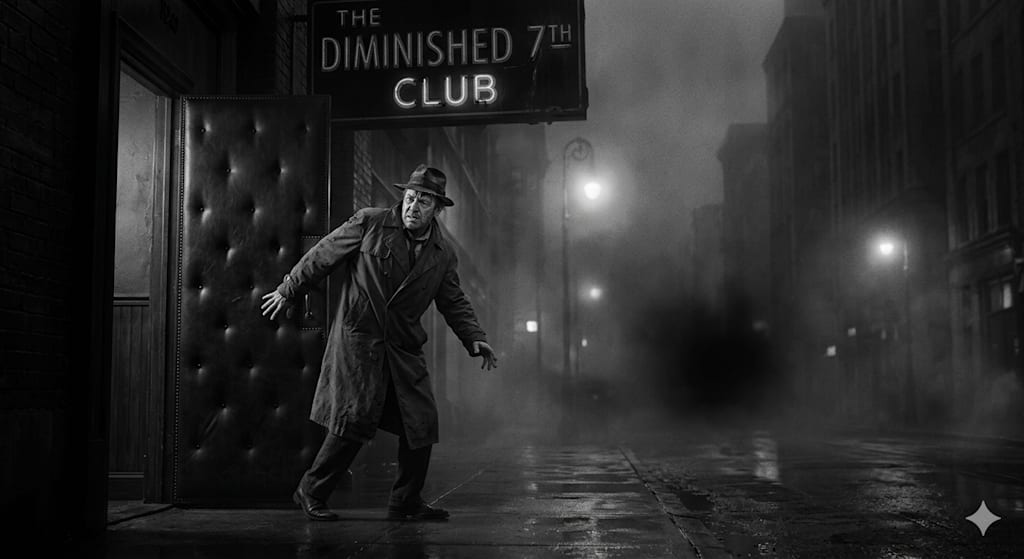
The Mist parted enough to reveal a jagged neon sign bleeding a bruised purple into the fog. It read: The Diminished 7th Club.
The name itself was a warning. A diminished seventh chord is structure built of stacked minor thirds—a harmonic house of cards with no true root, no tonal center, completely unstable and desperate to resolve. The perfect name for a sanctuary of damned. I pushed through the heavy, padded leather door, expecting the thick smell of stale gin and the numbing embrace of oblivion.
Instead, I stepped into a vacuum of eerie, unmoored terror.
The club was a cavern of velvet and cigarette smoke, illuminated by low-wattage bulbs that struggled against the encroaching dampness of the city’s Vapor. On the cramped corner stage, a modern jazz quintet was in the middle of a set that felt less like music and more like a vivisection. The upright bass player was hunched over his instrument, his fingers tearing at the thick strings, while the saxophonist blew frantic, breathy phrases that shattered against the exposed brick.
As the door swung shut behind me, severing the heavy drone of the street, the atmospheric pressure in my skull inverted. The band sizzled in the Locrian mode.
If Phrygian is the sound of a man standing on a crumbling ledge, Locrian is the sound of the man after the ledge has given way, suspended in the horrifying, weightless void of the fall. It is the only diatonic mode with a diminished tonic triad. The perfect fifth—that single, stable pillar of the Phrygian mode—flattened. The foundation was gone. The music was built on the tritone, the devil's interval, a structural failure written into the very mathematics of the sound.
I stumbled to a stool at the end of the scarred mahogany bar. The sound from the stage was tearing at my already frayed nerves. The bass walked a line that deliberately avoided any sense of "home," wandering through a wasteland of flattened seconds and fifths. The piano player dropped jagged, dissonant voicings that hung in the air like rusted shrapnel. It was a masterpiece of auditory entropy. The music was an eerie, unsettled labyrinth, a geometric impossibility that perfectly mirrored the shattered architecture of my own soul.
"Vodka," I rasped to the bartender, a faceless shadow moving in the dim light. "Leave the bottle."
He slid a heavy rocks glass across the wood, followed by a bottle of clear, cheap poison. This was supposed to be the mortar that filled the cracks in my foundation, the chemical leveling agent that would silence the shrieking dissonance in my head. I wrapped my trembling, unhewn fingers around the glass.
The saxophonist hit a sustained, agonizing flat five that vibrated the liquor in my glass. The note hung there, refusing to resolve, refusing to offer even a momentary illusion of peace. It was a raw, naked frequency of absolute instability.
I stared into the clear liquid. The Mist hadn't stayed outside; it had followed me in, curling around the legs of the barstools, weaving through the cigarette smoke. The Locrian mode had stripped away the last of my defenses. I realized with a sudden, horrifying clarity that the grease wouldn't work tonight. You cannot pour liquid mortar into a foundation that no longer exists. Drinking the vodka wouldn't quiet the noise; it would only drag me further into the dissonant void, vibrating at a frequency I couldn't control.
My heart hammered a frantic, syncopated rhythm against my ribs—a polyrhythm of panic and loss. The ghosts of the "Synthesis" were standing in the shadows of the club, their faces redacted by the fog, swaying to the eerie sizzle of the diminished chords.
I released the glass. The condensation left a wet, imperfect circle on the wood.
The piano player struck a final, unresolved chord that hung in the air like a guillotine blade refusing to drop. I couldn't breathe. The atmosphere of the Diminished 7th was a vacuum, sucking the oxygen from my lungs. I slid off the stool, my legs heavy and disconnected from my brain.
"Hey, pal!" the bartender barked, his voice cutting sharply through the lingering decay of the cymbals. "The tab!"
I didn't turn around. I couldn't. The flat fifth was pulling me backward, an undertow of pure entropy. I pushed through the heavy leather door and stumbled back out into the suffocating Vapor of the street, leaving the full glass and the unpaid tab behind. I was utterly destabilized, a Rough Ashlar tumbling blindly through the Mist, praying for the brutal, honest strike of a Master's Gavel before the Locrian void swallowed me forever.
About the Creator
Nathan McAllister
I create content in the written form and musically as well. I like topics ranging from philosophy, music, cooking and travel. I hope to incorporate some of my music compositions into my writing compositions in this venue.
Cheers,
Nathan
Keep reading
More stories from Nathan McAllister and writers in Horror and other communities.
The Legend of Percy Vance
The rain in Alcyone didn’t wash the city; it merely redistributed the soot. It clung to the windshield of Percy Vance’s city-issued sedan, a greasy film that turned the neon signs of the District of Rust into blurred bruises. Inside the car, the heater hummed a discordant note that vibrated against the base of Percy’s skull, a precursor to the "urban tinnitus" he had begun to hear whispers about in the darker corners of the Public Works breakroom.
By Nathan McAllistera day ago in Horror




Comments
There are no comments for this story
Be the first to respond and start the conversation.