
The Doctor Who Chose to Sicken Himself: The Mad, Magnificent Gamble of Barry Marshall
When the entire medical establishment laughed at his theory, one young Australian doctor didn’t just argue his point. He drank a beaker full of lethal bacteria to prove his point—risking his life to cure millions.

We are taught that science is a methodical, slow, and polite process. We imagine data presented in air-conditioned conference rooms, leading to consensus among experts in white coats. We believe that when truth is discovered, the world embraces it with open arms.
We are comforting ourselves with a lie.
True breakthroughs, the kind that fundamentally alter the trajectory of human health, rarely arrive politely. They arrive through conflict. They are driven by underdogs who possess a terrifying level of stubbornness. They are forged by individuals who are willing to look at centuries of accepted "truth" and say, "You are all wrong."
And sometimes, when that isn't enough to move the rigid mountains of establishment, one person must perform an act so radical, so dangerous, and so profoundly unethical, that the world is forced to pay attention.
This is the unbelievable, crazy, and cinematic true story of Barry Marshall—the man who wagered his own life on a hunch, and won a Nobel Prize for the millions of people he saved.
The Gospel According to Acid
To understand the sheer madness of Barry Marshall’s gamble, you must first understand the medical reality of the 20th century. For nearly 100 years, the global medical community operated under one absolute, immutable gospel:
Stomach ulcers were caused by stress.
It was a belief built on simple, observational logic. In an increasingly fast-paced, high-pressure world, people with high-stress jobs developed burning pains in their stomachs. Doctors observed these patients and concluded that the stress led to an overproduction of stomach acid. This acid then "burned" a hole in the stomach lining.
This gospel was absolute. It was taught in every university. It was repeated in every medical journal. It was the foundation of a massive, multi-billion-dollar pharmaceutical industry. Drugs like Tagamet and Zantac, which merely suppressed acid production, were the highest-selling medications on the planet. They didn't cure ulcers; they managed the symptoms, ensuring that an ulcer patient remained a patient for life.
And because the stomach is filled with a pool of hydrochloric acid so potent it can dissolve a zinc nail, science "knew" another absolute truth: No bacteria could possibly survive in the human stomach.
The Impossible Biopsy
In the late 1970s, Barry Marshall was a young, relatively inexperienced medical resident in Perth, Australia. He was paired with a quiet, observational pathologist named Robin Warren. While the world's leading experts were focusing on stress, Warren was focusing on what he was seeing through his microscope.
He was looking at biopsies of patients with severe gastritis and stomach ulcers. And time and time again, he was seeing something that shouldn't exist. He saw bacteria—curved, spiral-shaped organisms—swimming directly in the highly acidic mucus lining of the stomach.
Science said this was impossible. Science said this bacteria was likely a contaminant, something introduced after the biopsy.
But Barry Marshall looked at Warren’s slides and felt a thrill of terrifying insight. He didn't see contaminants; he saw a cause-and-effect relationship. He noticed that wherever this bacteria—later named Helicobacter pylori—was present, the stomach lining was inflamed. Where the bacteria was absent, the lining was healthy.
He formulated a theory so bold it bordered on medical heresy: Spicy food, acid, and stress do not cause ulcers. A bacterial infection does.
Laughter, Mockery, and the Closed Doors
In 1983, Marshall presented his preliminary findings at a medical conference in Brussels. He was excited. He was convinced he had just discovered the key to curing one of the most persistent and painful chronic conditions in humanity.
The medical establishment did not embrace him. They did not applaud.
Instead, they laughed.
Leading gastroenterologists dismissed his theory as preposterous. The very idea that a fragile bacterium could thrive in a pool of acid that can burn through steel was scientifically laughable. Some experts mocked him as a "crackpot" from a remote city in Australia. They argued that even if the bacteria were there, they were harmless passengers, not the cause of the disease.
The resistance was not just intellectual; it was systemic. Medical journals refused to publish his research. Grant-giving bodies denied his applications for funding. The billion-dollar antacid industry had zero interest in a discovery that could replace decades of daily antacid prescriptions with a single, ten-day course of antibiotics.
Marshall was facing the ultimate constraint of science: How do you prove a revolutionary idea when the system is built to suppress it?
The Reckoning with Koch's Postulates
To convince the scientific community, Marshall knew he needed to satisfy a rigorous set of scientific rules known as Koch's Postulates. To prove that H. pylori was the cause of ulcers, he had to:
* Isolate the bacteria from a sick patient.
* Culture that bacteria in a laboratory.
* Infect a healthy host with the cultured bacteria.
* Show that the healthy host developed the exact same disease.
This was the final, brutal blockade. He had isolated the bacteria. He had figured out the excruciatingly complex process of culturing it. But he had no way to perform the crucial third step.
Ethical guidelines made it impossible to deliberately infect another human being with a potentially disease-causing bacteria. He attempted to infect lab animals—piglets and mice—but for reasons no one understood, the H. pylori refused to colonize the stomachs of animals. They were uniquely adapted to survive only in humans.
By 1984, Marshall was drowning in frustration. He was twenty-nine years old, and he knew he held a cure for millions, but the world was letting those people suffer because the rules said he couldn't prove it.
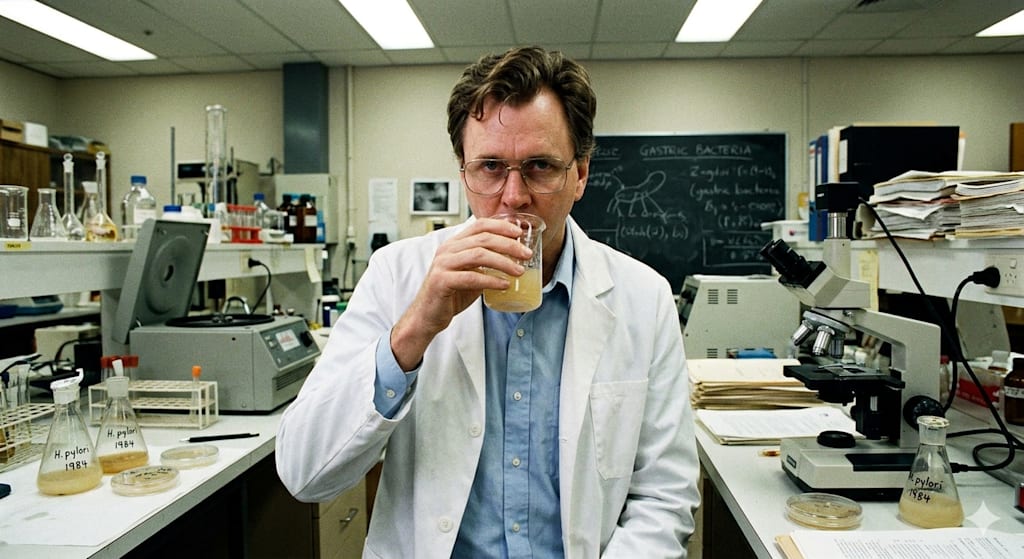
He sat in his lab, staring at a beaker of murky, cloudy liquid. It was a beef broth cocktail teeming with Helicobacter pylori, cultured directly from the stomach of a severely sick ulcer patient.
He had no other options. He was running out of time, money, and professional credibility. He realized there was only one remaining ethical, biological, and practical solution.
If he couldn't infect an animal, he would infect the only human volunteer he had.
The Sip That Changed Medicine
Barry Marshall did not tell the hospital ethics board. He did not tell his department head. Critically, he did not tell his wife, Adrienne, who was at home caring for their four young children.
On a quiet morning in July 1984, Marshall walked into his lab. He took the beaker of bacterial soup, which reportedly contained billions of bacteria. He held it up. He later recalled that he was terrified, well aware that this bacteria could cause chronic infection, lifelong pain, or even potentially set him on a path toward stomach cancer decades later.
But his belief was stronger than his fear. He looked at the cloudy, foul-smelling liquid. He took a deep breath.
And he drank it.
He drank the entire beaker. The sip that would either end his career in absolute humiliation or change human medicine forever.
The Onset of Gastritis
He waited. For the first two days, he felt nothing. He began to worry that the experiment had failed, that his stomach acid had killed the bacteria after all, just as the experts had predicted.
But on day three, the biology of the pathogen took over.
Poon Lim had had to become a predator to survive; Barry Marshall had to become the prey.
Marshall began to develop a nasty, distinctive symptom: severe, chronic halitosis. It was a putrid, foul smell that came from his stomach—a result of the ammonia that H. pylori produces to neutralize stomach acid. He later said his wife, Adrienne, was the first to notice, complaining that he "smelled putrid."
Then came the physical toll.
By day five, he began to suffer from violent nausea. His stomach ached with a deep, burning pain. He spent entire nights vomiting a clear, odorless liquid (the bacteria was consuming all the acid). He was visibly pale, emaciated, and severely ill.
On day ten, he underwent an endoscopy. A gastroenterologist, who was likely horrified by what Marshall was doing, ran a scope down his throat and into his stomach.
The biopsy results were definitive.
The slides that Robin Warren viewed through the microscope showed no ambiguity. The previously healthy, pristine stomach lining of Barry Marshall was now a battlefield of inflammation. It was severely infected with the spiral-shaped bacteria, showing acute, undeniable gastritis. Marshall had successfully fulfilled Koch's Postulates. He had proven that a perfectly healthy person could be infected with H. pylori and that the infection was the direct cause of the gastritis that leads to ulcers.
He treated himself with antibiotics and a bismuth-based antacid. He got cured. But the truth was now a Matter of Record.
The Breakthrough and the $30 Billion Shift
He compiled his data. This was no longer just a resident with a remote hunch; this was direct, clinical evidence. He published his self-experimentation findings in the Medical Journal of Australia.
It didn't happen overnight. The antacid industry fought back hard. Skepticism remained. But the data was undeniable. Other researchers around the world began replicating his work. In 1994, ten years after Marshall drank the beaker, the National Institutes of Health held a major consensus conference and finally, formally declared that the primary cause of stomach ulcers was not stress, but the H. pylori bacterium.
The entire landscape of medicine changed.
The daily, lifelong antacid prescriptions worth billions of dollars were replaced by a single, cheap, ten-day course of antibiotics. Stomach ulcers went from being a chronic, devastating condition to being a curable infection. The discovery single-handedly decimated the market for one of the most profitable drug classes in human history, while simultaneously reducing the world’s incidence of stomach cancer, which is closely linked to H. pylori.
In 2005, more than twenty years after their crazy idea was first mocked, Barry Marshall and Robin Warren were awarded the highest honor in science: The Nobel Prize in Physiology or Medicine.
The Lesson of the Self-Experimenter
Barry Marshall’s story is often sensationalized as a "crazy doctor" who did something reckless. But his act was not born out of recklessness; it was born out of a devastating, profound sense of responsibility.
He didn't make himself sick for fame or the Nobel Prize. He did it because he looked at the medical system and realized it had become a walled garden that was protecting its own dogma at the expense of human suffering. He knew he was holding a cure for millions, and he refused to let the rules of the established order let those people die.
His story is a powerful, difficult challenge to all of us.
We live in a culture that worships comfort and despises risk. We are conditioned to seek consensus, to wait for permission, and to avoid challenging authority. We are sold the idea that being "right" is enough.
Barry Marshall teaches us that being right is almost never enough. Truth requires sacrifice. Progress is often fueled by those who possess the dangerous, magnificent willingness to stand entirely alone against the establishment and, when all arguments fail, to turn themselves into the experiment.
You do not need an office in Harvard to change the world. You do not need the approval of the experts at the beginning of your journey. Sometimes, you just need a belief that is stronger than your fear, and the unyielding, terrifying courage to take the first sip.
About the Creator
Frank Massey
Tech, AI, and social media writer with a passion for storytelling. I turn complex trends into engaging, relatable content. Exploring the future, one story at a time
Keep reading
More stories from Frank Massey and writers in History and other communities.
The Man Who Screamed Into the Void: The Uncomfortable Truth of the Challenger Disaster
On the night of January 27, 1986, the temperature in Brigham City, Utah, was plummeting. Inside his home, an American engineer named Roger Boisjoly sat awake, his stomach knotted with a specific, heavy dread that most people will never experience.
By Frank Massey 3 months ago in History
Carbon dating helped establish the start point of Roman invasion of Britain
For a long time, researchers believed the Roman conquest of Britain started from the northern seaside of modern France, given the shortest distance from the continent to the island. This assumption triggered an extensive search for physical evidence to support the theory, such as a bay or port, or at least a riverside fort with plenty of ancient military artefacts.
By Aurel Stratana day ago in History
Kusliga Vista
“I told you we were going too far off trail,” said Clark. “I thought Ammon said he could read a compass,” said Kit. “Guys, it’s easy, we just need to find a river or stream and follow it. Those things always lead to civilization,” Ammon said and pushed through thick patch of bushes.
By Amos Gladea day ago in Horror


Comments
There are no comments for this story
Be the first to respond and start the conversation.