
Carbon dating helped establish the start point of Roman invasion of Britain
For a long time, researchers believed the Roman conquest of Britain started from the northern seaside of modern France, given the shortest distance from the continent to the island.
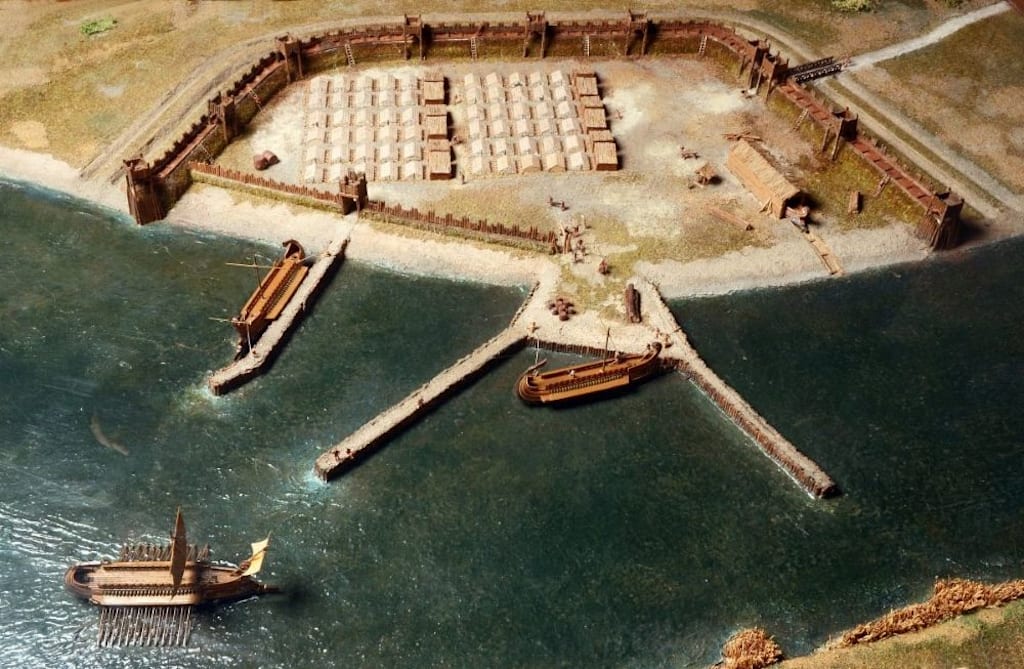
For a long time, researchers believed the Roman conquest of Britain started from the northern seaside of modern France, given the shortest distance from the continent to the island. This assumption triggered an extensive search for physical evidence to support the theory, such as a bay or port, or at least a riverside fort with plenty of ancient military artefacts.
When archaeologists discovered in late 2001 the ruins of an ancient fortress near the Dutch city of Velsen, they thought it was just one of many fortified bases for Roman legionaries defending the empire’s northern flank. Clashes with Germanic tribes were frequent and required a permanent presence of troops in the region.
The size of the excavated structure, as suggested by the Netherlands Research Council, indicates that it was a “castra” — a complex of buildings capable of accommodating thousands of soldiers. The large cache of items used in the Roman army arsenal suggested the place was used as a supply or distribution point for Roman camps scattered across Western Europe.
But they were not aware that it served a greater purpose, playing a crucial role in the conquest of Britain. Until carbon dating was possible.
Carbon dating of the wood used in the construction revealed that it originated in the winter of 42 AD, a few months before the launch of the full-scale invasion into Britain. Roman soldiers crossed what is now called the English Channel, and soon the largest part of the island became a province of the Roman Empire.
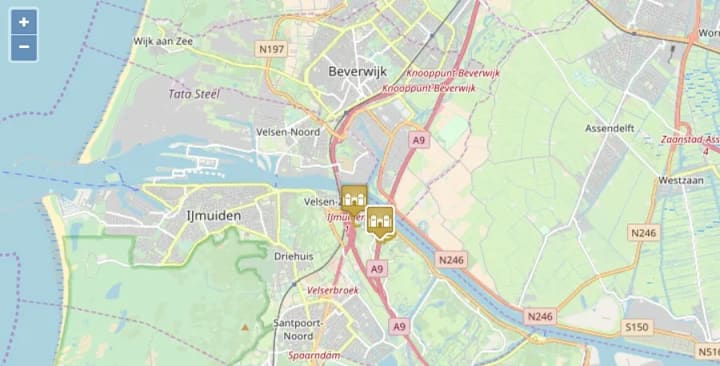
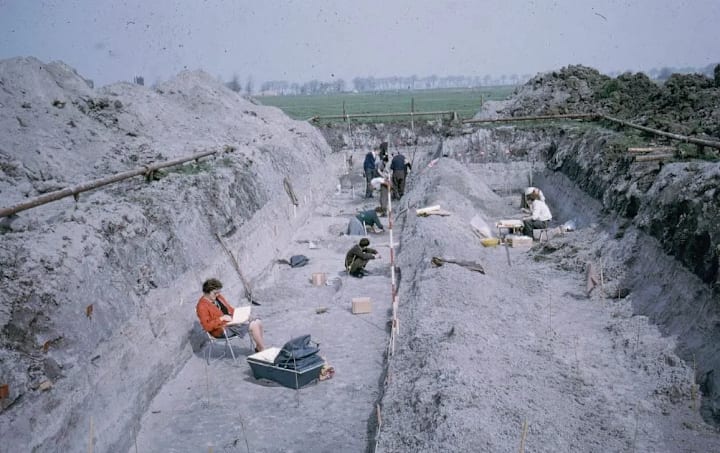
As a matter of fact, the Roman presence near Velsen has been known since 1945 when pottery shards were found in the area. The first fortress (Velsen 1), built in 15 AD and rediscovered in 1972, was the site of a fierce battle: archaeologists found slingshot pellets and human remains. Velsen 1 spread on 2 hectares and could house up to 1,000 troops in former times.
Some researchers suggested that Velsen 1, located 35 km from Amsterdam, was actually the ancient Flevum, a “castellum” or castle, which was almost completely destroyed in Frisian attacks in 28 AD, according to accounts of ancient historian Tacitus.
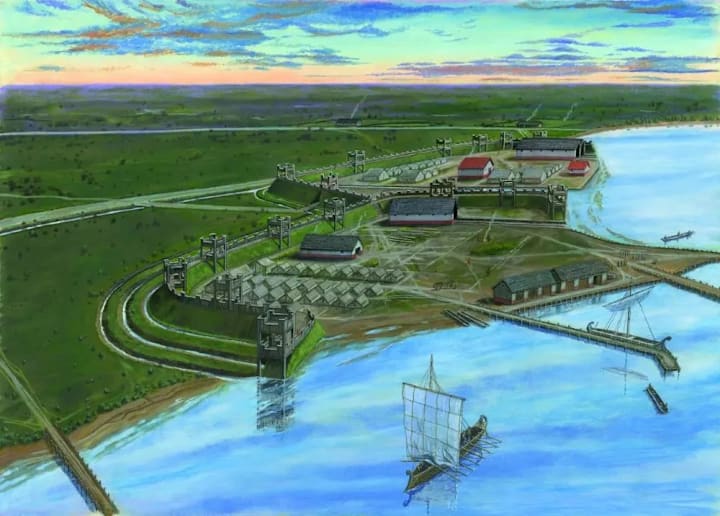
The second, larger fortress (Velsen 2, pictured above) was built near the first one under the orders of Emperor Caligula, the son of General Germanicus, who — lacking military accomplishments — sought to cover himself in military glory by conquering the island. Previously, Julius Caesar had occupied a small part of Britain for a brief period without incorporating it into the empire.
Velsen 2 is also believed to have served as starting point for a military campaign against the Chauci. In their country, general Aulus Gabinius Secundus reconquered the eagle standard of one of the legions that were defeated in the battle in Teutoburg Forest. The second fortress could have housed a garrison consisting of between 5,000 and 6,000 soldiers.
Both fortresses were built on the banks of the Oer-IJ river, a tributary of the Rhine, albeit on different sides.
The aggregated findings lead to one important conclusion: the Velsen area was as a launching point for the Roman army to invade Britain in addition to providing defenses for the northern flank of the fleet from Germanic tribes.
Archaeologists believe that Emperor Caligula personally visited the region to inspect the readiness for the planned invasion. This theory is supported by the discovery of several wine barrels with the initials of the sovereign, burned into the wood and found near Utrecht and Valkenburg.
Caligula, however, did not see his dream fulfilled. He was assassinated by members of the Praetorian Guard before the invasion began in 43 AD, and all the praises for victory were claimed by his successor, Claudius.
There are no records indicating that Germanic tribes ever attacks the second, new fortress — probably due to its size and strength. It was recognized as a structure of Roman origin after 1960 only.
***
This story was first published on my blog NewsCafe and on Medium. Please notify me of broken links.
You may support my writing effort via BuyMeCoffee. Any amount is welcome.
About the Creator
Keep reading
More stories from Aurel Stratan and writers in History and other communities.
An empire born from betrayal
In addressing the motives of the ongoing Russo-Ukrainian war, it is important to know the roots of relationships between Moscow and Kyiv. Here’s a chronicle of the failed Cossack-Muscovite alliance that split Ukraine for centuries and forged Greater Russia.
By Aurel Stratana day ago in History
Something Is Beginning, I Think Challenge Winners
This challenge wasn’t about clean starts. It was about that weird in-between where something is beginning, but no one really knows what yet. A lot of these stories leaned into hesitation, into pauses and false starts and that feeling that something is about to happen but hasn’t quite.
By Vocal Curation Team5 days ago in Resources



Comments
There are no comments for this story
Be the first to respond and start the conversation.