Biographies
The Surgeon of Auschwitz
Dr. Josef Mengele, the Nazi physician known as the Angel of Death, performed horrific medical experiments on over 3,000 twins at Auschwitz, most of whom died from the procedures or were murdered when the experiments concluded, but approximately 200 survived liberation, and their testimonies reveal the full scope of atrocities committed in the name of science, including surgeries without anesthesia, deliberate infection with diseases, attempts to change eye color by injecting chemicals directly into children's eyes, and efforts to artificially create conjoined twins by sewing children together, all conducted by a doctor who whistled opera while selecting victims and who showed more compassion to his dogs than to the human beings he tortured.
By The Curious Writer41 minutes ago in History
How Ali Khamenei Rose to Power and the Impact of His Rule on Iran
The rise of Ali Khamenei to power is deeply tied to one of the most important turning points in modern Middle Eastern history: the Iranian Revolution. His leadership, which lasted from 1989 until his death in 2026, shaped Iran’s political system, society, and international relations for nearly four decades. While supporters viewed him as a defender of Iran’s sovereignty and Islamic identity, critics argue that his rule brought repression, economic hardship, and widespread human rights abuses.
By Sorea Cataabout 6 hours ago in History
215 Children’s Remains Found at Former Residential School
In a sorrowful revelation that has shaken Canada and the world, the remains of 215 children were recently discovered buried on the grounds of a former residential school in British Columbia. This discovery has reignited the painful conversation about Canada’s colonial past and the systemic mistreatment of Indigenous peoples, particularly children, within the residential school system.
By Irshad Abbasi about 12 hours ago in History
The Mysterious Couple of Harappa
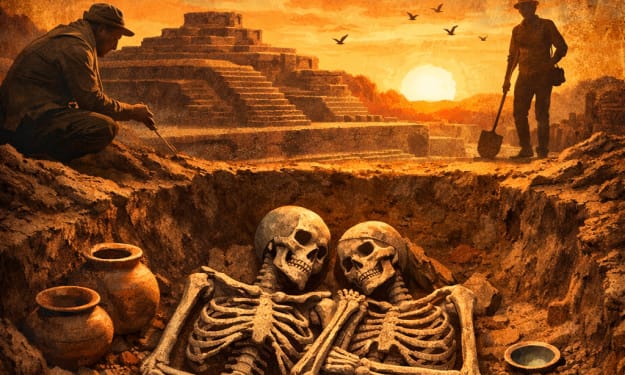
The ancient city of Harappa, once a thriving center of the Indus Valley Civilization, continues to reveal remarkable stories from humanity’s distant past. Among its many discoveries, one of the most intriguing is the burial of a mysterious couple found lying side by side in a grave that dates back more than 4,000 years. This unusual discovery has sparked debate among archaeologists and historians, raising questions about love, ritual, and social customs in one of the world’s earliest urban societies.
By Irshad Abbasi about 12 hours ago in History
The Golden Islamic Era
Insights from Baroness Saeeda The Islamic Golden Age, spanning roughly from the 8th to the 14th century, stands as one of the most remarkable periods of intellectual, cultural, and scientific development in human history. Scholars, scientists, and philosophers flourished in an environment that highly valued learning, reason, and documentation. Among the towering figures of this era, Imam Muhammad ibn Ismail al-Bukhari (810–870 CE) occupies a place of unparalleled significance, not only in Islamic scholarship but in the history of knowledge itself.
By Irshad Abbasi about 16 hours ago in History
From Sanctuary to Symbol of Fear
Article (≈700 words): There are places in the world that once stood as powerful symbols of peace, unity, and human connection. These were spaces where communities gathered not only to worship or reflect, but also to find comfort, belonging, and hope. Over time, however, some of these sanctuaries have undergone tragic transformations. What was once a center of harmony has, in certain cases, become a symbol of fear—its meaning reshaped by conflict, violence, or neglect.
By Irshad Abbasi a day ago in History
The Life and Legacy of Madame de Pompadour
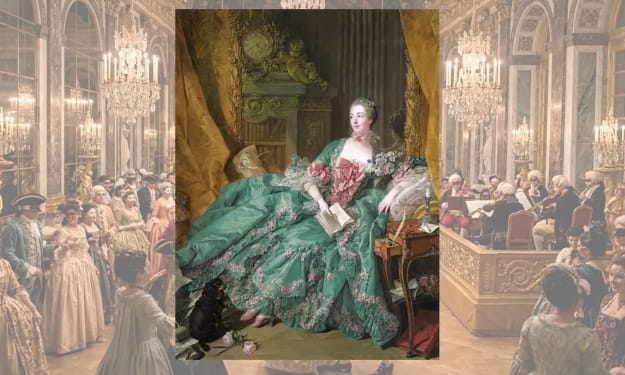
Jeanne-Antoinette Poisson was better known in history as the Marquise de Pompadour. She remains one of the most polarising and fascinating figures ever to grace the halls of Versailles. While the palace is now a museum for the modern masses, in the 18th century, it was a high-stakes arena of power and prestige.
By Sam H Arnolda day ago in History
The Golden Age of Islam
The name Harun al-Rashid often evokes images of dazzling palaces, wise rulers in disguise, and tales filled with intrigue and adventure. Known as one of the most famous Abbasid caliphs, his legacy exists at the crossroads of history and legend. While his reign marked a true golden age of Islamic civilization, much of what people believe about him comes from literary imagination, particularly stories like One Thousand and One Nights. Understanding Harun al-Rashid requires separating documented historical achievements from the myths that later surrounded his name.
By Irshad Abbasi a day ago in History
Princess Yoshiko Kawashima
A Princess Caught Between Worlds Yoshiko Kawashima in her high school days (Wikipedia) Princess Yoshiko Kawashima, born Aisin Gioro Xianyu in 1907, was never destined for an ordinary life. As a descendant of the Manchu Qing Dynasty’s imperial family, she had royal blood running through her veins, but after the dynasty fell in 1912, she was sent to Japan and raised by Naniwa Kawashima, a nationalist with his own ambitions. Stripped from her homeland, she grew up navigating a strange, shifting identity — was she Manchu? Was she Japanese? Or was she simply a survivor?
By J.B. Millera day ago in History
The Baghdad Battery
Archaeologists found clay jars in Iraq containing copper cylinders and iron rods that produce electrical current when filled with acidic liquid, and if they're really batteries, they prove ancient civilizations had technology we thought was impossible until the modern era.
By The Curious Writera day ago in History