
Iran And Israel - The Secret Love Story that turned into a War
Iran And Israel Story

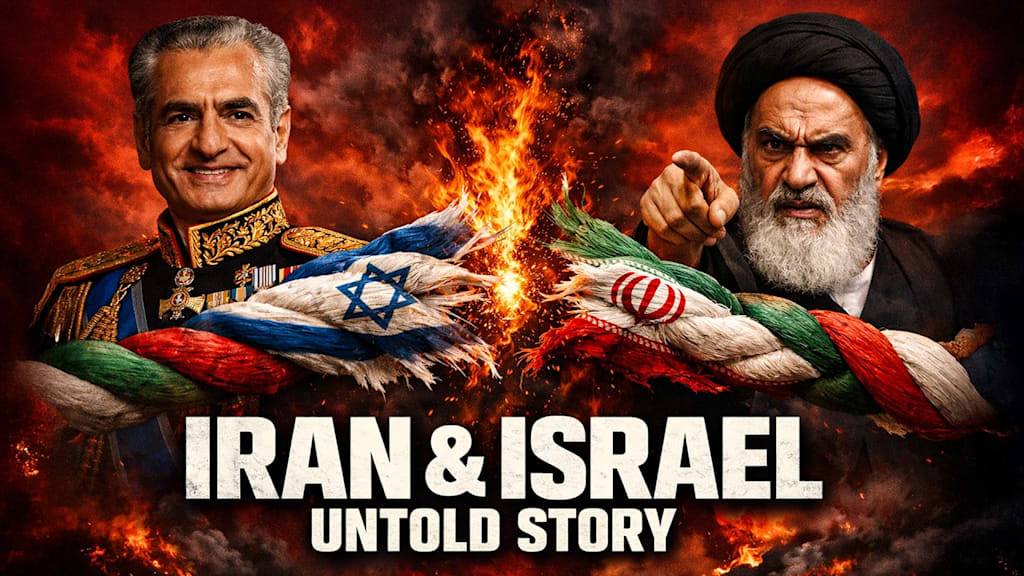
At first, it sounds quite strange that countries which today seem determined to wipe each other out were once extremely close friends. Yes, we are talking about Iran and Israel. This wasn’t just an ordinary friendship—leaders from both sides used to meet secretly, exchange gifts, and even sign hidden agreements. Their relationship was once considered a strong example of cooperation.
What’s even more surprising is that the very nuclear program that is criticized today was actually initiated with help from Israel and the United States. But how did this happen? When did Iran and Israel become friends? Who was jealous of this relationship? Why were weapons still taken from Israel during the Ayatollah regime? And what was the turning point that transformed this deep friendship into hostility?
To understand this, we need to go back in time—when the Middle East looked very different. Before 1922, the region was ruled by the Ottoman Empire, which collapsed after World War I. After that, Britain gained control, and Arab nationalism began to rise. Arabs, newly freed from Ottoman rule, wanted their own independent nations.
However, besides the British and Arabs, there was another powerful country in the region that had issues with Arab nationalism: Iran. At that time, Iran was a strong nation, and its leadership viewed Arabs as inferior. The Shah of Iran feared that if Arab countries united, they could become a threat. It could weaken Iran’s control over the Persian Gulf and increase Sunni influence, while Iran was largely Shia. Historically, there has always been a silent rivalry over who represents Islam.
The Shah, Mohammad Reza Pahlavi, worried that rising Sunni influence might destabilize his rule. But unexpectedly, Iran—feeling isolated—was about to find a powerful ally.
In 1948, the State of Israel was established following a United Nations declaration. Arab nations saw this as an injustice to Palestinians and attacked Israel. While this war threatened Israel’s existence, it also gave Iran an opportunity to counter Arab influence. Iran wasn’t as concerned about Israel as it was about the growing power of Arab nations.
At the same time, Israel realized it needed allies beyond its hostile Arab neighbors. Its first Prime Minister, David Ben-Gurion, introduced a strategy called the “Periphery Doctrine”—forming alliances with non-Arab countries surrounding Arab states. Iran was the most important among them.
This policy laid the foundation of Iran-Israel friendship. In 1950, Iran became the second Muslim-majority country after Turkey to recognize Israel de facto. Though not officially public, Iran allowed Israel to operate a mission in Tehran that functioned like an embassy.
Why did a Muslim country like Iran support Israel? There were three main reasons:
The Shah wanted to modernize Iran and needed advanced technology.
He feared Arab nationalism, especially Egypt’s leader Gamal Abdel Nasser.
Iran was closely aligned with the United States, which supported Israel.
In 1953, when Iran’s Prime Minister Mohammad Mossadegh tried to reduce the Shah’s power, the CIA helped restore the Shah. After that, Iran remained loyal to U.S. interests.
The Shah also created a secret police force called SAVAK to suppress opposition. Israel’s intelligence agency Mossad trained SAVAK agents. The two countries shared intelligence and worked together against communism and Arab militant groups.
Israel provided Iran with advanced weapons, military training, and even collaborated on missile and nuclear technology. Iran’s nuclear program actually began under U.S. support through the “Atoms for Peace” initiative. In 1967, the U.S. provided Iran with its first nuclear reactor, and Israeli experts trained Iranian scientists.
Their relationship wasn’t only military—it was also economic. Israel needed oil, but Arab countries had boycotted it. Iran had oil but no direct route to Israel. So, they built a secret pipeline called the Eilat-Ashkelon Pipeline, bypassing Arab territories and the Suez Canal.
This project allowed Israel to receive oil and Iran to export oil to Europe. It symbolized strong cooperation between the two nations.
Their friendship reached its peak in the 1970s. Israeli experts worked in Iran, direct flights operated, and cooperation flourished in agriculture and technology.
However, everything changed in 1979. The Iranian Revolution led by Ayatollah Khomeini overthrew the Shah and established an Islamic Republic. Khomeini declared Israel an enemy of Islam. The Israeli mission in Tehran was taken over and handed to Palestinian leadership.
This marked the official end of their friendship—but not entirely.
During the Iran-Iraq War (1980–1988), Iran secretly received weapons from Israel again. Israel supported Iran to weaken Iraq, its regional rival.
After the war, Israel began to see Iran’s nuclear program—now under an Islamic regime—as a major threat. This led to a long-standing shadow conflict between the two nations that continues today.
And that was the turning point where a once deep friendship between Iran and Israel was completely buried.
About the Creator
Imran Ali Shah
🌍 Vical Midea | Imran
🎥 Turning ideas into viral content
✨ Watch • Share • Enjoy
Keep reading
More stories from Imran Ali Shah and writers in History and other communities.
The Man Who Vanished in front of 134 People in Sahara part 2
The sun of the fifth day was about to set when suddenly a sound hit his ears—the sound of a helicopter. He felt his prayers had been answered. Without wasting time, Prosperi took out his flare gun and fired a signal to get the pilot's attention. But perhaps nature had other plans. The light of the setting sun was so bright that the flash of the flare was drowned out. The pilot didn't see him, and the helicopter vanished from sight.
By Imran Ali Shah6 days ago in History
Middle East War: Next Phase Incoming
Middle East War Update: A Dangerous New Phase May Be Approaching The Middle East is once again moving toward a tense and uncertain moment as new developments suggest that the next phase of conflict may be approaching. Military movements, diplomatic warnings, and increased security alerts across several countries have created growing concern among global leaders and analysts. While no official declaration of war has been made, the situation appears to be evolving rapidly, and the coming days may prove critical for regional and global stability.
By Wings of Time 6 days ago in History


Comments
There are no comments for this story
Be the first to respond and start the conversation.