space
Space: The Final Frontier. Exploring space developments and theorizing about how humans fit into the universe.
Are the Memories Lost?
Are the Memories Lost? Journals of a Galactic Traveler I opened my eyes. My head felt like it was being removed from an ethereal memory extraction vise. That feeling of dense, fog-like, frozen particles of a neutron star dragging the very essence of your mind below its ascended cognitive state, held my mind with gravitational like pull against the headrest of the chair.
By Joshua C. Miller3 years ago in Futurism
Could Space Force provide the means to raise a false flag?
A short time before his two-year anniversary in the White House, former American president Donald Trump proudly announced the creation of his country’s first new “armed service” since 1947 through the establishment of the US Space Force.
By Steve Harrison3 years ago in Futurism
Forgotten Legacy
Two years have passed since I began working here. I am a caretaker, but not in the normal way. My job is to oversee the production of wheat for the I.U.G. or Intergalactic Unified Government. Earth has been chosen as a type zero civilization, which means the planet is used for production with an easily countable population. Currently there is one human per landmass, of which there are seven. The wheat makes the planet particularly beautiful with all the golden fields. It is affectionately known as the golden orb by neighboring planets.
By Abraham Boulter3 years ago in Futurism
Why You Should Worry About Black Holes
The sun and stars have always fascinated me. I did a bit of astrophysics as part of my physics undergrad degree. And since then, living on a boat as I do, I’ve spent over 400 nights sailing at sea (and I don’t mean in a harbour or anchorage), many of them spent staring up at the cosmos and wondering about it.
By James Marinero3 years ago in Futurism
Biggest Leap of Human Beings - James Webb Telescope
What is James Webb Telescope? The James Webb Space Telescope (JWST) is a large, space-based observatory that is set to launch in 2021. It is being developed and built by NASA, with significant contributions from the European Space Agency and the Canadian Space Agency. The JWST will be able to observe in the infrared part of the electromagnetic spectrum, allowing it to see through dust clouds and into the early universe. It is considered as the successor of the Hubble Space Telescope. It will be able to study the first galaxies that formed in the early universe, as well as the formation of stars and planets. It will also be able to study the atmospheres of exoplanets, which are planets that orbit stars other than the Sun.
By Pragadees Waran3 years ago in Futurism
Humans Vs Aliens
What is Convergent Evolution of Aliens? The concept of convergent evolution can be applied to the hypothetical idea of extraterrestrial life, or "aliens." If there is other intelligent life in the universe, it is possible that they may have evolved similar adaptations and features to those found on Earth, even if their evolutionary history and environment is vastly different.
By Shiju Bharathan3 years ago in Futurism
Studying a Theoretical Wormhole in a Lab
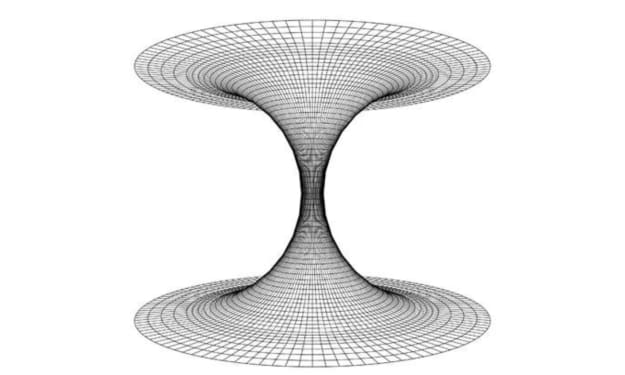
Studying Scientists have observed quantum entanglement-generated phenomena that are consistent with the properties of a traversable wormhole. The results of their study confirm that relatively small quantum systems on quantum computers can be used to study traversable wormhole dynamics providing a potent testbed for theories of quantum gravity.
By Sikandar prasad3 years ago in Futurism
Is There a Mirror World?
In case you are already puzzled, the above image is a logarithmic representation of the observable universe. Notable astronomical objects are annotated. Distance from Earth increases exponentially from center to edge. Celestial bodies were enlarged to appreciate their shapes. Rendered specially for Wikipedia.org by Pablo Carlos Budassi.
By James Marinero3 years ago in Futurism