
Rainwater Harvesting Market Trends: Government Regulations, Water Security & Forecast to 2034
How rising water scarcity, urbanization, and government mandates are accelerating adoption of rainwater harvesting systems across residential, commercial, and industrial infrastructure globally

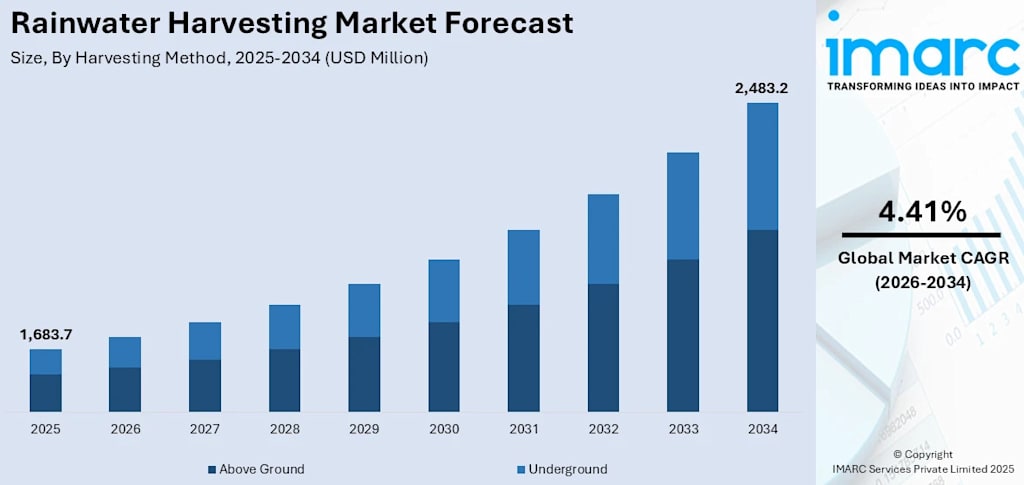
Increasing water scarcity, rapid urbanization, and a global shift toward sustainable infrastructure are accelerating the adoption of rainwater harvesting systems. These solutions offer a decentralized and cost-effective method to reduce reliance on overstrained municipal grids while recharging depleting groundwater reserves. According to IMARC Group’s latest data, the global rainwater harvesting market size was valued at USD 1,683.7 Million in 2025. Looking forward, IMARC Group estimates the market to reach USD 2,483.2 Million by 2034, exhibiting a CAGR of 4.41% from 2026-2034.
The rainwater harvesting sector has evolved into a critical pillar of global water security, with systems now integrated into residential complexes, industrial parks, and agricultural zones. The market is supported by the rising demand for non-potable water for irrigation and industrial cooling, alongside the increasing frequency of drought conditions in major economies. With the United Nations reporting that over 2 billion people currently live in water-stressed regions, the move toward "catching the rain" has transitioned from an eco-friendly choice to a regulatory and survival necessity. Innovations in modular storage, smart filtration, and IoT-enabled monitoring are further enhancing the efficiency of these systems, making them more accessible to a broader range of users.
Rainwater Harvesting Market Growth Drivers:
- Escalating Global Water Scarcity and Stress
As freshwater reserves dwindle, nearly 50% of global cities are currently facing significant water stress. This environmental pressure forces municipalities and private owners to seek alternative sources. Rainwater harvesting serves as a proactive buffer, potentially offsetting 20% to 40% of potable water demand in commercial buildings with large catchment areas. With over 70% of freshwater consumed by agriculture and urban activities, the ability to capture and store localized rainfall is essential. The market's valuation at over USD 1.6 billion reflects this urgent transition toward self-sufficient and climate-resilient water infrastructure.
- Mandatory Building Codes and Regulatory Support
Governments worldwide are increasingly mandating rainwater capture for new constructions to mitigate urban flooding and conserve resources. Approximately 28% of global building codes now include specific requirements for rainwater harvesting or reuse systems. For instance, in regions like India, the "Model Building Bye-Laws" mandate these systems for all new residential projects. These regulations, combined with financial incentives such as tax rebates and grants, significantly lower the barrier to entry for developers. Such policy-driven frameworks ensure steady market expansion by making sustainable water management a non-negotiable standard in modern urban planning.
Get Your Free "Rainwater Harvesting Market" Strategic Insights Report
- Rising Demand in the Residential and Agricultural Sectors
The residential segment remains a primary driver, generating substantial revenue as homeowners prioritize lower utility bills and eco-friendly features. Recent surveys indicate that 77% of homebuyers now prioritize sustainable features, directly boosting the demand for rain barrels and modular tanks. Simultaneously, the agricultural sector is adopting large-scale surface runoff harvesting to ensure crop survival during erratic rainfall patterns. By utilizing cost-effective storage solutions, such as polyethylene tanks which account for 61% of global demand, users can maintain productivity without depleting local aquifers, reinforcing the market’s utility across diverse demographics.
Rainwater Harvesting Market Trends:
- Integration of Smart Technologies and IoT Monitoring
The industry is witnessing a rapid shift toward intelligent water management. Modern systems now incorporate IoT-based sensors, automated first-flush diverters, and remote pump controllers to optimize collection and quality. For example, some advanced setups have improved catchment efficiency by over 15% through automated valve controls. These "smart" features allow users to monitor water levels and filtration health in real-time via mobile apps. This trend toward digitalization appeals to tech-savvy consumers and industrial managers seeking high-precision data to meet sustainability targets and manage decentralized water supplies more effectively across large-scale facilities.
- Focus on Nature-Based and Green Infrastructure
There is a growing preference for integrating harvesting systems with green roofs, permeable pavements, and rain gardens. This holistic approach helps manage stormwater runoff while naturally filtering water through soil and vegetation. These nature-based solutions can achieve a 40% reduction in municipal water reliance for landscaping and non-potable uses. Cities are increasingly funding these "sponge city" concepts to combat the "urban heat island" effect and prevent sewer overflows during heavy storms. By combining traditional storage with biological filtration, developers are creating multifunctional landscapes that provide both aesthetic value and environmental utility.
- Market Premiumization and Advanced Filtration Systems
As consumers become more discerning about water quality, there is a rising demand for premium filtration components, including UV sterilization units and multi-stage carbon filters. The market for these specialized accessories is expanding, with hundreds of millions of units sold annually as users move beyond simple irrigation to high-quality non-potable applications like laundry and toilet flushing. This trend toward premiumization is supported by the adoption of durable, high-capacity modular storage tanks and underground cisterns. Brands are emphasizing longevity and "clean-label" water quality, positioning advanced harvesting systems as a sophisticated investment for long-term property value.
Recent News and Developments in Rainwater Harvesting Market
- July 2025: GRAF Group announced a significant expansion of its sustainable energy program, investing in new internal technologies to produce greener stormwater and wastewater management solutions, reinforcing its commitment to circular water economies.
- September 2025: In India, the Ministry of Jal Shakti intensified its "Jal Shakti Abhiyan: Catch the Rain" campaign, establishing Jal Shakti Kendras across all districts to provide technical guidance and support for low-cost harvesting structures at the community level.
- January 2026: The San Francisco Public Utilities Commission expanded its Green Infrastructure Grants, allocating USD 150,000 to support residential installations of rainwater cisterns and permeable pavements to enhance urban water resilience.
Note: If you require specific details, data, or insights that are not currently included in the scope of this report, we are happy to accommodate your request. As part of our customization service, we will gather and provide the additional information you need, tailored to your specific requirements. Please let us know your exact needs, and we will ensure the report is updated accordingly to meet your expectations.
About the Creator
Andrew Sullivan
Hello, I’m Andrew Sullivan. I have over 9+ years of experience as a market research specialist.
Keep reading
More stories from Andrew Sullivan and writers in Futurism and other communities.
Fin Fish Market Trends: Eco-Friendly Farming, Consumer Demand Shift & Industry Forecast to 2034
Rising health awareness, changing dietary preferences, and a significant shift toward lean protein sources are fueling the global demand for fin fish. This growth is further supported by advancements in aquaculture technology, such as Recirculating Aquaculture Systems (RAS), and a rising consumer preference for sustainably sourced seafood. According to IMARC Group’s latest data, the global fin fish market size was valued at USD 209.0 Billion in 2025. Looking forward, IMARC Group estimates the market to reach USD 284.6 Billion by 2034, exhibiting a CAGR of 3.38% from 2026-2034.
By Andrew Sullivana day ago in Futurism
The Fears of AI And How Much Fun It Can Be
ChatGPT has come a long way, as has AI in general. There are those people who are scared of it, and for understandable reasons. People fear that as technologies advance, they’ll be replaced in the workforce. Then, there are the fears that AI could evolve into something that brings us to the brink of extinction.
By Jason Morton4 days ago in Futurism
Agriculture Termite Control Market Worth USD 3.7 Bn by 2035 at 7.1% CAGR
Overview The Global Agriculture Termite Control Market is projected to grow from USD 1.9 billion in 2025 to approximately USD 3.7 billion by 2035, expanding at a compound annual growth rate (CAGR) of 7.1% during the forecast period from 2026 to 2035. Agriculture termite control encompasses a variety of products and techniques used by farmers to safeguard crops against subterranean and drywood termites.
By Hayden Kulas4 days ago in Futurism
Something Is Beginning, I Think Challenge Winners
This challenge wasn’t about clean starts. It was about that weird in-between where something is beginning, but no one really knows what yet. A lot of these stories leaned into hesitation, into pauses and false starts and that feeling that something is about to happen but hasn’t quite.
By Vocal Curation Team2 days ago in Resources



Comments
There are no comments for this story
Be the first to respond and start the conversation.