
Fin Fish Market Trends: Eco-Friendly Farming, Consumer Demand Shift & Industry Forecast to 2034
How eco-friendly aquaculture practices, certification standards, and regulatory frameworks are driving sustainability and influencing purchasing decisions in the fin fish market

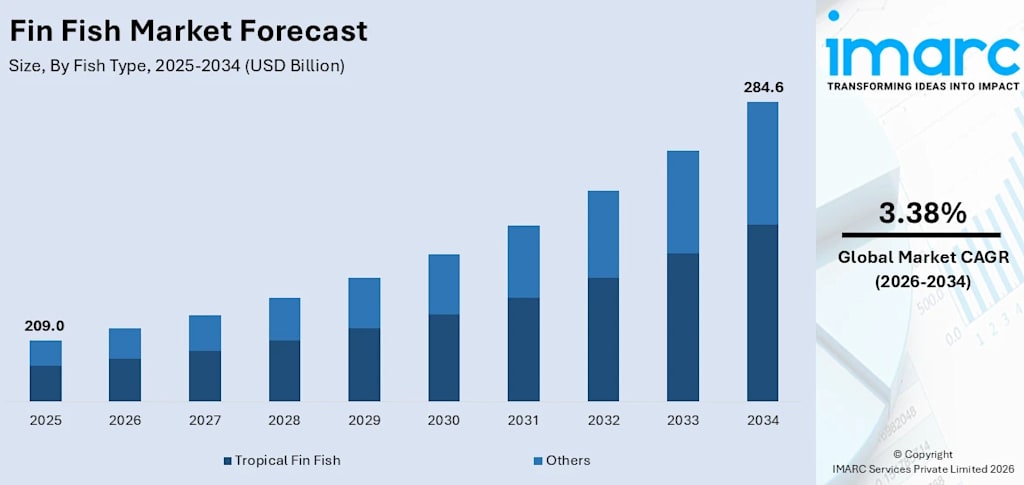
Rising health awareness, changing dietary preferences, and a significant shift toward lean protein sources are fueling the global demand for fin fish. This growth is further supported by advancements in aquaculture technology, such as Recirculating Aquaculture Systems (RAS), and a rising consumer preference for sustainably sourced seafood. According to IMARC Group’s latest data, the global fin fish market size was valued at USD 209.0 Billion in 2025. Looking forward, IMARC Group estimates the market to reach USD 284.6 Billion by 2034, exhibiting a CAGR of 3.38% from 2026-2034.
The fin fish sector has evolved into a critical pillar of the global food economy, surpassing the USD 200 billion mark as consumers pivot away from red meat. Modern market dynamics are defined by a surge in "clean label" seafood and high-value species like salmon, tuna, and tilapia. With per capita fish consumption hitting record highs reaching approximately 20.5 kg globally the industry is seeing rapid expansion in both fresh and frozen segments. Retailers are responding by enhancing cold-chain logistics, while the rise of e-commerce has made premium, sushi-grade, and responsibly farmed fin fish accessible to urban populations worldwide, prioritizing transparency and nutritional density.
Fin Fish Market Growth Drivers:
- Rising Global Demand for Lean Protein and Omega-3s
Consumers are increasingly choosing fin fish as a primary protein source due to its dense nutritional profile, rich in heart-healthy omega-3 fatty acids, vitamins, and minerals. This shift is particularly visible in North America and Europe, where health practitioners recommend at least two servings of fish weekly to combat lifestyle diseases. Current data indicates that the global appetite for species like mackerel and trout has risen significantly, with retail demand for packaged healthy fish products increasing by 14% recently. This consistent push for wellness-oriented dieting ensures a steady flow of investment into high-protein fish varieties.
- Technological Breakthroughs in Precision Aquaculture
The transition from traditional fishing to high-tech "smart farming" is a massive driver for the industry. Innovations like automated feeding systems, AI-driven health monitoring, and advanced sonar for biomass estimation are maximizing yields while reducing overhead costs. For instance, Recirculating Aquaculture Systems (RAS) saw a 22% increase in production volume last year, totaling 2.6 million metric tons. These closed-loop systems allow for year-round production regardless of geographical location, providing a consistent supply of fresh fin fish to landlocked markets and reducing the industry's reliance on unpredictable wild-catch seasons.
- Expansion of E-commerce and Cold Chain Logistics
The convenience of "click-to-door" seafood delivery is transforming how fin fish reaches the end consumer. Specialized online platforms and grocery apps have solved the historical challenge of maintaining freshness through significant investments in ultra-low-temperature logistics. In markets like China and South Korea, online sales now represent a substantial portion of fresh seafood transactions. This digital shift allows smaller, premium producers to reach a global audience directly, bypassing traditional wholesalers. Enhanced traceability tech, such as QR codes on packaging, further builds consumer trust by providing real-time data on the fish’s origin and harvest date.
Fin Fish Market Trends:
- Sustainability and "Blue Economy" Initiatives
There is a powerful trend toward ethical sourcing and eco-labeling as consumers demand transparency regarding the environmental impact of their food. Major retailers are now committing to 100% certified sustainable seafood, favoring farms that utilize carbon-neutral energy and responsibly sourced feed. Government support is also surging; for example, India’s 2026-2027 budget allocated a record USD 315.54 million specifically for fisheries and aquaculture infrastructure. These "Blue Economy" policies encourage the adoption of eco-friendly practices, such as biofloc technology, which minimizes water exchange and nutrient waste, aligning commercial profitability with environmental stewardship.
- Rise of Value-Added and Ready-to-Cook Formats
The "busy lifestyle" trend has birthed a lucrative segment for value-added fin fish products, such as pre-marinated fillets, fish burgers, and heat-and-eat seafood bowls. Manufacturers are focusing on portion-controlled, boneless options that cater to single-person households and health-conscious professionals. Real-world applications show a high uptake in urban centers where consumers want the benefits of a home-cooked fish meal without the preparation time. This trend is supported by packaging innovations that extend shelf life without the need for artificial preservatives, keeping the product's "fresh" appeal intact while meeting the demand for maximum convenience.
- Diversification into Alternative and Lab-Grown Seafood
A fascinating shift is occurring as the market explores hybrid and cultivated seafood solutions to meet the supply-demand gap. While traditional fin fish remains dominant, the industry is seeing the first wave of lab-grown tuna and mahi-mahi entering pilot phases in the U.S. and Singapore. Concurrently, there is a trend toward "forgotten" or underutilized species to prevent over-reliance on salmon and tuna. This diversification helps stabilize prices and ensures food security. Brands are increasingly marketing these alternatives as "mercury-free" and "ocean-friendly," appealing to the most environmentally conscious demographic of the seafood-buying public.
Recent News and Developments in Fin Fish Market
- February 2026: The Indian Government announced its highest-ever budget outlay for the fisheries sector, totaling over USD 315 million, aimed at modernizing aquaculture infrastructure and supporting the Pradhan Mantri Matsya Sampada Yojana (PMMSY) scheme.
- September 2025: A major European seafood conglomerate successfully launched a large-scale land-based salmon farm using 100% recirculating water technology, significantly reducing the carbon footprint associated with traditional sea-cage farming.
- July 2025: The "Stronger America Through Seafood" (SATS) campaign intensified its lobbying efforts for federal legislation to streamline offshore fin fish aquaculture in the U.S., aiming to decrease reliance on imported seafood.
Note: If you require specific details, data, or insights that are not currently included in the scope of this report, we are happy to accommodate your request. As part of our customization service, we will gather and provide the additional information you need, tailored to your specific requirements. Please let us know your exact needs, and we will ensure the report is updated accordingly to meet your expectations.
About the Creator
Andrew Sullivan
Hello, I’m Andrew Sullivan. I have over 9+ years of experience as a market research specialist.
Keep reading
More stories from Andrew Sullivan and writers in Futurism and other communities.
Carmine Market Insights: Cosmetics Industry Growth, Natural Pigments & Industry Forecast to 2034
Rising interest in natural alternatives to synthetic dyes, alongside a global push for clean-label transparency, is fueling the demand for carmine. This shift is particularly evident in the food, beverage, and cosmetic sectors, where brands are moving away from petroleum-based colorants in response to consumer health concerns and updated safety regulations. According to IMARC Group’s latest data, the global carmine market size was valued at USD 60.0 Million in 2025. Looking forward, IMARC Group estimates the market to reach USD 94.5 Million by 2034, exhibiting a CAGR of 5.02% from 2026-2034.
By Andrew Sullivana day ago in Futurism
The Fears of AI And How Much Fun It Can Be
ChatGPT has come a long way, as has AI in general. There are those people who are scared of it, and for understandable reasons. People fear that as technologies advance, they’ll be replaced in the workforce. Then, there are the fears that AI could evolve into something that brings us to the brink of extinction.
By Jason Morton4 days ago in Futurism
Scones
Alright, let's not fuck about - here is what you need: Ingredients: 350g self raising flour 90g butter pinch of salt tsp of baking powder 3 tbsp caster sugar (or just normal white sugar would probably be fine) 175ml milk a squeeze of lemon a drop of vanilla an egg fresh strawberries, if they're in season Extra flour Even more flour Dried fruit (I consider this completely optional and usually leave it out)
By L.C. Schäfer5 days ago in Feast




Comments
There are no comments for this story
Be the first to respond and start the conversation.