
Carmine Market Insights: Cosmetics Industry Growth, Natural Pigments & Industry Forecast to 2034
How increasing adoption in food, beverages, and cosmetics, along with sustainability concerns, is shaping innovation and competitive dynamics in the carmine market

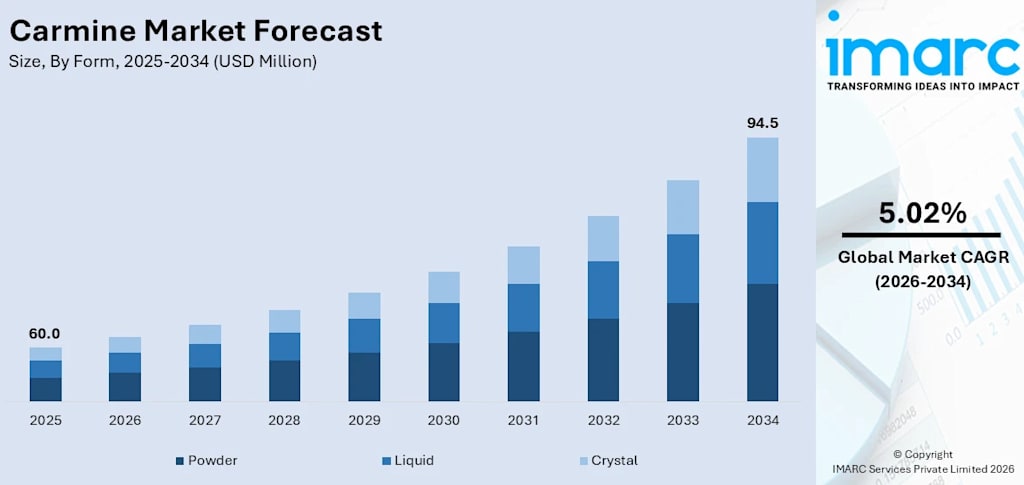
Rising interest in natural alternatives to synthetic dyes, alongside a global push for clean-label transparency, is fueling the demand for carmine. This shift is particularly evident in the food, beverage, and cosmetic sectors, where brands are moving away from petroleum-based colorants in response to consumer health concerns and updated safety regulations. According to IMARC Group’s latest data, the global carmine market size was valued at USD 60.0 Million in 2025. Looking forward, IMARC Group estimates the market to reach USD 94.5 Million by 2034, exhibiting a CAGR of 5.02% from 2026-2034.
Carmine has transitioned from a niche traditional pigment to a critical component of the modern multi-million-dollar natural colorant industry. Extracted from cochineal insects, it remains one of the most stable and vibrant natural red pigments available, outperforming many plant-based alternatives in terms of heat and light resistance. Demand is increasingly driven by the "clean label" movement, where shoppers prioritize recognizable, naturally derived ingredients over artificial additives like Red 40. Key applications span across dairy products, such as strawberry yogurts and flavored milks, as well as premium confectionery, meat processing, and high-end cosmetics where color intensity is paramount
Carmine Market Growth Drivers:
- Accelerated Shift Toward Natural Food Colorants
Consumers are increasingly wary of synthetic additives, often linking them to behavioral issues in children or long-term health risks. This skepticism has pushed food manufacturers to reformulate iconic products using carmine to achieve deep red and pink hues. In the United States, major brands have already pledged to eliminate petroleum-derived dyes by the end of 2026. Because carmine offers superior stability in high-heat applications compared to beet or anthocyanins, it has become the go-to solution for the bakery and meat industries, which currently utilize a significant portion of the global supply.
- Stringent Regulatory Pressure on Synthetic Dyes
Regulatory bodies like the FDA and EFSA are tightening the leash on artificial colorants. For instance, the FDA’s 2025 initiatives to phase out certain synthetic dyes have forced a massive industry pivot toward "exempt-from-certification" colors like carmine. In the European Union, the mandatory "Southampton Six" warning labels for specific artificial dyes have made natural alternatives a commercial necessity rather than a choice. These legislative environments create a protective moat for the carmine market, ensuring steady demand from multinational corporations that require globally compliant, safe, and standardized coloring agents for their diverse product portfolios.
- Expanding Footprint in the Premium Cosmetics Sector
The beauty industry is experiencing a "natural-only" renaissance, where carmine is prized for its high pigment load in lipsticks, blushes, and eye shadows. Unlike many botanical pigments that fade quickly or change color when exposed to skin oils, carmine maintains its vibrancy, making it a staple for luxury cosmetic brands. Data indicates that the personal care segment is growing rapidly as consumers seek "clean beauty" products. This is further supported by the rising purchasing power in Asia-Pacific, where urban consumers are shifting toward premium, naturally-pigmented makeup, significantly boosting the demand for high-purity carmine extracts.
Carmine Market Trends:
- Technological Advancements in Extraction and Purity
Innovation is focusing on making carmine more versatile for diverse manufacturing needs. Modern extraction techniques now allow for the production of carmine in various forms liquid, powder, and water-soluble to suit everything from clear beverages to dense dairy products. In 2025, several leading producers introduced deodorized and taste-neutral carmine variants, resolving historical issues where the extract might subtly affect a product's flavor profile. These refinements ensure that carmine can be used in sensitive applications like delicate pastries or flavored waters without compromising the sensory experience, broadening its appeal to high-end artisanal food producers.
- Supply Chain Resilience and Sourcing Transparency
With production concentrated heavily in regions like Peru, which supplies over 80% of the world's cochineal, the market is seeing a trend toward vertical integration and long-term sourcing contracts. Companies are now emphasizing "ethical harvesting" and traceability to satisfy eco-conscious consumers. By securing direct relationships with farmers, major color houses are stabilizing prices and ensuring a consistent supply despite environmental fluctuations. This trend is vital for the pharmaceutical industry, which relies on carmine for coating tablets and supplements and requires a transparent, high-quality supply chain to meet strict medical-grade purity standards and safety certifications.
- Rise of Hybrid Formulations and Specialized Blends
Rather than using carmine as a standalone ingredient, manufacturers are increasingly blending it with other natural pigments like annatto or turmeric to create a wider spectrum of warm shades, such as corals and deep oranges. This customization allows brands to create "signature" colors that are difficult to replicate. Furthermore, the development of "acid-stable" carmine has opened new doors in the beverage industry, specifically for carbonated drinks and fruit juices where lower pH levels previously caused natural pigments to precipitate or degrade. These specialized formulations are essential for capturing the burgeoning market for functional and wellness-focused drinks.
Recent News and Developments in Carmine Market
- September 2025: A leading European dairy conglomerate announced the complete removal of artificial dyes from its yogurt lines, replacing them with carmine-based blends to maintain the visual appeal of its fruit-flavored products.
- January 2026: Peru-based exporters reported a 15% increase in carmine shipments to the Asia-Pacific region, driven by the rapid expansion of the processed meat and confectionery sectors in China and Southeast Asia.
- March 2026: Several major cosmetic brands launched "Heritage Red" collections, specifically highlighting the use of ethically sourced carmine to appeal to the growing demographic of consumers who favor traditional, time-tested natural pigments over synthetic lab-made dyes.
Note: If you require specific details, data, or insights that are not currently included in the scope of this report, we are happy to accommodate your request. As part of our customization service, we will gather and provide the additional information you need, tailored to your specific requirements. Please let us know your exact needs, and we will ensure the report is updated accordingly to meet your expectations.
About the Creator
Andrew Sullivan
Hello, I’m Andrew Sullivan. I have over 9+ years of experience as a market research specialist.
Keep reading
More stories from Andrew Sullivan and writers in Futurism and other communities.
Power Electronics Market Insights: Renewable Integration, Efficiency Standards & Industry Forecast to 2034
Rising energy efficiency requirements, the transition to electric mobility, and the rapid expansion of renewable energy infrastructure are the primary catalysts for the global power electronics market. The sector is benefiting from the shift toward wide-bandgap semiconductors like Silicon Carbide (SiC) and Gallium Nitride (GaN), which offer superior thermal management and reduced power loss compared to traditional silicon. According to IMARC Group’s latest data, the global power electronics market size reached USD 34.6 Billion in 2025. Looking forward, IMARC Group expects the market to reach USD 53.1 Billion by 2034, exhibiting a CAGR of 4.87% during 2026-2034.
By Andrew Sullivan2 days ago in Futurism
The Fears of AI And How Much Fun It Can Be
ChatGPT has come a long way, as has AI in general. There are those people who are scared of it, and for understandable reasons. People fear that as technologies advance, they’ll be replaced in the workforce. Then, there are the fears that AI could evolve into something that brings us to the brink of extinction.
By Jason Morton4 days ago in Futurism
The Silent Shift: How AI-Native Infrastructure Is Rewriting the Internet’s Future
In the early days of the internet, websites were static brochures—digital placeholders that conveyed information but offered little intelligence. Over time, they evolved into dynamic systems powered by databases, APIs, and increasingly sophisticated front-end experiences. Yet, what we are witnessing today is not just another evolutionary step. It is a fundamental rewrite of how the internet itself operates—an era defined by AI-native infrastructure.
By Jeffrey Mathew7 days ago in Futurism
Swan
“During the Metal Age, humans took photographs of everything beautiful, which was everything, yet machines did not even wear shoes. The Fauxna thought of a better way. They colored all of the light rose, for a corrupted source cannot be verified.” - Origin Parable, 011
By Nicky Frankly2 days ago in Fiction



Comments
There are no comments for this story
Be the first to respond and start the conversation.