
Anti-Counterfeit Packaging Market Trends: Digital Watermarking, Invisible Security Features & Industry Forecast to 2034
How security inks, covert features, and digital watermarking technologies are strengthening multi-layer protection strategies in anti-counterfeit packaging systems

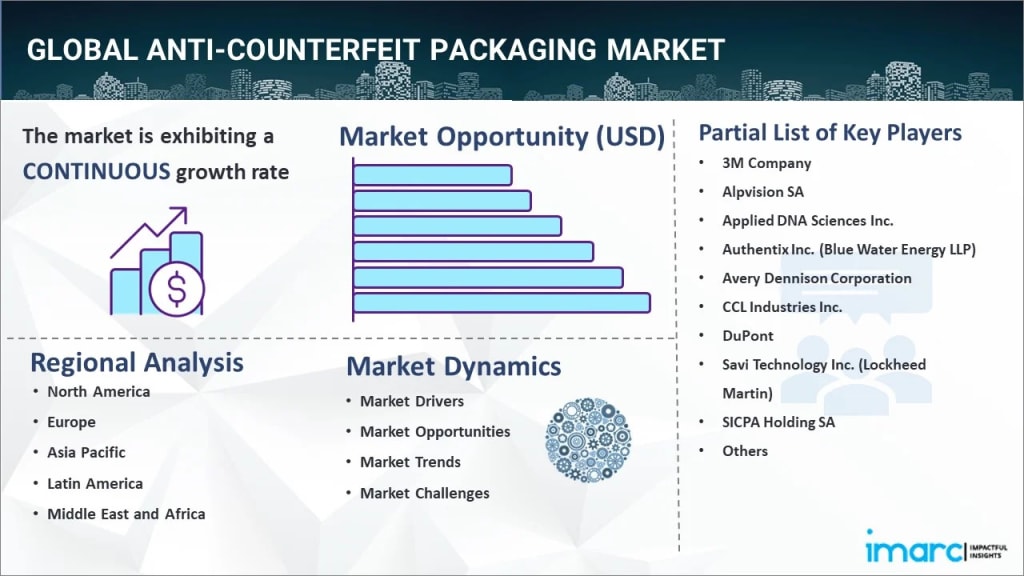
The global anti-counterfeit packaging market has emerged as a critical line of defense for brands facing an increasingly sophisticated landscape of illicit trade and product forgery. Beyond simple labels, modern solutions integrate complex digital and physical layers to ensure that everything from life-saving medications to high-end electronics reaches the consumer in its intended, authentic state. According to IMARC Group’s latest data, the global anti-counterfeit packaging market size was valued at USD 150.8 Billion in 2025. Looking forward, IMARC Group estimates the market to reach USD 356.0 Billion by 2034, exhibiting a CAGR of 9.72% from 2026-2034. North America currently dominates the market, holding a significant market share of over 41.4% in 2025.
Anti-counterfeit packaging now represents a massive global infrastructure that safeguards billions of dollars in trade across the pharmaceutical, food and beverage, and luxury sectors. The adoption of these technologies is no longer a luxury but a regulatory necessity, particularly in healthcare, where the World Health Organization (WHO) estimates that 1 in 10 medical products in developing countries are substandard or falsified. Market growth is further accelerated by the explosion of e-commerce, which has created more "blind spots" in the supply chain where fakes can slip through. To counter this, companies are moving toward "Phygital" solutions combining physical tamper-evidence with digital track-and-trace features like RFID and blockchain to provide a transparent, end-to-end history for every single unit produced.
Get Instant Access to Your Free "Anti-Counterfeit Packaging Market" Research Sample
Anti-Counterfeit Packaging Market Growth Drivers:
- Escalating Global Product Forgery and Brand Dilution
The sheer volume of counterfeit goods moving through international trade routes is a massive catalyst for market expansion. Reports indicate that global trade in fake products accounts for roughly 2.3% of total world imports, with sectors like electronics and luxury apparel losing billions in annual revenue. To protect their bottom line and reputation, brands are investing heavily in overt features like holograms and covert features like invisible inks. This drive for brand protection ensures that consumers receive genuine products, thereby maintaining long-term loyalty and preventing the financial bleeding caused by unauthorized replicas in the marketplace.
- Stringent Regulatory Mandates and Government Compliance
Governments worldwide are enforcing strict laws to secure supply chains, particularly in the healthcare sector. In the United States, the Drug Supply Chain Security Act (DSCSA) mandates an interoperable, electronic system to identify and trace prescription drugs at the package level. Similarly, the EU’s Falsified Medicines Directive (FMD) requires mandatory serialization and tamper-evident features on most medicine packs. These legal frameworks force manufacturers to adopt high-tech packaging solutions, such as unique 2D barcodes and mass encoding, to meet compliance standards and avoid heavy penalties or market exclusion.
- Rapid Expansion of E-commerce and Last-Mile Risks
The shift toward online shopping has decentralized the traditional retail supply chain, making it easier for counterfeiters to reach consumers directly. With the e-commerce market continuing its double-digit growth, the risk of "last-mile" tampering or product switching has surged. Consequently, logistics providers and retailers are integrating RFID and NFC tags into packaging to enable real-time tracking and instant authentication via smartphones. This ensures that even in a complex, multi-layered delivery network, the integrity of the product is verifiable by the end consumer, building a necessary layer of trust in digital transactions.
Anti-Counterfeit Packaging Market Trends:
- Integration of AI-Driven Authentication and Digital Watermarking
Artificial Intelligence is transforming how field agents and consumers verify products. Modern packaging now utilizes digital watermarks—imperceptible to the human eye but readable by smartphone cameras—that provide instant, cloud-based verification. In 2025, industry leaders like Digimarc launched mobile apps that allow stakeholders to detect fakes in real-time using standard mobile devices. These AI-driven platforms analyze unique printing patterns or micro-text to identify anomalies, offering a scalable and cost-effective way to monitor global distribution channels without requiring specialized, high-cost laboratory equipment or forensic-level hardware.
- Shift Toward Sustainability and Eco-Friendly Security Materials
There is a growing movement to align security features with environmental goals. Traditionally, tamper-evident seals and holographic films were difficult to recycle, but newer innovations focus on "green" anti-counterfeit solutions. Companies are now developing security inks derived from natural sources and biodegradable tamper-evident tapes that do not compromise the recycling process of paper or plastic containers. For instance, the rise of paper-based packaging with embedded security fibers allows brands to meet both their ESG (Environmental, Social, and Governance) targets and their security needs, appealing to the modern, eco-conscious consumer.
- Adoption of Blockchain for Immutable Supply Chain Traceability
Blockchain technology is being paired with smart packaging to create a permanent, tamper-proof record of a product’s journey. By linking an RFID tag or a serialized QR code to a blockchain ledger, every participant in the supply chain—from the factory to the pharmacy—can record and verify a product's movement. This "digital twin" approach prevents unauthorized diversion and ensures that any attempt to re-enter a counterfeit item into the legitimate stream is flagged immediately. This trend is particularly dominant in the luxury spirits and high-end cosmetics markets, where provenance and authenticity are paramount to the product's value.
Recent News and Developments in Anti-Counterfeit Packaging Market:
- February 2026: Avery Dennison inaugurated its AD InsightX studio in Pune, India, serving as a co-creation hub specifically focused on developing sustainable and functional anti-counterfeit solutions like smart labels and tamper-evident seals for the South Asian market.
- January 2026: A major pharmaceutical collaboration announced the pilot of "Forensic DNA Inks," which are virtually impossible to replicate, providing a new layer of covert protection for high-value biologic drugs sensitive to counterfeiting.
- September 2025: Nestlé and other global CPG leaders participated in a cross-industry initiative to standardize QR-code-based authentication across European markets, simplifying the verification process for consumers while enhancing supply chain transparency.
Note: If you require specific details, data, or insights that are not currently included in the scope of this report, we are happy to accommodate your request. As part of our customization service, we will gather and provide the additional information you need, tailored to your specific requirements. Please let us know your exact needs, and we will ensure the report is updated accordingly to meet your expectations.
About the Creator
Andrew Sullivan
Hello, I’m Andrew Sullivan. I have over 9+ years of experience as a market research specialist.
Keep reading
More stories from Andrew Sullivan and writers in Futurism and other communities.
Dialysis Market Insights: Hemodialysis Innovations, Enhanced Treatment Efficiency & Industry Forecast to 2034
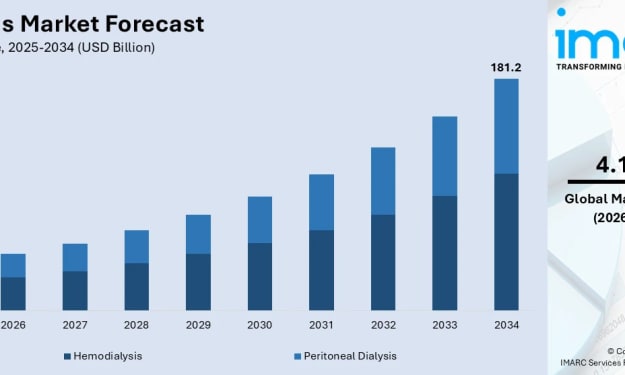
Rising prevalence of chronic kidney disease, an aging global population, and a surge in lifestyle-related conditions like diabetes and hypertension are fueling the global dialysis demand. This growth is further supported by the shift toward home-based renal care, favorable government reimbursement policies, and continuous technological breakthroughs in portable hemodialysis and automated peritoneal systems. According to IMARC Group’s latest data, the global dialysis market size was valued at USD 125.8 Billion in 2025. Looking forward, IMARC Group estimates the market to reach USD 181.2 Billion by 2034, exhibiting a CAGR of 4.14% from 2026-2034. North America currently dominates the market, holding a market share of over 41.0% in 2025.
By Andrew Sullivan14 days ago in Futurism
The Fears of AI And How Much Fun It Can Be
ChatGPT has come a long way, as has AI in general. There are those people who are scared of it, and for understandable reasons. People fear that as technologies advance, they’ll be replaced in the workforce. Then, there are the fears that AI could evolve into something that brings us to the brink of extinction.
By Jason Morton4 days ago in Futurism
A New Dawn: Why 2028 and 2050 Are the Most Important Dates in Human History 🚀🌌
I grew up with my eyes glued to the screen, following the crews of Star Trek and the teams of Stargate 🖖. While many of my peers were obsessed with Jedi Knights (who, to be honest, I never really cared for), I dreamed of a world where technology, science, and sheer determination would allow us to truly reach for the stars. Today, in April 2026, I am watching with fascination as the line between fiction and reality finally blurs. We are the generation that will not only witness the construction of bases on other celestial bodies but will likely personally participate in the digital revolution making it possible. 👨🚀✨
By Piotr Nowaka day ago in Futurism


Comments
There are no comments for this story
Be the first to respond and start the conversation.