
A New Dawn: Why 2028 and 2050 Are the Most Important Dates in Human History 🚀🌌
From Sci-Fi Dreams to Lunar Reality: How AI and Robotic Pioneers are Building Our Future Among the Stars

I grew up with my eyes glued to the screen, following the crews of Star Trek and the teams of Stargate 🖖. While many of my peers were obsessed with Jedi Knights (who, to be honest, I never really cared for), I dreamed of a world where technology, science, and sheer determination would allow us to truly reach for the stars. Today, in April 2026, I am watching with fascination as the line between fiction and reality finally blurs. We are the generation that will not only witness the construction of bases on other celestial bodies but will likely personally participate in the digital revolution making it possible. 👨🚀✨
Moon 2028: Our Gateway to Other Worlds 🌙🏗️
In my opinion, the pivotal moment will be 2028. That is when, according to current schedules, we will begin the permanent construction of infrastructure on the Moon. Yesterday’s successful launch of the Artemis II mission 🚀 proved there is no turning back—we are going there to stay! The Artemis program isn't a 1960s rerun; it’s not a short sprint for a flag and some rocks. It is the laying of the foundation for the Artemis Base Camp.
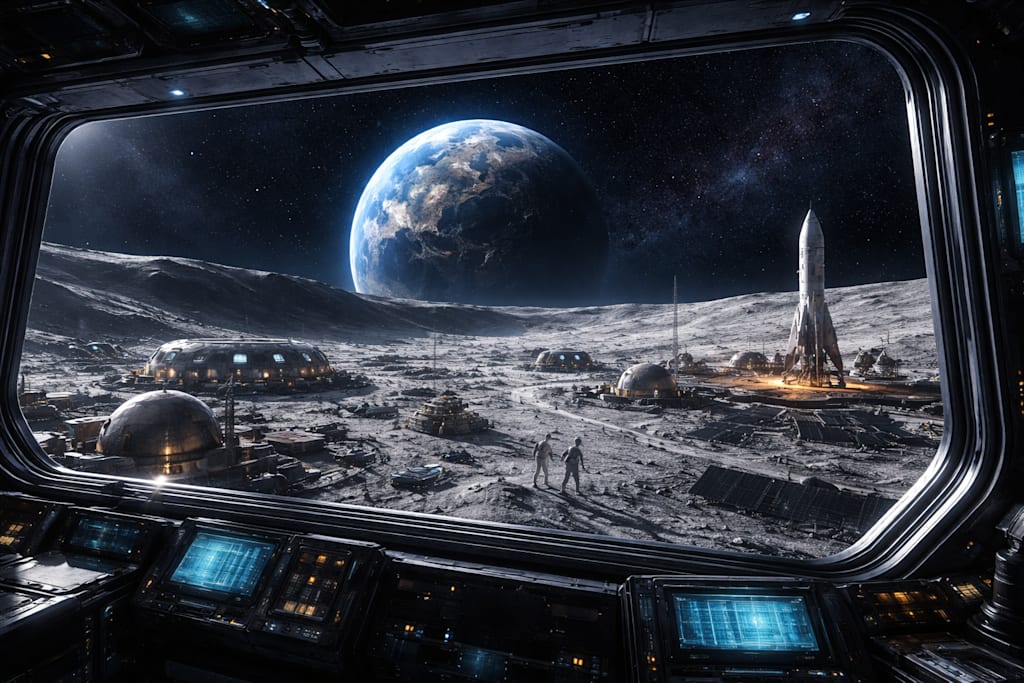
Why is the Moon so important? Because it’s our proving ground 🧪. If we want to think about traveling through "Stargates" to the farther reaches of the system, we must first learn to live where there is no air and help from Earth is three days away. In 2028, the first lunar habitats and solar power plants ☀️ will rise on the Moon's South Pole. There, we will learn to extract ice from permanently shadowed craters, turning it into water and fuel. For me, this is a dream come true—the sight of a real, bustling base that looks like something straight out of Deep Space Nine 🛸.
Mars 2050: The Ultimate Goal 🔴☄️
If the Moon is our stopover, Mars is the ultimate goal of my generation. The year 2050 is a date that ignites the imagination. Although the journey there takes months, not days, it is around the middle of the 21st century that we have the chance to see the first self-sustaining colony 🧱.
Building on Mars is a challenge of a different scale. The distance forces upon us something that has always fascinated me in sci-fi: total autonomy 🤖. There is no room for error there, and any delay in supplies from Earth could be a death sentence. That is why the Martian mission will be the ultimate test of our technology. But before the first human sets foot on the red dust as part of a permanent settlement, the era of robotic pioneers awaits us.
Robotic Pioneers: AI is Learning from Us 🤖🧠📸
This brings me to the point that intrigues me most: how will these bases actually be built? The answer: by the hands of robots that think more and more like us. I’ve noticed a fascinating connection between today’s flood of video content and the development of AI.
Currently, the billions of POV (point-of-view) recordings uploaded to the web aren't just for entertainment 📱. They have become a massive dataset for artificial intelligence algorithms. Thanks to a technique called Imitation Learning, robots no longer need to be tediously programmed line by line. They "watch" hundreds of thousands of hours of footage where humans perform precise manual tasks—from operating tools to repairing complex mechanisms 🛠️.
By sending robots to the Moon in 2028, we are sending machines that, thanks to POV training, can adapt to their environment. They will do the "dirty work":
3D Printing Structures: They will use regolith (space dust) to build thick radiation shields 🏠.
Resource Exploitation: They will autonomously search for water and minerals, making decisions in milliseconds 💎.
Base Maintenance: They will be our mechanical counterparts, preparing the ground for the crew's arrival 👷♂️.
A Type I Civilization 🌍➡️🌌
For a Star Trek fan, it’s clear that we are striving to become a civilization that masters its planetary system. The synergy between humans and AI is the key to this leap. The robots building bases on the Moon and Mars aren't just tools—they are an extension of our will and intelligence 🧠.
I often think about how what used to be just a TV script for me is now a part of my reality. 2028 on the Moon and 2050 on Mars are not just numbers on a calendar. They are milestones on the path that humanity began walking thousands of years ago while looking at the stars—a path that we, thanks to robotics and AI, finally have a chance to travel.
We don't need Star Wars. We need star-spanning cooperation between humans and machines. And that is exactly what is happening! 🤝✨
About the Creator
Piotr Nowak
Pole in Italy ✈️ | AI | Crypto | Online Earning | Book writer | Every read supports my work on Vocal
Keep reading
More stories from Piotr Nowak and writers in Futurism and other communities.
My Digital Conscience on the Line: How AI Watched My Hands in the Factory 🛠️🤖
Before I packed up my life in England and headed for the sunny shores of Italy ✈️🇮🇹, my daily reality was measured in hundreds of black and teal plastic components. I worked in a plastic manufacturing plant—a place where, theoretically, simple forms and repetition rule the day. It was there, on the production line for Makita power tool cases, that I first realized Artificial Intelligence isn’t just for Silicon Valley developers 💻. It’s a technology that has already "put on its high-vis vest" and is working side-by-side with us on the factory floor. 🏭
By Piotr Nowak4 days ago in Futurism
The Fears of AI And How Much Fun It Can Be
ChatGPT has come a long way, as has AI in general. There are those people who are scared of it, and for understandable reasons. People fear that as technologies advance, they’ll be replaced in the workforce. Then, there are the fears that AI could evolve into something that brings us to the brink of extinction.
By Jason Morton4 days ago in Futurism
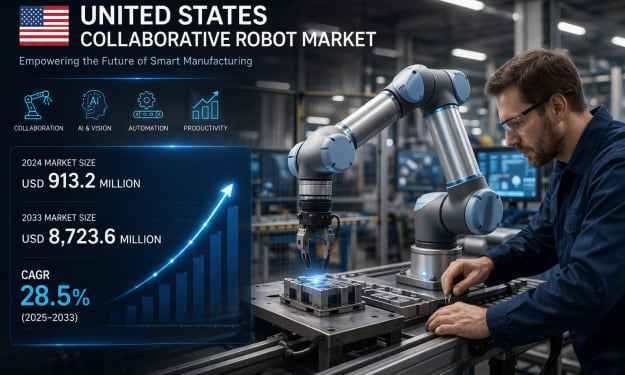
United States Collaborative Robot Market Transforming Automation In Various Industries
Most of the collaborative robots (cobots) are designed to work alongside‚ not replace‚ humans․ Unlike customary industrial robots or industrial robots operating in semi-structured or unstructured environments‚ they are intended to share the workspace with a human worker in a collaborative relationship․ This can make them more appealing for businesses that want flexible automation without undertaking a complete overhaul․
By michael matthew8 days ago in Futurism



Comments
There are no comments for this story
Be the first to respond and start the conversation.