
City of plague:A New Yorker’s pandemic chronicle Pt 18.
Humanity in Hard Times
One evening, my phone rang unexpectedly.
The caller ID showed the name Mr. Li, president of the Southern Hometown Association. I knew him well. He was a respected figure in the Chinese community—calm, thoughtful, and never someone who called without a reason.
“Kaide, it’s me, Li,” he said softly. “I need your advice about something.”
His voice was gentle, but there was a sense of urgency underneath it. That tone alone made my heart tighten.
“Of course, President Li,” I replied. “Please tell me. If there’s anything I can do, I won’t stand by and watch.”
During those days, the coronavirus was sweeping across New York City like a dark storm. Every headline brought worse news. Hospitals were overflowing. Sirens wailed day and night. My nerves had become unusually sensitive; even the smallest unexpected call could make me uneasy.
Li sighed quietly before speaking again.
“Under the Brooklyn Bridge in Manhattan,” he said, “there are more than ten homeless Chinese men sleeping on the street. They’ve been there for over a week. They desperately need a place to stay.”
His words stunned me.
“Are they long-term homeless?” I asked cautiously. “And what about their health? Are they sick?”
In those early days of the pandemic, every question revolved around the same fear: infection.
If they carried the virus, finding housing would become extremely difficult. As a property manager, I could help arrange apartments, but I certainly couldn’t take risks that might endanger tenants.
“Don’t worry,” Li reassured me immediately. “They were restaurant workers. When the restaurants closed because of the pandemic, they lost their jobs overnight. No income, no place to stay. I’ve already spoken with them personally. None of them seem sick.”
I paused for a moment, thinking.
“President Li,” I finally said, “our company actually has several vacant apartments right now. Some of them are in Chinatown. If necessary, we could rent those units to—”
I suddenly stopped mid-sentence.
The word rent hung awkwardly in the air.
Li understood immediately.
“Don’t worry about the rent,” he said firmly. “Our association will pay. If we don’t have enough funds, I’ll organize donations from members. We won’t make things difficult for you.”
His straightforward response relieved me instantly.
“When do you need the apartments?” I asked.
“I’m not sure yet,” he replied quickly. “If we decide to move them, I’ll contact you again.”
“All right,” I said. “Deal.”
We hung up.
Days passed.
Then a week.
But President Li never called back.
I began to feel uneasy.
What had happened to those homeless men? Were they still sleeping under the bridge? Had anyone helped them?
The thought lingered in my mind like a small stone in my shoe.
Then one afternoon my phone rang again.
It was Li.
“Kaide,” he said apologetically, “I’m sorry. Those men decided not to stay in Chinatown. They were afraid they might get infected there. We’ve already arranged a place for them in Flushing. Sorry to bother you.”
“That’s great news,” I replied sincerely. “What matters is that they have shelter now. Thank you for helping them. You’re truly someone I deeply respect.”
Li chuckled modestly.
“You’re giving me too much credit.”
Later, he told me more about those men.
There were about a dozen of them, ranging in age from their twenties to their fifties. Strong, capable workers. Most of them had come to the United States with limited English skills, so their job options were limited. Many worked in restaurant kitchens in small towns across different states.
Their lives had followed a simple routine: work long hours, save money, and send most of their earnings back home to support family members in China.
Restaurants usually provided meals and shared housing, so their living expenses were minimal.
Some of them lived frugally.
Others spent their paychecks quickly and lived month to month.
Then the pandemic struck.
Restaurants shut down almost overnight.
Owners laid off workers.
Within days, the men lost both their jobs and their housing.
With nowhere else to go, they took buses back to New York City—specifically Manhattan’s Chinatown—hoping to find temporary lodging in cheap family-run hostels while waiting for the pandemic to pass.
But things went wrong quickly.
One man had his wallet stolen.
Another ran out of savings.
By the time they arrived in New York, some of them had literally nothing left.
So they gathered under the Brooklyn Bridge.
Sleeping together in the cold, they tried to protect one another.
Safety in numbers.
It was under those desperate circumstances that the Southern Hometown Association stepped in to help.
After hearing the full story, my respect for President Li grew even deeper.
Fortunately, New York City had many free meal distribution sites during the pandemic.
If you needed food, you could get it—no questions asked.
Age didn’t matter. Income didn’t matter.
Breakfast, lunch, and dinner were available.
For people who had fallen into hardship overnight, these meal programs were a lifeline.
I, however, never went to those places.
I was neither elderly nor homeless. Even though no one would check closely, I knew I didn’t belong there.
Perhaps I could have pretended.
But my conscience wouldn’t allow it.
If I wanted to eat, I had to buy groceries and cook for myself.
Since the pandemic began, supermarkets had become one of the few essential businesses still operating.
While most of the city was shut down, grocery stores remained open, quietly carrying the heavy responsibility of feeding millions.
Large retail chains continued to operate.
But some smaller supermarkets closed temporarily because employees were getting infected by customers.
Under such dangerous circumstances, the grocery stores that remained open became pillars of survival in the city.
Their role felt almost heroic.
Every weekend after staying home all week, I would open my refrigerator and find it nearly empty.
The shelves looked depressing.
Food, after all, is the foundation of life.
Without it, the body weakens.
Without nutrition, the immune system suffers.
And in the middle of a pandemic, a weak immune system could be deadly.
So despite the risks, I had no choice.
I had to go to Chinatown to buy groceries.
Even before reaching New York Mart, I could already see the long line stretching outside the entrance.
The sight was astonishing.
People stood quietly in a winding queue that seemed to disappear around the corner.
Because everyone had to maintain six feet of distance, the line stretched farther and farther.
Head and tail were almost invisible to each other.
But I wasn’t afraid of the wait.
At that moment, just seeing a supermarket open felt like a blessing.
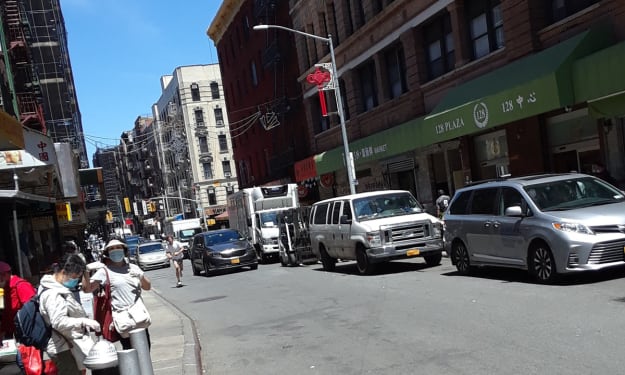
Chinatown had once been packed with businesses.
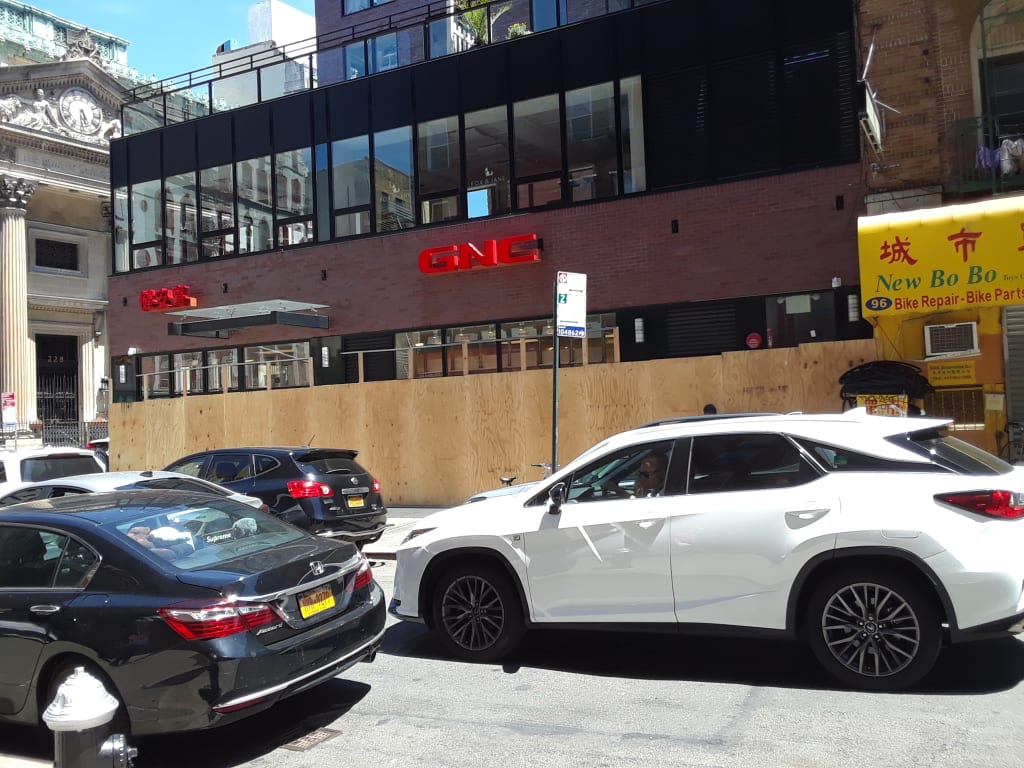
Now, on Mott Street, nearly ninety percent of stores were closed.
Some shops had even boarded up their doors with plywood, sealing themselves off like fortresses.
Only two supermarkets remained open.
Naturally, everyone crowded there.
Nearly two hours later, I finally entered the store.
The first step inside was a temperature check.
Walking through the doors, I felt my heartbeat quicken.
Supermarkets were high-risk places.
Crowded.
Busy.
Impossible to fully maintain social distance.
Every visit felt like entering a battlefield.
I remembered hearing an expert on television warning:
“If someone without a mask coughs in a grocery store, droplets can travel across aisles. People standing ten feet away may still become infected.”
The thought made me nervous.
But once inside, I noticed something reassuring.
Every employee wore a mask.
Cashiers even wore full protective gear—white gowns, gloves, face shields, and goggles.
They looked like hospital workers rather than grocery clerks.
Their careful precautions made me feel safer.
Customers were cautious too.
Almost everyone wore masks.
Many wore gloves.
Some even wore plastic face shields.
The atmosphere was tense, but disciplined.
Slowly, my confidence grew.
I pushed my shopping cart through the produce, seafood, and meat sections.
Immediately I noticed something troubling.
Food choices were far more limited than before.
Variety had shrunk.
Quality wasn’t as good.
And stock levels were clearly low.
Still, I had come all this way.
Leaving empty-handed wasn’t an option.
Even if my preferred foods were gone, I had to find substitutes.
But every time I placed an item into my cart, my heart gave a small jolt.
The prices were shocking.
A box of twelve eggs that once cost $1.25 now sold for nearly five dollars.
Vegetable prices had doubled or even tripled.
Disposable surgical masks were worse.
A box of fifty masks that used to cost ten dollars was now nearly fifty.
N95 masks had jumped from two dollars each to over ten.
The price surge felt almost unbelievable.
I couldn’t tell whether wholesalers had raised their prices, forcing supermarkets to do the same…
Or whether some merchants were simply exploiting the crisis.
In times of disaster, supply and demand often spiral out of control.
Truth becomes hard to distinguish from rumor.
Just like the debates about the virus’s origin—everyone seemed to have a different version.
When I finally finished shopping and walked out of the supermarket, I decided not to dwell on the extra money I had spent.
Instead, I felt grateful.
Despite everything, the store had remained open.
It had given people a safe space to buy food while maintaining some distance from each other.
In a way, we were all helping one another survive.
With that thought in mind, I left the store in surprisingly good spirits.
A few days later, something unexpected happened.
Suddenly, every major news outlet began reporting the same story.
The Chinatown supermarket that had dramatically raised the price of masks had been investigated by the city.
Authorities concluded that it had violated price-gouging laws during the emergency.
The penalty was severe.
Nearly $100,000 in fines.
The news shocked both business owners and residents across New York City.
Within the Chinese community, discussions erupted everywhere.
Some people felt deeply saddened.
Others applauded the punishment.
As for me, I simply felt a mixture of emotions.
In times of crisis, disasters do more than test public health systems.
They reveal something deeper.
They reveal the true nature of human hearts.
About the Creator
Peter
Hello, these collection of articles and passages are about weight loss and dieting tips. Hope you will enjoy these collections of dieting and weight loss articles and tips! Have fun reading!!! Thank you.
The First Rainbow Baby
Pitter-patter, pitter-patter. The rain fell in rhythmic splatters, slowly slowing, but still constant. Mira rolled onto her side pulling the blanket tight against her ears, but still she could hear chitter-chatter and scurrying feet of the creatures that refused to sleep in the lower decks.
By A. J. Schoenfeld5 days ago in Fiction
Author’s Advice
If you would’ve asked me 20 years ago did I know I’d become a writer and an author, I would’ve said “nope, ain’t happening”. As fate would have it I did become an author and I can honestly say I’m loving it so far. It really does feel good to be a writer. I’ve learned a lot on this journey and I feel like with even me being as new to this world as I am, there’s some wisdom I need to share with every other aspiring author.
By Joe Patterson7 days ago in Journal


Comments
There are no comments for this story
Be the first to respond and start the conversation.