Nature
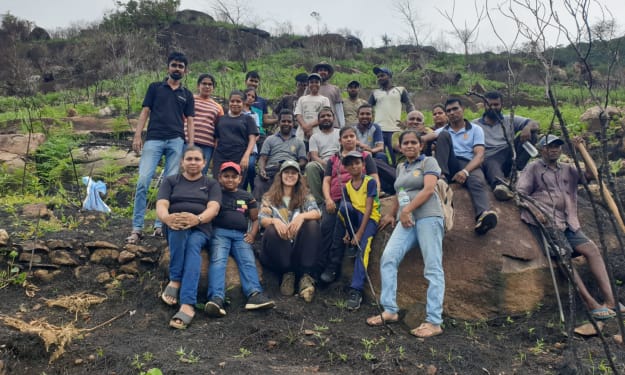
Balangoda Restoration Project: Volunteering for Rainforest Recovery in Sri Lanka. AI-Generated.
In the foothills of Sri Lanka’s wet zone, near the historic town of Balangoda, a quiet but powerful ecological restoration effort is taking shape. The Balangoda Restoration Project, initiated by Rainforest Protectors of Sri Lanka, is working to restore degraded lands back into functioning rainforest ecosystems and volunteers from around the world are invited to be part of this living experiment in regeneration.
By Jayantha Wijesingha18 days ago in Earth
The Bloop
NOAA detected an ultra-low frequency sound in 1997 that matched no known animal or geological phenomenon In the summer of 1997, an array of underwater microphones operated by the National Oceanic and Atmospheric Administration (NOAA) detected an extremely powerful ultra-low-frequency sound originating from a remote point in the South Pacific Ocean west of South America, and the sound, which was nicknamed "the Bloop" because of the blooping noise it made when sped up to be audible to human ears, was so loud that it was detected on sensors over 3,000 miles apart, making it the loudest underwater sound of unknown origin ever recorded, and the frequency pattern and characteristics of the Bloop did not match any known geological phenomena like volcanic activity or earthquakes, but intriguingly it did show characteristics similar to sounds produced by living creatures, specifically matching the frequency profile of sounds made by marine animals, though the Bloop was many times louder than the loudest sounds produced by the largest known animal, the blue whale, leading to speculation that it might have been generated by an enormous unknown marine animal far larger than any creature known to science.
By The Curious Writer18 days ago in Earth
The Great Attractor
Why the Milky Way and thousands of galaxies are being dragged at 1.4 million mph toward something we cannot see In the 1970s, astronomers studying the movement of galaxies through space discovered something that should not exist according to our understanding of how the universe works: our Milky Way galaxy and thousands of neighboring galaxies are being pulled at extraordinary speeds toward a specific region of space located approximately 220 million light-years away in the direction of the constellations Triangulum Australe and Norma, moving at approximately 1.4 million miles per hour toward this location, but when scientists looked at that region of space to identify what massive gravitational source could be pulling such an enormous volume of galaxies, they found nothing visible that could account for the attraction, no super-cluster of galaxies large enough to create the observed gravitational effect, no obvious structure that would explain why thousands of galaxies including our own are streaming toward this point like water circling a cosmic drain. This mysterious phenomenon became known as the Great Attractor, and despite decades of observation and increasingly sophisticated astronomical instruments, we still cannot directly observe whatever is causing this massive gravitational pull, though we have developed theories and collected indirect evidence that suggests the reality is even stranger than the initial mystery implied.
By The Curious Writer18 days ago in Earth
The Wow! Signal
How a 72-second radio burst from deep space shocked SETI scientists and remains unexplained after 47 years On August 15, 1977, at 11:16 PM Eastern time, the Big Ear radio telescope at Ohio State University detected a radio signal from space so powerful, so precisely tuned, and so apparently artificial that astronomer Jerry Ehman, reviewing the computer printout data the next day, circled the signal's alphanumeric designation and wrote "Wow!" in red pen in the margin, giving the transmission its now-famous name and creating what remains the most compelling potential evidence of extraterrestrial intelligence ever detected despite nearly five decades of attempts to find the signal again or explain it through natural phenomena. The signal lasted exactly seventy-two seconds, the maximum time any object could be observed by the Big Ear telescope as Earth's rotation carried that section of sky through the telescope's field of view, and it was detected at a frequency of 1420 megahertz, the exact frequency that hydrogen atoms emit radiation, and this frequency is significant because hydrogen is the most abundant element in the universe and because international agreements prohibit terrestrial radio transmissions at this frequency precisely because scientists believe any intelligent civilization would use this frequency for interstellar communication, making it the logical channel to monitor when searching for alien signals.
By The Curious Writer18 days ago in Earth
Hormuz on Fire
Hormuz on Fire The narrow waters of the Strait of Hormuz have once again become one of the most dangerous flashpoints on Earth. Located between Iran and the Arabian Peninsula, this strategic passage connects the Persian Gulf to the Gulf of Oman and ultimately to the global ocean. Though small in size, the strait carries enormous global importance. Nearly one-fifth of the world’s oil supply passes through this narrow corridor every day.
By Wings of Time 18 days ago in Earth
The Moment Between Rest and Breakthrough
Why Being “Busy” Isn’t Always Moving Forward Lately, I’ve been looking at the sky more than usual. My daughter has started a little routine every evening. She runs outside and asks in her tiny voice, “Mommy, where’s the moon?” Then she squints into the fading light, searching for the first tiny spark of what she calls the sparkling stars.
By Noman Khan 20 days ago in Earth
How Bad Is AI for the Environment, Really?
Artificial intelligence is rapidly becoming part of everyday life. From chatbots and image generators to recommendation algorithms and automated customer service, AI systems are now embedded in countless digital tools.
By Navigating the World20 days ago in Earth
The Last Forest: Witnessing the Destruction of the Amazon and What It Means for Human Survival
The first thing you notice when you stand at the edge of an area where rainforest has been recently cleared is the silence, an absence of sound so complete and unnatural that it seems to press against your eardrums like physical weight, because a healthy rainforest is never quiet, never still, but rather pulses with constant life, the calls of hundreds of bird species layering over insect buzzing and monkey vocalizations and the rustling of creatures moving through the canopy, a symphony of biodiversity that represents millions of years of evolution creating intricate webs of interdependence, and when that forest is cut down, when the chainsaws finish their work and the fires burn out, what remains is a silence that feels like death, because that is exactly what it is, the death of an ecosystem and all the countless beings who called it home. I have stood at that terrible edge dozens of times over the past decade working as an environmental journalist documenting the accelerating destruction of the Amazon rainforest, and each time the silence hits me with fresh force, a reminder of what we are losing, not in some distant future but right now, in this moment, at a pace that should terrify anyone who understands what the Amazon means for global climate stability, biodiversity preservation, and ultimately human survival on this planet.
By The Curious Writer20 days ago in Earth
Iowa Weather Alert: Strong Winds Ease Tonight, But Winter Storm Could Bring Blizzard Conditions Sunday
Residents across eastern Iowa are experiencing an active and rapidly changing weather pattern this weekend. While strong winds are expected to gradually diminish Friday evening, meteorologists are warning that a significant winter storm could impact the region beginning Sunday, potentially bringing snow, powerful winds, and dangerous travel conditions.
By Omasanjuwa Ogharandukun21 days ago in Earth
A Sound Has Been Echoing From the Bottom of the Ocean for 25 Years — And No One Knows What Made It
It started with a sound no one expected to hear. In 1997, deep in the Pacific Ocean, underwater microphones picked up something strange—something powerful enough to travel thousands of miles through the water. The signal was so loud that multiple sensors across the ocean detected it at the same time.
By Noman Khan 21 days ago in Earth
Manaslu Circuit vs. Langtang Valley: Which Nepal Trek Is Right for You?. AI-Generated.
Nepal offers some of the most extraordinary trekking routes in the world. While many travelers focus on famous trails like Everest Base Camp or the Annapurna Circuit, other routes provide equally memorable experiences with fewer crowds.
By Alex Winslow21 days ago in Earth