
Why Industrial Automation and Control Systems Are Becoming the Backbone of Modern Industry
As factories race toward smarter, faster, and more connected operations, industrial automation is shifting from a competitive advantage to a business necessity.

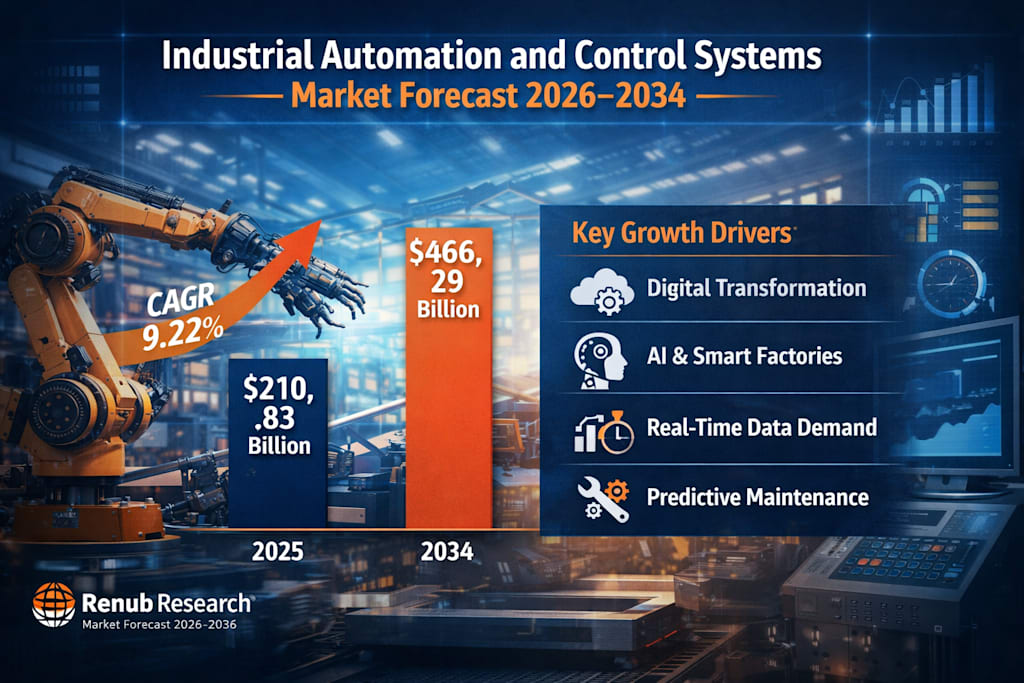
Industrial production is no longer defined only by machinery, labor, and output. It is increasingly being shaped by data, software, connectivity, and intelligent control. Across factories, energy facilities, pharmaceutical plants, oil refineries, and logistics-heavy industries, companies are rethinking how work gets done. At the center of that transformation is one of the most important industrial technology segments of the decade: Industrial Automation and Control Systems.
According to Renub Research, the Industrial Automation and Control Systems Market is projected to grow from US$ 210.83 billion in 2025 to US$ 466.29 billion by 2034, expanding at a CAGR of 9.22% from 2026 to 2034. That is not just a sign of industry growth—it is a sign of structural change across the global economy.
In practical terms, industrial automation is no longer something reserved for large, futuristic factories. It is becoming the operating model for modern industry.
What Industrial Automation and Control Systems Actually Do
Industrial Automation and Control Systems, often shortened to IACS, are the integrated hardware and software platforms used to monitor, automate, and control industrial processes with minimal human intervention. These systems include technologies such as programmable logic controllers (PLCs), supervisory control and data acquisition (SCADA), distributed control systems (DCS), human-machine interfaces (HMI), sensors, industrial communication networks, and intelligent controllers.
That may sound highly technical, but the business value is easy to understand.
These systems help manufacturers and operators:
Reduce manual errors
Improve production consistency
Monitor operations in real time
Detect equipment issues before failure
Increase throughput
Lower energy and maintenance costs
Improve worker and plant safety
In short, automation allows industrial businesses to produce more with greater accuracy and less waste.
That matters more than ever in an economy where downtime is expensive, supply chains are under pressure, and customers expect speed, quality, and reliability.
Why the Market Is Growing So Fast
The biggest reason behind the rapid expansion of this market is simple: industries can no longer afford inefficiency.
For years, many factories and industrial facilities relied on a mix of legacy equipment, isolated control systems, and manual decision-making. That model is now being replaced by a smarter one—where machines, sensors, software, and analytics work together in real time.
As described in the research material, several powerful trends are accelerating adoption, including industrial digitalization, demand for real-time monitoring, predictive maintenance, AI-driven analytics, robotics, and Industrial Internet of Things (IIoT) integration.
The shift is not just technological; it is strategic.
Companies are under pressure to:
Increase productivity without dramatically increasing labor costs
Improve resilience in volatile supply chains
Reduce equipment downtime
Meet sustainability and energy-efficiency targets
Compete in a market where speed and flexibility matter
Automation helps address all of those at once.
That is why the conversation around industrial automation has evolved. It is no longer “Should we automate?” It is increasingly “How fast can we modernize?”
The Rise of Open and Flexible Automation
One of the most important developments in the industry is the move away from rigid, proprietary systems and toward more open, software-defined automation architectures.
Historically, many industrial control environments were built around closed ecosystems. Once a company chose a vendor, it often became expensive and technically difficult to integrate tools from others. That limited flexibility and slowed innovation.
Today, the market is moving in the opposite direction.
Open and vendor-agnostic automation systems allow businesses to connect different devices, software platforms, and applications more easily. This gives manufacturers more freedom to scale, upgrade, and customize operations without being locked into a single provider.
That trend received a strong signal in April 2025, when Schneider Electric introduced its Open Automation Movement, emphasizing more accessible, software-driven, and vendor-neutral industrial automation. According to the supplied market material, this reflects a broader industry push toward interoperability, engineering efficiency, and long-term system resilience.
For businesses, that flexibility matters because the future of industrial operations will not be built around one device or one software suite. It will be built around ecosystems.
AI and Edge Intelligence Are Changing the Factory Floor
If open automation is changing how systems connect, artificial intelligence is changing how they think.
Modern automation is no longer limited to pre-programmed commands and repetitive control loops. Increasingly, industrial systems are being designed to interpret data, recognize patterns, predict outcomes, and optimize operations automatically.
That means factories can now do far more than simply run machines. They can anticipate problems, improve performance, and make near-instant operational decisions.
This is especially important in areas such as:
Predictive maintenance
Machine anomaly detection
Production optimization
Autonomous robotics
Smart logistics and mobility
Real-time process correction
The market data highlights a notable example from March 2025, when Oxa partnered with NVIDIA to advance industrial mobility automation using physical AI and photorealistic simulation. The significance of that move goes beyond autonomous systems—it reflects the increasing role of AI in training, testing, and optimizing industrial processes before they ever reach the physical environment.
This is where industrial automation becomes especially powerful. It does not just automate what people already do. It creates new ways of operating that were previously impossible.
Why Controllers, Networks, and Communication Chips Matter More Than Ever
A smart factory is only as effective as the infrastructure supporting it.
Behind every advanced automation system is a network of controllers, communication modules, and industrial-grade computing hardware that keeps everything synchronized. As industrial operations become faster and more connected, the need for low-latency, high-performance control systems grows sharply.
That is why demand is rising for advanced PLCs, industrial PCs, servo controls, motion systems, and industrial networking solutions.
A clear example came in November 2024, when GigaDevice launched its GD32H75E EtherCAT SubDevice Controller, designed for industrial PLCs, servo control, communication modules, and variable frequency drive applications. Innovations like this are essential because they improve synchronization, speed, and real-time communication across industrial systems.
This may not be the most glamorous side of the market, but it is one of the most important. Automation is only as effective as the infrastructure that powers it.
The Big Challenge: Automation Is Not Cheap
Despite the optimism, the industrial automation story is not without friction.
One of the biggest barriers to adoption is the high initial investment required to deploy advanced automation systems. Implementing PLCs, SCADA, DCS, robotics, sensors, analytics, cybersecurity layers, and modern industrial networking is expensive—especially for small and medium-sized companies.
And the cost is not only about hardware.
The real complexity often comes from integration.
Many industrial businesses still operate legacy equipment that was never designed to communicate with today’s software-defined, data-rich environments. Connecting old and new systems requires engineering expertise, careful planning, and ongoing maintenance.
As noted in the research material, automation rollouts often also require:
Infrastructure upgrades
Workforce retraining
Cybersecurity improvements
Operational redesign
Long-term service and maintenance investment
That is why many companies adopt automation in phases rather than all at once.
The good news is that even partial automation can deliver strong returns. But the reality remains: digital transformation in industry is rarely a plug-and-play process.
Cybersecurity Has Become a Core Industrial Issue
As industrial environments become more connected, they also become more vulnerable.
That is one of the defining tensions in the automation market.
The same connectivity that allows real-time visibility, remote operation, cloud analytics, and AI optimization also creates more opportunities for cyber threats. Industrial environments are especially sensitive because a cyberattack is not just a data problem—it can become a production, safety, and infrastructure problem.
The research highlights this as a major challenge, noting the growing risk of ransomware, unauthorized access, network disruption, and vulnerabilities in legacy systems that were not originally designed with modern cybersecurity standards in mind.
This is why cybersecurity is no longer a separate IT discussion. In industrial settings, it is now part of operational strategy.
The market is already responding. In July 2024, Nozomi Networks introduced Arc Embedded, a security sensor that can be embedded directly within Mitsubishi Electric PLCs, helping teams detect threats and improve operational resilience without disrupting existing networks.
That kind of embedded security is likely to become increasingly standard as automation ecosystems grow more complex.
Which Countries Are Leading the Market?
Industrial automation is a global story, but some markets are standing out more clearly than others.
United States
The U.S. remains one of the most advanced automation markets, driven by adoption across automotive, aerospace, electronics, energy, and food processing. Strong digital infrastructure, AI integration, reshoring efforts, and high investment in smart manufacturing continue to strengthen the country’s leadership.
Germany
Germany continues to be one of the world’s most influential automation markets thanks to its strong engineering tradition and deep manufacturing base. As the birthplace of Industry 4.0, Germany remains central to the evolution of smart factories, industrial robotics, and high-precision control systems.
China
China is arguably the fastest-growing industrial automation market, supported by large-scale manufacturing, rising labor costs, and policy-driven digital transformation through initiatives such as Made in China 2025. The country is rapidly adopting robotics, intelligent machinery, and advanced control systems at scale.
Saudi Arabia
Saudi Arabia is emerging as a significant automation growth market due to industrial diversification efforts under Vision 2030, along with investment in oil and gas, petrochemicals, mining, water treatment, and smart infrastructure.
These country-level shifts matter because they show that automation is not confined to a single region or industry. It is becoming a global industrial standard.
Where the Market Is Heading Next
The next chapter of industrial automation will likely be defined by convergence.
That means the future is not just about machines getting smarter. It is about formerly separate technologies becoming deeply interconnected:
AI + automation
Robotics + edge computing
Cybersecurity + operational technology
Cloud analytics + real-time control
Open platforms + industrial hardware
The winners in this market will likely be the companies that can simplify that complexity.
Businesses do not just want advanced tools. They want systems that are scalable, secure, interoperable, and practical enough to improve performance without disrupting operations.
That is why industrial automation is becoming such a strategic category. It sits at the intersection of efficiency, resilience, intelligence, and competitiveness.
And in a world where industrial margins are tight and operational risk is high, that combination is incredibly valuable.
Final Thoughts
Industrial Automation and Control Systems are no longer a future-facing concept reserved for innovation labs and flagship factories. They are becoming the operating foundation of modern industry.
The companies that invest wisely in automation today are not just upgrading machinery. They are redesigning how decisions are made, how operations are optimized, and how industrial value is created.
With the market expected to climb from US$ 210.83 billion in 2025 to US$ 466.29 billion by 2034, this is clearly more than a passing technology trend. It is a long-term transformation of global production itself.
About the Creator
Why Mexico’s Carpets and Rugs Market Is Growing With Housing and Home Design Demand.
The flooring of a home or office is an often ignored element of design that impacts the use‚ feel and durability of the space․ Carpets and rugs are a less common type of flooring for homes‚ but have become more mainstream in Mexico as people consider comfort‚ looks‚ and design․ Factors such as lifestyle changes‚ economic shifts‚ housing construction‚ renovation‚ and increasing retail penetration are anticipated to augment the market growth of Mexico carpets and rugs in the near future․ According to IMARC Group‚ the Mexico carpets and rugs market was valued at USD 1224․35 million in 2025 and is expected to reach USD 1966․29 million by 2034‚ exhibiting a CAGR of 5․40% during 2026-2034․
By michael matthewabout 14 hours ago in Trader
Why Mexico’s Broom and Mop Market Is Growing Beyond Basic Cleaning Needs
Some markets are not glamorous․ They are close to the everyday life of the customer․ One such market within the cleaning category is the broom and mop market in Mexico․ They are used in the home and in commercial spaces and their purchasing habits are changing due to hygiene considerations‚ urbanization‚ accessibility and the rising demand for more durable and ergonomic cleaning tools․ While customarily monosectoral‚ the category of laundry is becoming more lifestyle‚ performance‚ and sustainability-oriented․
By michael matthewa day ago in Trader
The Cave Part 11
Darkness, and the countless points of light, as if the entire void beyond was filled with the fire of a million stars. I felt as if I was staring into the eternity of a night sky beyond those wooden doors, the place beyond the actual reality, while I stood behind a curtain of scenery, the mountain and sky a mere pretense. And in that void beyond of unfathomable space, there hung suspended a mighty shard of crystal floating in place, with hundreds of a far smaller chunks orbiting around it in balanced but intersecting circles, no two in the same path. These caught the light from the center, and sparkled with inner fire each.
By Jamye Sharp2 days ago in Chapters




Comments
There are no comments for this story
Be the first to respond and start the conversation.