
Vietnam Organic Food Market Set for Strong Growth as Health Awareness and Sustainability Trends Accelerate
Rising consumer consciousness, government support, and eco-friendly farming practices are reshaping Vietnam’s food industry landscape through 2033

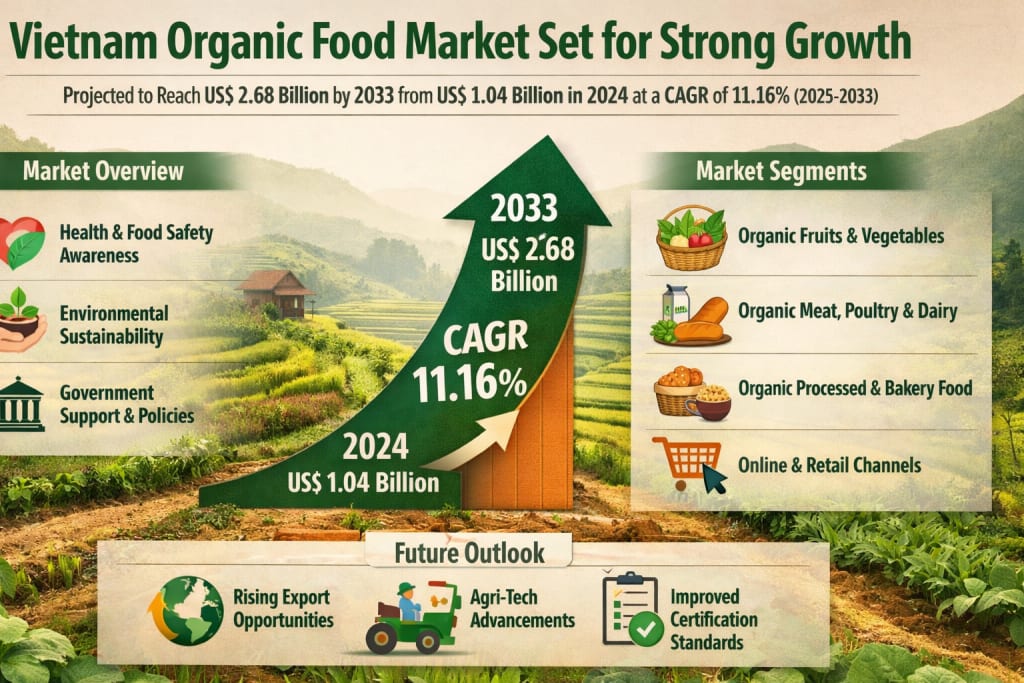
Vietnam’s organic food market is undergoing a remarkable transformation, emerging as one of Southeast Asia’s most promising sectors in the global food industry. As consumers increasingly prioritize health, sustainability, and food safety, the demand for organic products has witnessed a significant surge across the country.
According to recent market insights, Vietnam Organic Food Market is projected to grow from US$ 1.04 billion in 2024 to US$ 2.68 billion by 2033, expanding at a CAGR of 11.16% from 2025 to 2033 . This rapid growth reflects a broader shift in consumer preferences and agricultural practices, positioning Vietnam as a key player in the organic food ecosystem.
Understanding Organic Food in the Vietnamese Context
Organic food refers to products cultivated and processed using environmentally sustainable methods. These include crop rotation, organic fertilizers, and natural pest control techniques, all aimed at preserving ecological balance. Unlike conventional food, organic products are free from synthetic chemicals, genetically modified organisms (GMOs), and artificial additives.
In Vietnam, organic food is increasingly viewed as a healthier alternative due to its higher nutritional value and absence of harmful residues. Consumers associate organic products with purity, freshness, and long-term health benefits, making them an attractive choice in both urban and semi-urban areas.
Moreover, organic farming contributes to biodiversity preservation, improved soil health, and reduced environmental degradation—factors that are becoming increasingly important in a country facing rapid industrialization and climate challenges.
Key Growth Drivers Fueling Market Expansion
1. Rising Health and Food Safety Awareness
One of the most significant factors driving the organic food market in Vietnam is the growing awareness of health and food safety. Consumers are becoming more cautious about pesticide residues, chemical additives, and preservatives commonly found in conventional food.
Urban populations, in particular, are leading this shift. With better access to information and higher disposable incomes, they are actively seeking safer and more nutritious alternatives. Organic food fits this demand perfectly, offering transparency and assurance of quality.
This trend is expected to intensify as lifestyle diseases and wellness concerns continue to rise, pushing more consumers toward clean-label and organic products.
2. Government Support and Policy Initiatives
The Vietnamese government has played a crucial role in promoting organic agriculture through various policies and initiatives. These include:
Financial incentives and subsidies for farmers transitioning to organic farming
Certification programs to ensure product authenticity
Awareness campaigns targeting both producers and consumers
Such measures not only reduce the cost burden on farmers but also enhance consumer trust in organic labels. By increasing the land allocated for organic farming and improving product quality, the government is laying a strong foundation for long-term market growth.
3. Environmental Sustainability Concerns
Environmental awareness is another major driver of the organic food market in Vietnam. As concerns about pollution, soil degradation, and unsustainable farming practices grow, consumers are increasingly opting for eco-friendly alternatives.
Organic farming aligns with these values by avoiding harmful chemicals and emphasizing biodiversity, water conservation, and soil regeneration. This shift reflects a broader global movement toward sustainability, where consumers are willing to support brands that prioritize environmental responsibility.
4. Expanding Distribution Channels
The availability of organic food products across multiple distribution channels has significantly boosted market accessibility. Consumers can now purchase organic products from:
Supermarkets and hypermarkets
Specialty organic stores
Convenience stores
Online retail platforms
Major retail chains in Vietnam have expanded their organic offerings, making these products more visible and accessible to the general public. Additionally, the growth of e-commerce has enabled consumers to conveniently explore and purchase organic goods from the comfort of their homes.
Market Segmentation Overview
The Vietnam organic food market is diverse and segmented across several categories:
By Product Type:
Organic Fruits and Vegetables
Organic Meat, Poultry, and Dairy
Organic Processed Food
Organic Bread and Bakery
Organic Beverages
Organic Cereals and Food Grains
Others
Among these, organic fruits and vegetables dominate the market due to their high demand and relatively easier production processes.
By Distribution Channel:
Supermarkets/Hypermarkets
Specialty Stores
Convenience Stores
Online Retail Stores
Others
Supermarkets and hypermarkets remain the leading distribution channels, offering a wide range of certified organic products under one roof.
By Application:
Bakery and Confectionery
Ready-to-Eat Food Products
Breakfast Cereals
Others
The increasing popularity of ready-to-eat and convenience foods is driving demand for organic ingredients in processed food applications.
By Region:
East
West
North
South
Each region exhibits unique growth patterns influenced by urbanization, consumer awareness, and agricultural practices.
Regional Insights: East vs. West Vietnam
East Vietnam: A Hub of Organic Growth
East Vietnam, including major cities like Hanoi, Hai Duong, and Hai Phong, is witnessing rapid growth in organic food consumption. Urban consumers in these areas are highly conscious of food safety and are willing to pay a premium for organic products—even when prices are 25–35% higher than conventional alternatives.
Retail expansion has played a key role here, with supermarkets offering a wide range of organic products. Additionally, local cooperatives and farming initiatives are helping improve farmer incomes and strengthen supply chains.
West Vietnam: Emerging Opportunities
West Vietnam, comprising regions such as Cà Mau, Bến Tre, and Tuyên Quang, is gradually developing its organic food sector. Investments in organic farming projects, such as large-scale organic farms, are contributing to market growth.
For instance, regions are focusing on specialized organic products like coconut, rice, and citrus fruits. While awareness is still growing, the region holds significant potential due to its agricultural base and increasing consumer interest.
Challenges Hindering Market Growth
Despite its promising outlook, the Vietnam organic food market faces several challenges:
1. Lack of Organized Production Chains
One of the most pressing issues is the absence of well-structured production and supply chains. This leads to:
Inconsistent product quality
Limited traceability
Reduced consumer trust
Without standardized systems, ensuring compliance with organic certification requirements becomes difficult, hindering market scalability.
2. Limited Land Allocation for Organic Farming
Organic farming currently occupies a relatively small portion of Vietnam’s total agricultural land. This limitation restricts production capacity and makes it challenging to meet both domestic and international demand.
Expanding land allocation for organic farming is essential to enhance supply, improve competitiveness, and position Vietnam as a global organic food exporter.
3. Certification and Standardization Issues
Uniform certification processes are still evolving in Vietnam. Inconsistent standards can create confusion among consumers and reduce confidence in organic labels. Establishing clear and standardized certification systems is crucial for market credibility.
Competitive Landscape
The Vietnam organic food market features a mix of international and domestic players. Key companies operating in the market include:
Danone S.A.
General Mills Inc.
Sprouts Farmers Market Inc.
The Hain Celestial Group Inc.
The Kroger Company
United Natural Foods Inc.
Dole Food Company Inc.
These companies are focusing on product innovation, strategic partnerships, and expanding distribution networks to strengthen their market presence.
Future Outlook: A Market Poised for Transformation
Looking ahead, the Vietnam organic food market is set to experience sustained growth driven by evolving consumer preferences and supportive government policies. The increasing integration of technology in agriculture, such as precision farming and digital supply chains, is expected to further enhance efficiency and transparency.
Additionally, rising export opportunities will play a crucial role in shaping the market’s future. As global demand for organic products continues to grow, Vietnam has the potential to become a significant exporter, provided it addresses existing challenges related to production and certification.
Final Thoughts
Vietnam’s organic food market is more than just a trend—it represents a fundamental shift toward healthier living and sustainable consumption. With strong growth projections, increasing consumer awareness, and proactive government support, the sector is well-positioned for long-term success.
However, unlocking its full potential will require coordinated efforts across the value chain. Strengthening production systems, expanding organic farmland, and standardizing certification processes are critical steps toward building a robust and reliable market.
As Vietnam continues its journey toward a greener and healthier future, the organic food industry stands at the forefront of this transformation—offering not just economic opportunities, but also a pathway to sustainable development and improved quality of life.
About the Creator
Alginate Market: Unlocking Growth Across Food, Pharma, and Industrial Applications
The alginate market is experiencing consistent growth due to its expanding role in multiple industries. The rising demand for processed and convenience foods, particularly those requiring texture enhancement and stabilization, is a major growth driver. Alginate is widely used in products such as dairy, sauces, desserts, and bakery items, contributing significantly to market expansion.
By James Smithabout 13 hours ago in Trader
Powering the Supply Chain: The Explosive Growth and Future of the Pallet Market
In today’s fast‑paced logistics environment, the humble pallet has become a strategic asset rather than just a wooden platform. The Pallet Market — encompassing wood, plastic, metal, and composite pallets — is experiencing significant transformation driven by global supply chain demands, sustainability pressures, and digital innovation.
By James Smith5 days ago in Trader
Bibbidi-Bobbidi-Booyah!
Dear Professor Donkeldong, I would like to formally apologize. Last night I snuck into your office. I sat in your chair and poured myself three fingers of Scotch from the bottle you’ve got stashed in the top desk drawer. Then I helped myself to your private library.
By Leslie Writes3 days ago in Humor



Comments
There are no comments for this story
Be the first to respond and start the conversation.