
The Global Vitiligo Market: Advancing Dermatological Care Amid Rising Awareness
From stigma to science—how innovation, awareness, and healthcare investment are reshaping the future of vitiligo treatment worldwide

Introduction
Vitiligo, a chronic skin condition characterized by the loss of pigmentation, has long been misunderstood and stigmatized across societies. However, in recent years, a significant transformation has taken place—not just in how the condition is perceived, but also in how it is treated. Increasing awareness, technological innovation, and rising healthcare investments are fueling the expansion of the global vitiligo market.
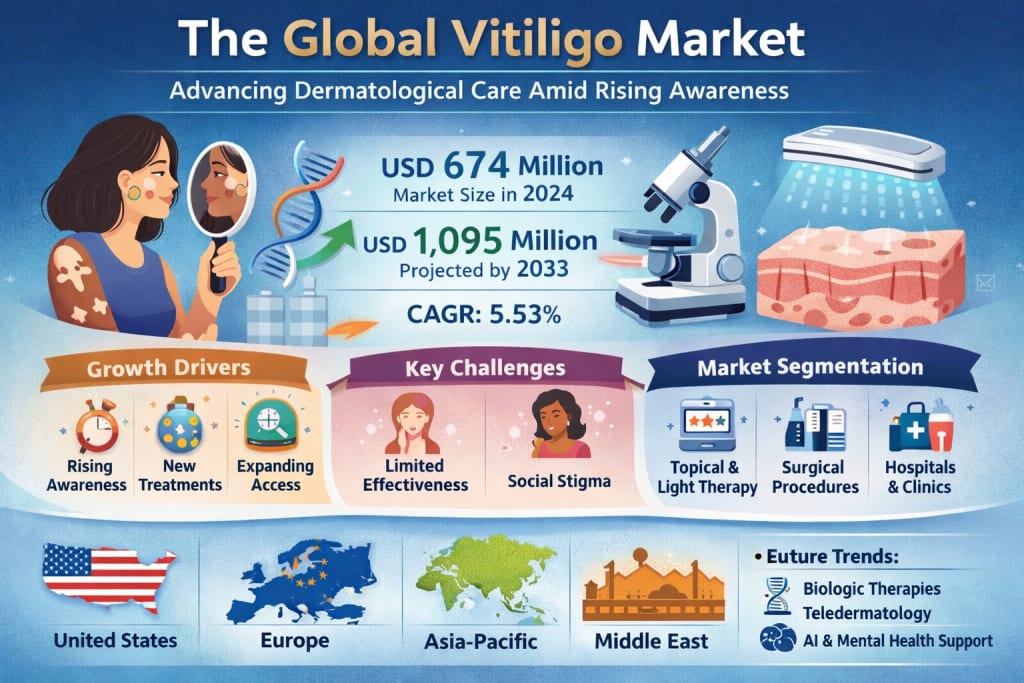
According to Renub Research, the global vitiligo patient market reached USD 674 million in 2024 and is projected to grow to USD 1,095 million by 2033, expanding at a compound annual growth rate (CAGR) of 5.53% between 2025 and 2033.
This steady growth reflects a broader shift in dermatology—one that emphasizes early diagnosis, personalized treatments, and improved patient quality of life.
Understanding Vitiligo: More Than Skin Deep
Vitiligo is an autoimmune condition in which melanocytes—the cells responsible for producing skin pigment—are destroyed or become dysfunctional. The result is the appearance of white patches on various parts of the body. While the condition is not life-threatening or contagious, it carries profound psychological and emotional implications.
Globally, vitiligo affects approximately 1–2% of the population, making it one of the most common dermatological disorders. The visibility of the condition, especially in individuals with darker skin tones, often leads to self-esteem issues, social anxiety, and emotional distress.
Despite these challenges, growing public awareness and advocacy are helping normalize the condition and encourage individuals to seek treatment.
Market Growth Drivers: What’s Fueling Expansion?
1. Rising Awareness and Early Diagnosis
One of the most significant drivers of market growth is the increasing awareness of vitiligo. Public health campaigns, social media discussions, and celebrity advocacy have played a pivotal role in breaking the stigma surrounding the condition.
Healthcare organizations are also investing in educational initiatives, encouraging early diagnosis and timely intervention. As more individuals recognize the symptoms and seek medical advice, demand for both prescription and over-the-counter treatments continues to rise.
Improved diagnostic technologies are further enhancing early detection, enabling dermatologists to initiate treatment plans sooner and improve patient outcomes.
2. Advancements in Treatment Modalities
Innovation in dermatology is revolutionizing the treatment landscape for vitiligo. Traditional therapies such as corticosteroids and phototherapy are now being complemented by cutting-edge approaches, including:
Topical Janus kinase (JAK) inhibitors
Advanced phototherapy devices
Melanocyte transplantation techniques
These innovations are not only improving repigmentation outcomes but also enhancing patient convenience and satisfaction. Pharmaceutical and biotechnology companies are actively investing in research and clinical trials to develop targeted therapies with long-lasting effects.
Such advancements are significantly boosting the adoption of modern treatments and driving overall market growth.
3. Expanding Healthcare Access and Spending
Global healthcare expenditure is on the rise, particularly in emerging economies. Increased funding for dermatological care, coupled with improved insurance coverage, is making vitiligo treatments more accessible.
Teledermatology platforms are also playing a transformative role, enabling patients in remote or underserved areas to consult specialists and receive timely care.
As affordability improves and infrastructure expands, more patients are opting for treatment, thereby contributing to market expansion.
Key Challenges: Barriers to Growth
1. Limited Treatment Effectiveness
Despite technological advancements, vitiligo remains a challenging condition to treat. Many therapies require long-term commitment and may not deliver consistent results across all patients.
Complete or permanent repigmentation is still difficult to achieve, and recurrence is common. Treatments such as phototherapy may also pose risks like skin damage or uneven pigmentation.
These limitations can reduce patient adherence and satisfaction, posing a hurdle for sustained market growth.
2. Social Stigma and Psychological Barriers
In many parts of the world, vitiligo is still associated with misconceptions and social stigma. Some communities mistakenly believe the condition is contagious or linked to other illnesses.
Such beliefs can discourage individuals from seeking diagnosis or treatment, leading to delayed care and worsening emotional distress.
Addressing these psychological and cultural barriers through education and awareness is essential for unlocking the market’s full potential.
Market Segmentation: A Diverse Landscape
The global vitiligo market is segmented across several dimensions, each contributing uniquely to its growth:
By Treatment Type
Topical Treatments
Light Therapy
Surgical Procedures
Others
By Disease Type
Segmental Vitiligo
Non-Segmental Vitiligo
By End User
Hospitals
Ambulatory Clinics
Others
Each segment reflects evolving patient needs and technological capabilities, offering diverse opportunities for stakeholders.
Spotlight on Key Segments
Topical Treatments: The First Line of Defense
Topical therapies remain the most commonly used treatment for vitiligo. Corticosteroids and calcineurin inhibitors are widely prescribed to reduce inflammation and promote repigmentation.
The emergence of targeted therapies like JAK inhibitors is adding a new dimension to this segment, offering improved efficacy and patient outcomes.
Their non-invasive nature and ease of use make topical treatments a preferred choice among both patients and dermatologists.
Light Therapy: Advancing Precision Care
Light therapy, particularly narrowband UVB (NB-UVB) and excimer laser treatments, plays a critical role in managing moderate to severe cases.
These therapies stimulate melanocyte activity and are often used in combination with topical agents for enhanced results.
Technological innovations, including home-based phototherapy devices, are improving accessibility and patient compliance, although cost and frequency of sessions remain challenges.
Hospitals and Ambulatory Clinics: Care Delivery Hubs
Hospitals continue to be central to vitiligo treatment, offering advanced diagnostic tools, specialized care, and access to combination therapies.
Meanwhile, ambulatory clinics are gaining popularity due to their affordability, convenience, and shorter wait times. These clinics are increasingly equipped to provide services such as phototherapy and minor surgical procedures.
Together, these healthcare settings form a robust ecosystem for delivering comprehensive vitiligo care.
Regional Insights: A Global Perspective
United States
The U.S. leads the global vitiligo market, driven by advanced healthcare infrastructure, high awareness, and strong research and development activities.
With approximately 1.5 million individuals affected, the demand for innovative treatments continues to grow.
Europe
Countries like the United Kingdom and Germany benefit from well-established healthcare systems and strong public awareness initiatives. Access to subsidized treatments and cutting-edge therapies supports steady market growth.
Asia-Pacific
The Asia-Pacific region is emerging as a high-growth market, fueled by rising healthcare investments, increasing awareness, and a growing middle-class population.
Countries such as China and Japan are witnessing rapid adoption of both traditional and modern treatment approaches.
Middle East
Nations like Saudi Arabia and the UAE are investing heavily in healthcare infrastructure and dermatological services. Increasing health literacy and cosmetic awareness are driving demand for vitiligo treatments in the region.
Competitive Landscape: Key Players
The global vitiligo market features a mix of pharmaceutical giants and emerging biotech firms. Key players include:
Incyte Corporation
Bristol-Myers Squibb
Clinuvel Pharmaceuticals Ltd
Astellas Pharma Inc.
Baxter International Inc.
Pfizer
Dr. Reddy’s Laboratories Ltd
These companies are actively engaged in research, product development, and strategic collaborations to strengthen their market presence.
The Road Ahead: Future Opportunities
The future of the vitiligo market lies in innovation, personalization, and inclusivity. Key trends to watch include:
Biologic therapies and precision medicine
AI-driven diagnostic tools
Expansion of teledermatology
Increased focus on mental health support
As the understanding of vitiligo deepens, the industry is moving toward holistic care—addressing not just physical symptoms but also emotional well-being.
Final Thoughts
The global vitiligo market is undergoing a meaningful transformation. What was once a condition overshadowed by stigma is now at the forefront of dermatological innovation and public health awareness.
With a projected market size of over USD 1 billion by 2033, the sector holds immense potential for growth and impact.
However, the journey is far from complete. Bridging treatment gaps, overcoming social stigma, and ensuring equitable access to care remain critical challenges.
As science advances and awareness spreads, the future of vitiligo treatment looks increasingly promising—offering hope, confidence, and improved quality of life to millions worldwide.
About the Creator
Paper Packaging Market Outlook 2034: Sustainable Growth, Innovation, and Future Opportunities
The paper packaging market size has emerged as a cornerstone of the global packaging industry, driven by the growing shift toward sustainable and eco-friendly solutions. As environmental concerns around plastic waste continue to rise, businesses and consumers alike are increasingly turning to paper-based alternatives that are biodegradable, recyclable, and derived from renewable resources. This transition is not only reshaping packaging strategies across industries but also creating strong growth opportunities for manufacturers worldwide.
By James Smith4 days ago in Trader
42 Billion Dollar Bet: Strategy’s Bitcoin Engine or a Leveraged Illusion?
Michael Saylor’s Strategy has once again captured market attention. Through a Form 8-K filing with the SEC, the company announced a massive 42 billion dollar equity issuance program. The structure is split evenly between 21 billion dollars in common stock (MSTR) and 21 billion dollars in preferred shares (STRC), executed through an At-The-Market program that allows gradual issuance depending on market conditions.
By crypto genie7 days ago in Trader
Scones
Alright, let's not fuck about - here is what you need: Ingredients: 350g self raising flour 90g butter pinch of salt tsp of baking powder 3 tbsp caster sugar (or just normal white sugar would probably be fine) 175ml milk a squeeze of lemon a drop of vanilla an egg fresh strawberries, if they're in season Extra flour Even more flour Dried fruit (I consider this completely optional and usually leave it out)
By L.C. Schäfer5 days ago in Feast



Comments
There are no comments for this story
Be the first to respond and start the conversation.