
Saudi Arabia Poultry Meat Market: Growth, Challenges, and the Road to Self-Sufficiency
Rising Demand, Strategic Investments, and the Future of Halal Protein in the Kingdom

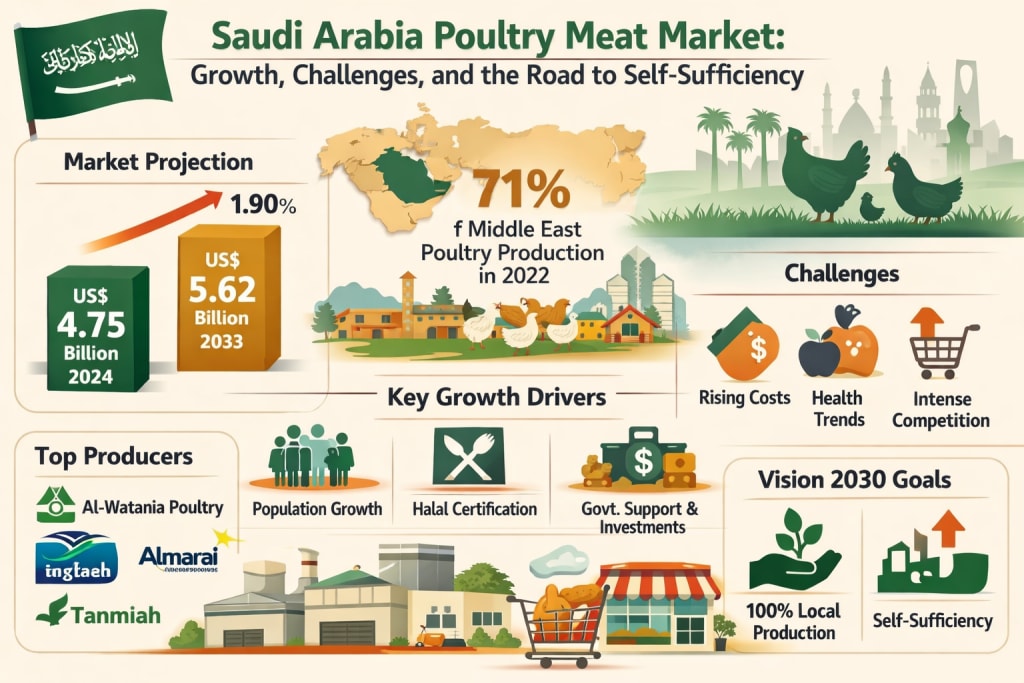
Saudi Arabia’s poultry meat industry is emerging as one of the most strategically important sectors within the Kingdom’s broader food ecosystem. Driven by population growth, changing dietary habits, and strong government backing, the market continues to evolve steadily despite global supply challenges and shifting consumer preferences.
According to Renub Research, the Saudi Arabia poultry meat market is projected to reach US$ 5.62 billion by 2033, up from US$ 4.75 billion in 2024, growing at a CAGR of 1.90% from 2025 to 2033.
This steady expansion reflects not only increasing domestic demand but also a long-term national vision focused on food security, sustainability, and reduced reliance on imports.
A Market Anchored in Everyday Consumption
Poultry meat—particularly chicken—has become a staple protein source across Saudi households. Its affordability compared to red meat, ease of preparation, and wide availability make it a preferred choice among consumers.
Urbanization has played a pivotal role in shaping consumption patterns. As more people migrate to cities and adopt fast-paced lifestyles, the demand for convenient, ready-to-cook, and ready-to-eat poultry products has surged. Supermarkets, hypermarkets, and online platforms now offer an extensive variety of processed poultry options, including nuggets, sausages, and marinated cuts.
At the same time, the expanding foodservice sector—ranging from quick-service restaurants to premium dining—continues to fuel bulk demand for poultry products. This dual consumption pattern, household and commercial, has made poultry a cornerstone of the Kingdom’s food economy.
Production Growth and Regional Dominance
Saudi Arabia has established itself as a dominant poultry producer in the Middle East. The country accounted for approximately 71% of the region’s poultry production in 2022, highlighting its leadership position.
Domestic production has seen remarkable progress over recent years. Between 2017 and 2022, poultry production increased by nearly 73.85%, supported by technological advancements, improved farm management practices, and government incentives.
Even more significant is the shift toward self-reliance. Domestic production met around 68% of total poultry consumption in 2022, a substantial rise from 45% in 2016.
This transformation reflects a broader national strategy aimed at strengthening food security and minimizing dependence on imports.
Government Vision and Strategic Support
Saudi Arabia’s poultry market is deeply influenced by proactive government policies. Under Vision 2030, food security has become a national priority, with poultry production identified as a key focus area.
Authorities have implemented several initiatives to boost domestic output, including:
Financial incentives and subsidies for poultry farms
Interest-free loans for infrastructure development
Support for advanced farming technologies
Investment in processing and cold-chain logistics
The Ministry of Environment, Water, and Agriculture (MEWA) has also introduced programs offering up to USD 187 million annually in incentives to encourage production expansion.
Additionally, policies promoting 100% local ownership of poultry farms aim to strengthen domestic capabilities while still attracting foreign expertise and investment.
These efforts are expected to significantly increase production capacity, with projections suggesting an 80% rise by 2025 and up to 100% by 2030.
The Importance of Halal Certification
In Saudi Arabia, halal certification is not just a regulatory requirement—it is a cultural necessity. Poultry producers must adhere to strict Islamic guidelines for slaughtering and processing, ensuring compliance with religious standards.
This alignment with cultural values provides a competitive advantage, as consumers place high trust in certified products. It also opens doors for exports to other Muslim-majority countries, where demand for halal-certified poultry continues to grow.
The strong integration of halal practices into the supply chain ensures consistency, quality, and consumer confidence—key drivers of long-term market stability.
Retail Expansion and Changing Consumer Behavior
The rapid expansion of retail infrastructure has significantly improved poultry accessibility across the Kingdom. Modern supermarkets and hypermarkets now dominate distribution channels, offering a diverse range of products catering to different consumer preferences.
At the same time, e-commerce platforms are gaining traction, allowing consumers to purchase fresh and frozen poultry products online with ease. This shift toward digital retail is particularly prominent among younger, tech-savvy populations.
Another notable trend is the rising demand for processed and value-added poultry products. Busy lifestyles have led consumers to favor convenience, driving sales of pre-cooked meals, marinated cuts, and ready-to-eat items.
This evolution in consumer behavior is reshaping product innovation, packaging, and marketing strategies across the industry.
Key Growth Drivers
1. Population Growth and Urbanization
Saudi Arabia’s growing population continues to increase overall food demand. Urban living further amplifies the need for convenient protein sources, making poultry a natural choice.
2. Affordability Compared to Red Meat
Poultry remains a cost-effective alternative to beef and lamb, making it accessible to a broader segment of the population.
3. Technological Advancements
Modern farming techniques, automation, and improved feed efficiency have enhanced productivity and reduced mortality rates by approximately 8% in recent years.
4. Foreign Investments and Partnerships
International collaborations, such as joint ventures with global poultry companies, are bringing expertise and innovation into the domestic market.
Challenges Facing the Market
Despite its promising outlook, the Saudi poultry meat industry faces several challenges that could impact its growth trajectory.
Intense Competition and Market Saturation
As more players enter the market, competition has intensified. While this increases product availability, it also leads to price pressures and shrinking profit margins. Smaller producers, in particular, struggle to compete with larger, well-established companies.
Rising Production Costs
Production costs have increased due to factors such as higher feed prices and fuel costs. Saudi Arabia relies heavily on imported poultry feed from countries like France and Brazil, making the industry vulnerable to global price fluctuations.
Between 2017 and 2022, poultry prices rose by 7.84%, reflecting these cost pressures.
Shift Toward Health-Conscious Diets
Consumers are becoming more health-conscious, exploring alternatives such as plant-based proteins and leaner food options. This trend could limit long-term demand for traditional poultry products unless producers adapt with healthier offerings.
Market Segmentation Insights
The Saudi poultry meat market is segmented across several dimensions:
By Type
Chicken (dominant segment)
Turkey
Duck
Others
By Form
Fresh/Chilled
Frozen
Canned
Processed (including nuggets, sausages, and deli meats)
By Distribution Channel
Supermarkets and hypermarkets
Convenience stores
Online platforms
Others
Among these, chicken and fresh/chilled products continue to dominate, while processed poultry is gaining traction due to convenience-driven demand.
Competitive Landscape
The Saudi poultry market is moderately consolidated, with a mix of large domestic players and international companies. A handful of major producers account for over 80% of total production, indicating a strong concentration of market power.
Key companies include:
Al-Watania Poultry
Almarai Food Company
Almunajem Foods
Americana Group
BRF S.A.
Golden Chicken Farm Factory Company CJSC
Sunbulah Group
Tanmiah Food Company
The Savola Group
These companies are focusing on capacity expansion, product diversification, and strategic partnerships to maintain their competitive edge.
Future Outlook: Toward Self-Sufficiency
Looking ahead, the Saudi poultry meat market is poised for steady, sustainable growth. The government’s commitment to food security, combined with ongoing investments in technology and infrastructure, will continue to drive domestic production.
At the same time, evolving consumer preferences will push producers to innovate—whether through healthier product lines, organic offerings, or alternative protein solutions.
The journey toward full self-sufficiency is well underway, and while challenges remain, the Kingdom’s strategic approach positions it strongly for the future.
Final Thoughts
Saudi Arabia’s poultry meat industry stands at a critical intersection of tradition, innovation, and national strategy. As demand continues to rise and production capabilities expand, the market is gradually transforming into a more resilient and self-reliant system.
While factors such as cost pressures and changing dietary trends present challenges, they also create opportunities for innovation and differentiation. Companies that adapt to these shifts—by embracing technology, sustainability, and consumer-centric strategies—will be best positioned to thrive.
Ultimately, the Saudi poultry market is not just about meeting current demand; it is about building a future-ready food system that aligns with the Kingdom’s long-term vision of economic diversification and food security.
About the Creator
Stanislav Kondrashov on the Meaning of Billions Flowing Across Markets and the Signals They Reveal
In contemporary economic systems, the movement of large-scale capital is often described in terms of magnitude—figures expressed in billions that appear abstract and distant. Yet behind these numbers lies a complex language of signals, patterns, and structural shifts. According to Stanislav Kondrashov, understanding these movements requires moving beyond the surface and examining how flows of billions reflect deeper transformations within interconnected markets.
By Stanislav Kondrashov about 19 hours ago in Trader
Philippines Construction Equipment Market 2026: Infrastructure Expansion, Smart Machinery & Rental Growth
Philippines Construction Equipment Market Overview The Philippines construction equipment market is a vital segment of the country’s infrastructure and industrial ecosystem, encompassing a wide range of machinery such as excavators, loaders, cranes, forklifts and dozers used in construction, mining and transportation projects. The market is evolving with increasing adoption of advanced, fuel-efficient and technologically integrated equipment to enhance productivity and safety.
By Manisha Dixit7 days ago in Trader




Comments
There are no comments for this story
Be the first to respond and start the conversation.