
RFID Market Set for Strong Growth as Retail, Logistics, and Smart Security Accelerate Worldwide
From checkout-free retail to real-time warehouse visibility and smarter access control, RFID is moving from a back-end tracking tool to a front-line business necessity.

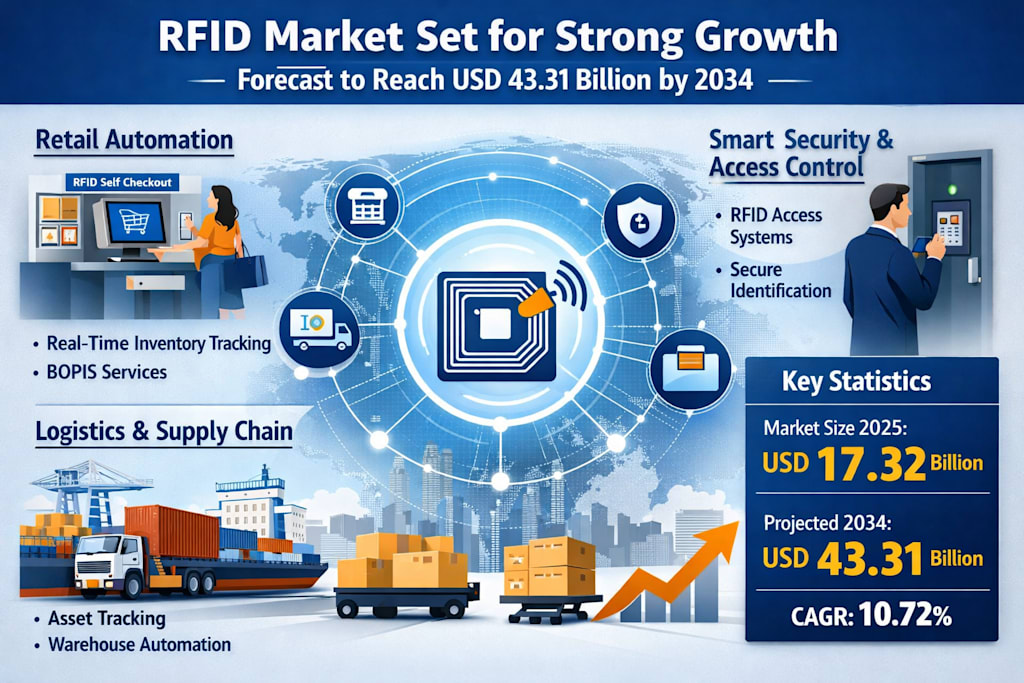
The way businesses track products, manage inventory, secure facilities, and optimize operations is changing fast—and RFID (Radio Frequency Identification) is at the center of that transformation.
Once viewed as a specialized tracking technology, RFID has now become a practical and increasingly essential tool across industries. Retailers are using it to maintain accurate shelf-level inventory. Warehouses are relying on it for faster order fulfillment. Hospitals are deploying it to monitor assets and improve patient safety. Even commercial buildings are integrating RFID into modern access-control systems.
That rising demand is showing up clearly in market numbers. According to Renub Research, the RFID Market is expected to grow from US$ 17.32 billion in 2025 to US$ 43.31 billion by 2034, expanding at a CAGR of 10.72% from 2026 to 2034. The growth is being fueled by automation, real-time visibility needs, lower hardware costs, and tighter integration with digital platforms such as IoT and cloud-based analytics.
In other words, RFID is no longer just about scanning items. It is about building smarter, more responsive operations.
What RFID Really Means in Today’s Business World
At its core, RFID is a wireless identification and data-capture system. It uses radio waves to read and track tagged objects without requiring direct line-of-sight, which gives it a major advantage over traditional barcodes. An RFID setup generally includes tags, readers, antennas, and software, all working together to identify items quickly and accurately.
That may sound simple, but the impact is significant.
Unlike barcode systems that often require manual scanning one item at a time, RFID can read multiple tagged objects almost instantly. That means businesses can reduce labor, improve inventory counts, cut errors, and make better decisions in real time.
This is why RFID has become especially valuable in environments where speed and accuracy matter: retail stores, fulfillment centers, hospitals, factories, airports, government systems, and security networks.
And as businesses push deeper into digital transformation, RFID is increasingly acting as a bridge between the physical and digital worlds.
Retail Is Becoming a Major Growth Engine
One of the biggest reasons RFID is growing so rapidly is its expanding role in modern retail.
Retailers are under pressure from every direction. Consumers expect accurate online stock availability, faster delivery, smooth returns, and better in-store experiences. At the same time, stores are dealing with shrinkage, labor shortages, and the need to run omnichannel operations more efficiently.
RFID addresses all of those pain points.
A notable sign of this trend came in January 2025, when SML IIS and Zebra Technologies introduced a ceiling-mounted RFID reader solution designed to improve read accuracy while reducing floor congestion in large retail environments. This kind of overhead infrastructure is especially important because it enables continuous, automated item visibility without disrupting store traffic or operations.
That matters because retail is no longer just about stocking shelves. It is about synchronizing physical stores with digital commerce systems. Services such as Buy Online, Pick Up In Store (BOPIS) depend on highly accurate inventory data. If a system says an item is available and it is not actually there, the customer experience breaks down immediately.
RFID helps close that gap.
As more retailers modernize stores to support real-time stock accuracy, automated cycle counting, and faster fulfillment, RFID is becoming less of a “nice to have” and more of a competitive requirement.
Logistics and Supply Chains Need Real-Time Visibility
If retail is helping popularize RFID, logistics is helping make it indispensable.
Supply chains today are more complex than ever. Products move across warehouses, trucks, ports, fulfillment centers, and final-mile delivery networks at enormous scale. Every delay, mis-scan, or misplaced shipment can create costly inefficiencies.
RFID offers a practical solution by enabling real-time asset and inventory visibility. Companies can track pallets, cartons, equipment, and even individual items more accurately and with less manual intervention.
That is especially useful in high-volume operations where barcode scanning can slow down throughput or leave blind spots. RFID can reduce bottlenecks, improve traceability, and make warehouse workflows more intelligent.
The continued rise of e-commerce has made this even more important. Consumers increasingly expect fast shipping and reliable delivery updates. To meet those expectations, logistics networks need better data, faster processing, and fewer errors.
RFID helps provide that operational clarity.
It also supports broader business goals, including lower labor dependency, better order accuracy, and improved use of storage and transportation resources. In a world where margins are often tight, that efficiency advantage matters.
Smart Security and Access Control Are Expanding the Market
RFID is not only growing in supply chains and retail. It is also becoming a major force in commercial security and access control.
Modern workplaces, campuses, industrial sites, and smart buildings increasingly require contactless, flexible, and integrated identity systems. RFID-based credentials are being used for door access, parking, lockers, secure zones, and employee authentication.
This part of the market received a notable boost in January 2025, when ASSA ABLOY acquired 3millID and Third Millennium for USD 21 million, strengthening its portfolio in RFID readers and secure credentialing technologies.
That move reflects a broader shift: organizations are no longer looking for isolated badge systems. They want connected access ecosystems that work across physical spaces and digital identity platforms.
RFID is well positioned for that future because it can integrate with mobile credentials, biometrics, and cloud-based security platforms. As businesses and governments invest in smarter, more secure infrastructure, RFID is gaining relevance far beyond inventory management.
This opens up a powerful new lane of growth for the industry.
Partnerships and Product Innovation Are Speeding Up Adoption
Another reason the RFID market is expanding is the growing number of strategic partnerships aimed at making the technology more scalable, accurate, and accessible.
A strong example came in January 2024, when Newland AIDC partnered with Impinj to integrate advanced RAIN RFID technology into its product portfolio. The significance of deals like this goes beyond branding—it reflects a deeper industry push to combine chips, readers, handhelds, and software into more complete, end-to-end solutions.
That is important because businesses do not just want tags. They want full systems that work smoothly with existing operations.
As RFID vendors improve interoperability and build stronger ecosystems, deployment becomes easier and more appealing to customers across sectors such as healthcare, retail, logistics, and industrial manufacturing.
This is one of the clearest signs that RFID is maturing as a commercial technology.
The Challenges Are Real—and Still Important
Despite all of its momentum, RFID is not without obstacles.
One of the biggest barriers remains deployment cost and integration complexity. While tag prices have fallen, full-scale RFID systems still require investment in readers, antennas, middleware, infrastructure design, and enterprise integration. Connecting RFID with systems such as ERP, WMS, or POS platforms often demands technical customization and expertise.
That can be especially challenging for small and medium-sized businesses, which may hesitate if the return on investment is not immediately obvious.
Environmental factors also matter. Metal surfaces, liquids, and radio interference can affect read performance, meaning deployments often need careful tuning and specialized hardware.
Then there is the issue of privacy, data security, and standardization.
Because RFID systems can generate large volumes of item-level and identity-related data, concerns around unauthorized tracking, cloning, eavesdropping, and data misuse remain relevant. On top of that, compliance requirements and radio-frequency standards vary by region, making global deployment more complicated.
These are not minor issues. They are the kinds of challenges that can slow adoption if not addressed properly.
Still, for many organizations, the operational benefits increasingly outweigh the friction.
Which Countries Are Leading the RFID Opportunity?
The RFID story is not unfolding equally everywhere. Some markets are emerging as especially influential.
United States
The United States remains one of the largest RFID markets thanks to strong adoption across retail, logistics, healthcare, and defense. Large retailers and e-commerce networks are driving major demand for inventory accuracy and warehouse automation, while military and government applications continue to support secure identification and asset tracking.
Germany
Germany is a major RFID market because of its deep strength in industrial automation and Industry 4.0. RFID is increasingly embedded in automotive production, intralogistics, machinery tracking, and precision manufacturing workflows.
China
China is one of the fastest-growing RFID markets, powered by its vast manufacturing base, large e-commerce ecosystem, smart city initiatives, and aggressive digitalization efforts. Local production of lower-cost RFID components is also helping drive accessibility and scale.
Saudi Arabia
Saudi Arabia is becoming an increasingly important growth market as Vision 2030 drives investment in smart infrastructure, logistics modernization, healthcare digitization, and secure identification systems. RFID is benefiting directly from that transformation agenda.
Taken together, these country-level trends show that RFID is not tied to one single industry or geography. It is becoming a foundational layer of operational intelligence worldwide.
Recent Developments Show a Market in Motion
The RFID industry has also seen a series of strategic developments that highlight just how broad the use cases have become.
Among the notable moves:
TOPPAN Holdings and TOPPAN Next acquired HID’s Citizen Identity Solutions division in October 2024, expanding into secure identity technologies.
Galaxy Entertainment Group and Melco Resorts planned RFID-enabled tablets in casinos in March 2024 to improve monitoring and reduce fraud.
HID Global partnered with Olea Kiosk in January 2024 to enhance check-in and authentication experiences.
Metalcraft launched its Universal Eco Mini RFID Tag in November 2023, targeting metal-surface tracking use cases.
Tata Power introduced RFID-enabled EV charging cards in August 2023, showing how RFID is also entering mobility and energy infrastructure.
These examples matter because they show RFID moving well beyond warehouse labels and retail shelves. It is now part of identity systems, transportation, hospitality, energy, and smart infrastructure.
That breadth is exactly what makes the market so compelling.
Final Thoughts
RFID is entering a new phase—one where it is no longer treated as a niche efficiency tool, but as a strategic technology for modern operations.
Businesses want real-time visibility. They want automation. They want fewer errors, stronger security, and better control over increasingly complex workflows. RFID delivers on all of those needs, which is why adoption is expanding across sectors and geographies.
Yes, implementation challenges remain. Integration still takes effort. Security and compliance must be taken seriously. But the direction of the market is clear.
As organizations continue investing in connected operations, RFID is likely to become a core part of how physical assets, products, people, and systems are managed in the digital economy.
And if Renub Research’s forecast is any indication, this is only the beginning. With the market projected to reach US$ 43.31 billion by 2034, RFID is on track to become one of the defining infrastructure technologies of the next business decade.
About the Creator
Keep reading
More stories from shibansh kumar and writers in Trader and other communities.
How to Find a Legitimate Crypto Recovery Service
Imagine logging into your crypto wallet only to discover that your balance has dropped to zero. For many investors, this moment feels like a devastating blow to their financial plans and digital security. Unfortunately, cryptocurrency theft and Frauds have become increasingly common, with thousands of incidents reported every month.
By Madelyn Bennettabout 18 hours ago in Trader



Comments
There are no comments for this story
Be the first to respond and start the conversation.