
North America Industrial Enzymes Market Set for Sustainable Growth Amid Rising Demand for Green Technologies
A Transformative Shift Toward Efficiency, Innovation, and Eco-Friendly Industrial Processes

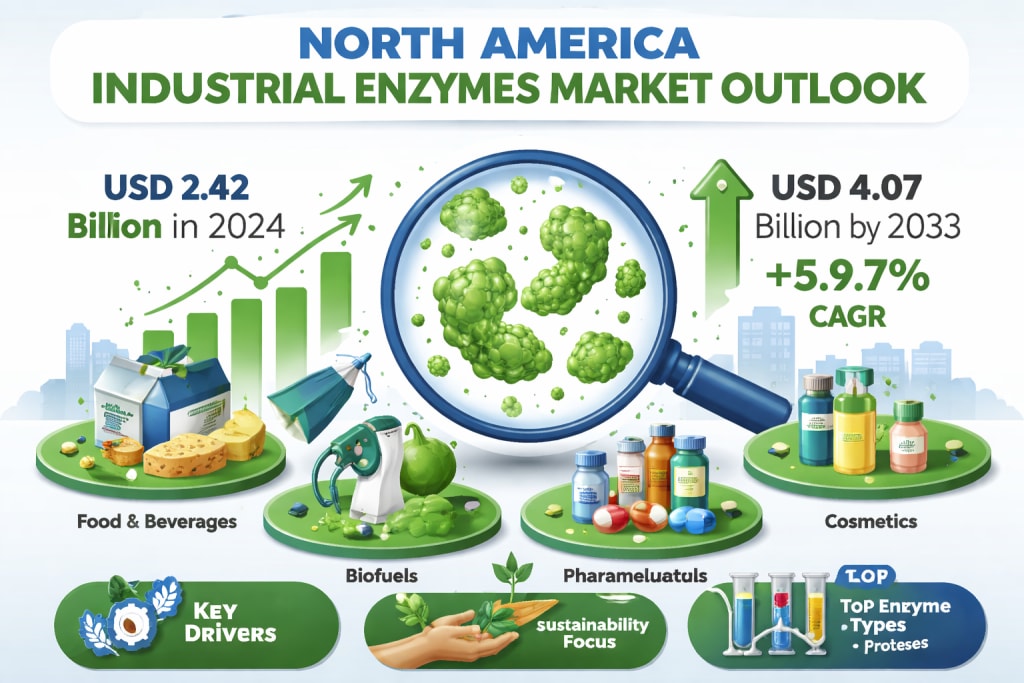
The North America Industrial Enzymes Market is entering a decisive phase of expansion, driven by a convergence of sustainability goals, technological innovation, and rising industrial demand. According to recent market insights, the sector was valued at USD 2.42 billion in 2024 and is projected to reach USD 4.07 billion by 2033, growing at a CAGR of 5.97% between 2025 and 2033 .
This steady growth reflects not only increasing industrial adoption but also a broader transformation in how industries approach production—shifting away from chemical-heavy processes toward more environmentally responsible alternatives. Industrial enzymes, known for their efficiency and specificity, are emerging as indispensable tools in this evolution.
Understanding Industrial Enzymes: The Backbone of Modern Bioprocessing
Industrial enzymes are biological catalysts that accelerate chemical reactions without being consumed in the process. Derived from microorganisms, plants, or animals, these enzymes are widely used across industries such as food and beverages, biofuels, textiles, detergents, and pharmaceuticals.
What makes them particularly valuable is their ability to operate under milder conditions, reduce energy consumption, and minimize waste—aligning perfectly with global sustainability goals. In North America, where regulatory frameworks increasingly prioritize environmental compliance, enzymes are becoming central to industrial innovation.
Market Growth Drivers: What’s Fueling the Expansion?
1. Rising Demand for Processed and Clean-Label Foods
One of the most significant drivers of the industrial enzymes market is the growing demand for processed and packaged foods. Enzymes play a critical role in enhancing flavor, improving texture, extending shelf life, and boosting nutritional value.
Consumers today are more conscious about what they eat, preferring clean-label products with fewer synthetic additives. This shift has encouraged manufacturers to adopt enzyme-based processes, which naturally improve product quality while maintaining safety standards. As a result, the food and beverage sector continues to dominate enzyme consumption in North America.
2. Expansion of the Biofuel Industry
The push toward renewable energy has significantly increased the use of enzymes in biofuel production. Enzymes such as carbohydrases are essential for breaking down starches and cellulose into fermentable sugars, which are then converted into bioethanol and biodiesel.
Government policies promoting clean energy, coupled with environmental concerns, are accelerating this trend. The United States, in particular, leads the region in biofuel production, making it a major consumer of industrial enzymes. This shift toward greener energy sources is expected to remain a key growth catalyst in the coming years.
3. Advances in Enzyme Engineering and Biotechnology
Technological advancements in biotechnology have revolutionized enzyme production. Modern enzyme engineering enables the development of highly stable and efficient enzymes capable of withstanding extreme industrial conditions such as high temperatures and varying pH levels.
These innovations have expanded enzyme applications into sectors like pharmaceuticals, textiles, and wastewater treatment. For instance, engineered enzymes can significantly improve production efficiency while reducing operational costs over time. As research and development continue to advance, the scope of industrial enzymes is expected to broaden even further.
Key Challenges: Barriers to Wider Adoption
High Production and Development Costs
Despite their advantages, industrial enzymes are not without challenges. The production process involves complex biotechnological methods, including fermentation and purification, which can be expensive.
These high costs can limit adoption, particularly among small and medium-sized enterprises. Additionally, maintaining enzyme stability during storage and processing adds to the overall expense, posing a barrier to widespread use.
Regulatory Compliance and Approval Processes
North America has stringent regulatory frameworks governing enzyme use, especially in food, pharmaceuticals, and personal care products. Regulatory bodies enforce strict safety and environmental standards, which can delay product approvals and increase compliance costs.
While these regulations ensure consumer safety, they also present challenges for manufacturers looking to introduce new enzyme-based solutions in the market.
Segment Analysis: A Diverse and Expanding Market
Carbohydrase Enzymes: Leading the Market
Carbohydrases, including amylases and cellulases, dominate the industrial enzymes market. These enzymes are widely used in food processing to break down complex carbohydrates, improving digestibility and texture.
They are also essential in bioethanol production and textile processing, making them a versatile and highly demanded enzyme category. Their role in energy-efficient processes further strengthens their market position.
Lipases: Gaining Momentum Across Industries
Lipases are increasingly popular due to their broad range of applications. They are widely used in detergents for effective cleaning and degreasing, as well as in food processing for flavor enhancement.
In the biofuel sector, lipases facilitate biodiesel production, aligning with sustainability trends. Their eco-friendly nature and versatility make them one of the fastest-growing enzyme segments.
Food & Beverages: The Largest Application Segment
The food and beverage industry remains the largest consumer of industrial enzymes in North America. Enzymes such as proteases, amylases, and lactases are used extensively in baking, dairy, and beverage production.
With rising demand for natural and high-quality food products, manufacturers are increasingly relying on enzyme-based solutions to meet consumer expectations.
Personal Care & Cosmetics: A Growing Niche
Enzymes are also making significant inroads into the personal care and cosmetics industry. Known for their exfoliating, cleansing, and anti-aging properties, enzymes offer a natural alternative to synthetic chemicals.
As consumers seek safer and more sustainable skincare products, enzyme-based formulations are gaining popularity, driving growth in this segment.
Source Analysis: Microorganisms Take the Lead
Microorganism-derived enzymes dominate the market due to their high yield, scalability, and cost efficiency. Bacterial and fungal sources are particularly favored for large-scale industrial applications.
Advances in microbial engineering have further enhanced the ability to produce customized enzymes tailored to specific industrial needs, accelerating innovation and commercialization.
Plant-based enzymes are also gaining traction, especially in food and nutraceutical applications. However, challenges related to stability and large-scale production remain, limiting their widespread adoption.
Regional Insights: Country-Level Growth Dynamics
United States: The Market Leader
The United States holds the largest share of the North American industrial enzymes market. Its strong biotechnology infrastructure, high R&D investment, and supportive government policies make it a hub for enzyme innovation.
The country’s emphasis on sustainability and clean energy further drives enzyme adoption across industries, particularly in biofuels and food processing.
Canada: Steady Growth with a Sustainability Focus
Canada’s market is growing steadily, supported by its commitment to sustainability and clean energy. Enzymes are increasingly used in food processing, textiles, and environmental applications such as wastewater treatment.
Collaborations with global biotech firms and investments in research and development are further boosting the country’s enzyme market.
Mexico: Emerging Opportunities
Mexico is witnessing rapid growth in enzyme applications, particularly in food and beverages, textiles, and biofuels. Rising middle-class consumption and increasing industrialization are key drivers of this expansion.
Government incentives for renewable energy and agricultural advancements are also encouraging the adoption of enzyme-based solutions.
Competitive Landscape: Key Players Driving Innovation
The North American industrial enzymes market is highly competitive, with several global players leading the charge. Companies such as DuPont Danisco, BASF SE, Novozymes, DSM, and Kerry Group are investing heavily in research and development to create advanced enzyme solutions.
Strategic collaborations, product innovations, and sustainability initiatives are shaping the competitive landscape, enabling companies to strengthen their market position.
The Future Outlook: A Market Built on Sustainability
The future of the North America Industrial Enzymes Market looks promising, with sustainability at its core. As industries continue to prioritize eco-friendly practices, the demand for enzyme-based solutions is expected to rise.
From reducing carbon footprints to improving production efficiency, enzymes offer a powerful tool for achieving both economic and environmental goals. Technological advancements will further enhance enzyme performance, making them more accessible and cost-effective for a wider range of applications.
Final Thoughts
The North America Industrial Enzymes Market is more than just a growing industry—it represents a fundamental shift in how modern industries operate. With a projected value of USD 4.07 billion by 2033, the market is poised for sustained growth driven by innovation, sustainability, and evolving consumer preferences .
While challenges such as high production costs and regulatory hurdles remain, the long-term outlook is undeniably positive. As industries continue to embrace greener and more efficient solutions, industrial enzymes will play an increasingly vital role in shaping the future of manufacturing and production.
In a world where sustainability is no longer optional, industrial enzymes stand out as a key enabler of progress—quietly transforming industries, one reaction at a time.
About the Creator
Europe’s Vending Machine Market Is Quietly Becoming a Smart Retail Powerhouse
Across Europe, vending machines are becoming smarter, faster, and far more relevant to modern life. They are no longer just backup snack points in office corridors. Instead, they are evolving into intelligent retail touchpoints—offering everything from premium coffee and fresh salads to ready-to-eat meals, healthy snacks, and even non-food essentials. What was once considered a convenience add-on is now turning into a serious component of the region’s retail and foodservice ecosystem.
By shibansh kumarabout 21 hours ago in Trader
US Dollar Index Update: Key Movements UK Traders Should Watch
The US Dollar Index is a major indicator of the dollar’s strength against other global currencies. For UK traders, keeping track of the index is essential because it influences the pound, import costs, investments, and even travel expenses. Understanding the US Dollar Index helps traders make informed decisions and stay ahead in a fast-moving market. In this article, we explore the latest trends, causes of movement, and practical ways UK traders can use this information.
By hamza mirza3 days ago in Trader
Watching The End Of The World From The Diner
Introduction I am not sure how to approach this. Guy Peellaert was an amazing artist who created iconic fantasy images of famous people, usually musicians or politicians, as well as creating commissioned album covers such as "It's Only Rock'n'Roll" by The Rolling Stones and David Bowie's "Diamond Dogs" which you can read more about below.
By Mike Singleton 💜 Mikeydred 7 days ago in Art


Comments
There are no comments for this story
Be the first to respond and start the conversation.