
Netherlands Real Estate Market 2026: Urban Growth, Housing Demand & Sustainable Development
How housing shortages, ESG investments, and urban expansion are shaping the Netherlands property market

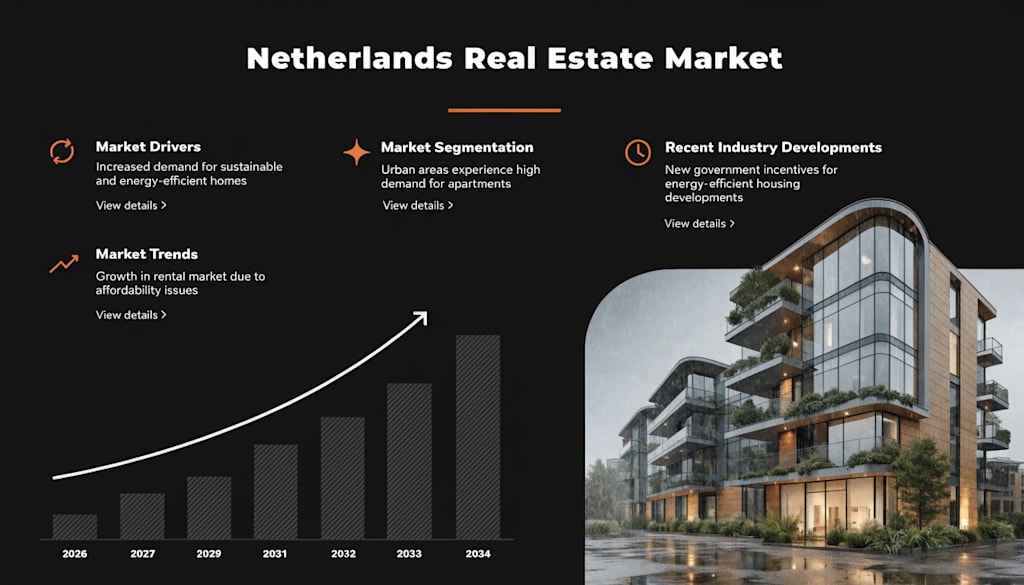
The Netherlands real estate market is experiencing steady growth as rising housing demand, urban development, and sustainability initiatives reshape the country’s property landscape. According to industry insights, the market reached USD 88.61 Billion in 2025 and is projected to grow to USD 114.65 Billion by 2034, exhibiting a CAGR of 2.61% during 2026–2034
Real estate in the Netherlands includes residential housing, commercial properties, industrial assets, and mixed-use developments. The sector plays a critical role in the country’s economy, supported by strong infrastructure, high urbanization levels, and a stable investment environment.
The market’s growth reflects a balanced combination of demand-driven expansion and regulatory influence, where housing shortages, sustainability mandates, and evolving investor strategies are shaping long-term development.
What’s Driving Market Growth?
One of the primary drivers of the Netherlands real estate market is the persistent housing shortage. Rapid urbanization and population growth in cities such as Amsterdam, Rotterdam, and Utrecht are increasing demand for residential properties, putting pressure on supply and driving development activity.
Another major factor is the increasing focus on sustainable and energy-efficient buildings. The Netherlands is at the forefront of adopting green construction practices, with Nearly Zero Energy Buildings (NZEB) becoming the standard for new developments. These initiatives are attracting environmentally conscious buyers and institutional investors focused on ESG (Environmental, Social, and Governance) assets.
Institutional investment trends are also shaping the market. Pension funds and real estate investors are actively reallocating portfolios toward residential and logistics assets, driven by stable returns and long-term demand. Additionally, the conversion of rental properties into owner-occupied housing is increasing homeownership opportunities and boosting transaction volumes.
Infrastructure development and the Netherlands’ strategic position as a European logistics hub further support growth. Strong connectivity, advanced transport networks, and proximity to major markets make the country attractive for commercial and industrial real estate investments.
Additionally, evolving work patterns, including hybrid work models, are influencing demand for residential space, suburban housing, and flexible office environments.
Market Segmentation & Key Insights
• By Property Type:
o Residential real estate dominates due to strong housing demand and population growth.
o Commercial properties include office spaces, retail outlets, and mixed-use developments.
o Industrial and logistics real estate is expanding rapidly due to e-commerce growth.
• By Business Model:
o Sales transactions hold a significant share, supported by homeownership demand.
o Rental market remains important, particularly in urban areas with high population density.
• By Mode:
o Offline transactions dominate due to the complexity and high-value nature of real estate deals.
o Digital platforms and PropTech solutions are gradually gaining traction.
• By Regional Dynamics:
o Major cities such as Amsterdam, Rotterdam, and Utrecht lead the market.
o Emerging urban areas and suburban regions are gaining attention due to affordability.
What the Opportunities Are?
The Netherlands real estate market presents strong opportunities in sustainable and green building development. As environmental regulations become stricter, developers can focus on energy-efficient construction, renewable energy integration, and smart building technologies.
Another major opportunity lies in residential housing development. Addressing housing shortages through new construction projects and urban redevelopment can unlock significant growth potential.
Logistics and industrial real estate offer additional opportunities, driven by the expansion of e-commerce and supply chain infrastructure. Warehousing and distribution centers are becoming increasingly valuable assets.
The adoption of PropTech and digital platforms also presents growth potential. Technologies such as AI-driven property analytics, virtual tours, and blockchain-based transactions can enhance efficiency and transparency in the market.
Additionally, urban regeneration and mixed-use developments are creating opportunities to transform underutilized spaces into vibrant residential and commercial hubs.
Recent News and Developments in Netherlands Real Estate Market
Jul 2025: Increasing adoption of sustainable housing solutions, including energy-efficient buildings and smart energy systems, strengthened market attractiveness and long-term value.
Sep 2025: Rising housing transactions and conversion of rental properties into owner-occupied homes improved market liquidity and accessibility for buyers.
Feb 2026: Strong investor interest driven by housing shortages, urbanization, and logistics demand supported continued expansion of the real estate sector.
Why Should You Know About Netherlands Real Estate Market?
The Netherlands real estate market is important because it reflects the intersection of urban development, sustainability, and investment strategies in a mature European economy.
For investors, this market offers exposure to a stable asset class with consistent demand and long-term growth potential. While the CAGR of 2.61% indicates moderate growth, it is supported by strong fundamentals such as housing demand, infrastructure development, and ESG-driven investments.
For developers and businesses, the market presents opportunities to innovate, expand housing supply, and integrate sustainable practices into real estate projects.
For policymakers and stakeholders, it highlights the importance of addressing housing shortages, promoting sustainable development, and ensuring balanced urban growth.
In essence, the Netherlands real estate market represents a resilient and evolving sector where demand, sustainability, and innovation converge — making it a key pillar of the country’s economic and social development.
About the Creator
Thomas
Market Research Analyst | Industry Trends & Forecasting | Turning market data into clear, actionable business insights across global sectors.
Mexico Factoring Market Size Growth & Trends Report 2034
Mexico Factoring Market Size, Growth, and Forecast (2026–2034) The Mexico factoring market has become an important part of the country’s financial services sector. Many businesses are using factoring services to improve cash flow, reduce payment delays, and support daily operations. Factoring is especially useful for small and medium-sized enterprises that may not have easy access to traditional bank financing.
By Kim Soo hyun7 days ago in Trader


Comments
There are no comments for this story
Be the first to respond and start the conversation.