
Middle East & Africa CGM Market: Why Continuous Glucose Monitoring Is Becoming a Healthcare Priority
From rising diabetes rates to smarter home-based care, the Middle East and Africa continuous glucose monitoring market is entering a decisive growth phase.

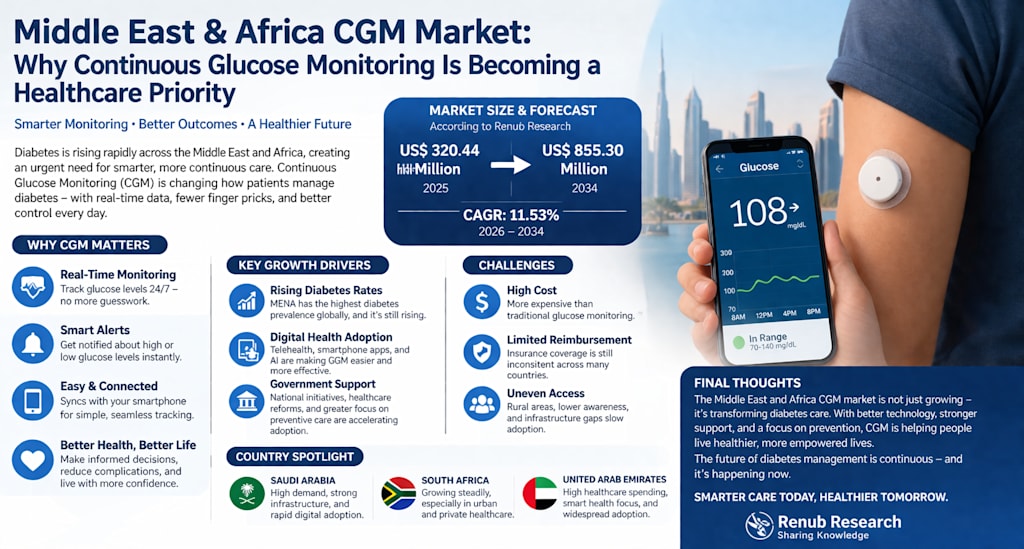
Diabetes is no longer a condition that can be managed with occasional checkups and scattered glucose readings. Across the Middle East and Africa, the pressure to improve diabetes care is becoming impossible to ignore. More people are being diagnosed younger, lifestyle diseases are becoming more common, and healthcare systems are under increasing strain to deliver faster, smarter, and more preventive treatment.
That is exactly where continuous glucose monitoring, or CGM, is stepping in.
Unlike traditional finger-prick testing, CGM offers real-time glucose readings throughout the day and night. For patients, that means fewer blind spots. For doctors, it means better data. And for healthcare systems, it opens the door to more efficient long-term disease management. This is why the Middle East and Africa CGM market is beginning to attract serious attention from investors, healthcare providers, and technology developers alike.
According to Renub Research, the Middle East and Africa Continuous Glucose Monitoring Market is projected to rise from US$ 320.44 Million in 2025 to US$ 855.30 Million by 2034, expanding at a CAGR of 11.53% from 2026 to 2034. That is not a minor shift. It reflects a structural transformation in how diabetes care is being delivered across the region.
Why CGM Is Becoming More Relevant Than Ever
At its core, a CGM system is designed to continuously track glucose levels in real time. Instead of depending on isolated blood sugar readings, the technology uses a small sensor placed under the skin to monitor glucose levels in interstitial fluid. This data is then sent to a receiver or smartphone app, allowing users to view patterns, trends, and alerts for highs and lows as they happen.
That shift from “occasional monitoring” to “continuous awareness” is powerful.
It changes how patients manage insulin, how they plan meals, how they exercise, and how they respond to unexpected glucose swings. More importantly, it reduces the guesswork that has traditionally made diabetes management exhausting and inconsistent.
In a region where diabetes prevalence is climbing rapidly, the value of this technology becomes even more obvious. Countries such as Saudi Arabia and the United Arab Emirates are already facing a significant diabetes burden, while South Africa, Egypt, and several other markets are also seeing increasing demand for better diabetes care tools. As awareness improves and digital health adoption expands, CGM is moving from being a premium device to a more practical medical necessity.
The Biggest Force Behind Market Growth: Rising Diabetes Cases
The strongest growth engine for the CGM market is simple: more people need better diabetes management.
Across the Middle East and Africa, urbanization, changing diets, sedentary routines, and rising obesity are pushing diabetes rates upward. The result is a much larger population requiring regular glucose monitoring and long-term care. This is particularly visible in Gulf countries, where diabetes prevalence is among the highest in the world.
As diabetes becomes more widespread, the limitations of traditional glucose testing are becoming harder to ignore. Finger-stick methods may still be common, but they provide only snapshots. CGM, by contrast, gives patients and physicians a much fuller picture of glucose behavior over time. That allows for better treatment decisions and often better outcomes.
This is not just about convenience. It is about clinical effectiveness.
When healthcare systems begin prioritizing preventive care and chronic disease management, technologies like CGM naturally move to the forefront. And that is exactly what is starting to happen in this market.
Digital Health Is Accelerating Adoption
One of the more interesting reasons behind the market’s momentum is the rise of digital healthcare infrastructure.
CGM is not just a medical device; it is part of a larger digital health ecosystem. It works particularly well when paired with telemedicine, smartphone apps, cloud-based monitoring, and remote care platforms. That matters because many healthcare systems in the Middle East are actively investing in modernization, while several African markets are increasingly adopting mobile-first healthcare solutions.
This digital compatibility gives CGM an edge.
A patient can wear a sensor at home, their glucose data can be transmitted automatically, and healthcare professionals can monitor trends without requiring constant in-person visits. For hospitals and clinics trying to improve efficiency, this is a major advantage. For patients managing diabetes daily, it adds flexibility and control.
The region’s growing smartphone penetration is also helping. Since many modern CGM systems sync directly with mobile apps, the device experience feels more integrated and user-friendly than older medical equipment. That familiarity matters. People are more likely to adopt technology when it fits naturally into daily life.
Government Support Is Strengthening the Market
Government involvement is another major factor pushing this market forward.
Several countries in the region are increasingly focused on preventive healthcare, diabetes screening, and healthcare digitization. This creates a favorable environment for CGM adoption, especially in better-funded healthcare systems. Governments are not only trying to treat chronic disease more effectively, but also reduce the long-term cost burden that unmanaged diabetes creates.
This is why policy changes, healthcare reforms, and insurance support can have an outsized effect on this market.
In the United Arab Emirates, for example, the healthcare sector continues to evolve through system modernization and regulatory streamlining. In Saudi Arabia, healthcare transformation under broader national development plans is helping accelerate digital health innovation. These kinds of changes create the conditions for CGM to move beyond niche adoption and into wider clinical use.
Awareness campaigns also matter more than many people realize. The more patients understand the benefits of real-time glucose monitoring, the more demand increases. Education is often the bridge between available technology and actual adoption.
What Is Still Holding the Market Back?
Despite the strong outlook, this is not a frictionless growth story.
The biggest challenge remains cost.
CGM systems are significantly more expensive than conventional blood glucose monitoring methods. Sensors need replacement, receivers may need upgrades, and app-linked ecosystems can create ongoing costs. In higher-income countries, this is manageable. In lower-income or underserved regions, it can be a serious barrier.
Reimbursement is another issue. While some healthcare systems and insurers are beginning to recognize the long-term value of CGM, reimbursement coverage is still inconsistent across much of the region. Without strong reimbursement support, many patients simply cannot afford sustained use.
There is also the problem of uneven healthcare access.
In rural and underserved areas, awareness about advanced diabetes technology may still be limited. Some patients continue to rely on traditional monitoring methods not because they prefer them, but because they are more accessible. Infrastructure gaps, lower specialist availability, and inconsistent internet connectivity can also slow adoption, particularly in parts of Africa.
So while the long-term direction is positive, the market’s growth will depend heavily on affordability, access, and education.
Which Segments Are Driving Revenue?
The market is not growing in a single direction. It is being shaped by several product and end-user segments, each playing a different role.
1. Sensors
Sensors are arguably the most important component in the CGM ecosystem. They are the part of the system that directly measures glucose levels and must be replaced regularly, which creates recurring demand. This makes the sensor segment a major revenue driver in the overall market.
As manufacturers improve comfort, wear time, and accuracy, sensors will likely remain at the center of both innovation and commercial growth.
2. Receivers
Receivers continue to play an important role, especially in settings where smartphone integration may not yet be universal or preferred. Improvements in battery life, display quality, and wireless connectivity are helping make receivers more practical and user-friendly.
3. Hospitals
Hospitals are a major institutional growth area for CGM. The technology is increasingly used for glucose management in intensive care units, post-surgical care, and maternity settings. Hospitals benefit from better glucose tracking and the ability to reduce complications through tighter control.
4. Homecare Settings
This is perhaps the most important long-term opportunity.
As healthcare increasingly shifts toward home-based and remote monitoring models, CGM becomes even more relevant. Patients want convenience. Providers want continuous visibility. Homecare offers both. In a region where telemedicine is growing and self-management is becoming more central to chronic care, CGM is well positioned to benefit.
Country Spotlight: Where Growth Is Happening
Saudi Arabia
Saudi Arabia stands out as one of the strongest CGM growth markets in the region. High diabetes prevalence, expanding healthcare infrastructure, strong digital health momentum, and rising patient awareness are all supporting adoption. Hospitals and specialists are increasingly recommending CGM systems for both Type 1 and insulin-dependent Type 2 diabetes.
South Africa
South Africa is growing more gradually, but it remains an important market. Adoption is stronger in urban and private healthcare settings, where advanced diabetes care tools are more accessible. Cost remains a challenge, but physician acceptance and patient awareness are improving steadily.
United Arab Emirates
The UAE continues to benefit from high healthcare spending, strong infrastructure, and a clear focus on preventive and smart healthcare. CGM fits naturally into that environment. Smartphone-led healthcare engagement and private hospital adoption are particularly helping the market move forward.
What This Market Really Represents
The growth of the Middle East and Africa CGM market is not just about device sales.
It represents a broader shift in healthcare thinking.
Instead of reacting to complications after they happen, healthcare systems are beginning to prioritize continuous monitoring, early intervention, and patient-led disease management. That is a smarter and more sustainable model for chronic conditions like diabetes.
CGM fits that future well.
It is data-driven, compatible with digital health systems, increasingly patient-friendly, and clinically useful. As prices improve, reimbursement expands, and awareness deepens, the market is likely to become more mainstream over the next decade.
And that is why this industry deserves attention.
It is not merely a medical device category. It is part of the infrastructure of future diabetes care.
Final Thoughts
The Middle East and Africa Continuous Glucose Monitoring Market is moving into a high-potential phase. Rising diabetes prevalence, digital healthcare expansion, hospital adoption, and home-based care trends are all aligning to create strong forward momentum. While affordability and access remain critical hurdles, the long-term growth trajectory is difficult to dismiss.
About the Creator
Keep reading
More stories from shibansh kumar and writers in Trader and other communities.
Saudi Arabia’s Hotel Boom Is More Than Tourism — It’s a National Transformation
Saudi Arabia’s hotel industry is no longer just about giving travelers a place to stay — it is becoming one of the clearest reflections of how the Kingdom is reshaping its economy, global image, and tourism ambitions.
By shibansh kumarabout 15 hours ago in Trader
Mexico Retail Market 2026: Industry Size to Reach USD 698.8 Billion by 2034, at a CAGR of 4.38%
Mexico Retail Market Size, Growth, and Forecast (2026–2034) The Mexico retail market is undergoing steady transformation as technology and consumer expectations continue to evolve. In 2026, the sector reflects a dynamic blend of traditional retail formats and rapidly expanding digital channels.
By Jackson Watson4 days ago in Trader
Stanislav Kondrashov on the Evolving Strategy of Bank Institutions in Europe’s Financial Landscape
The role of the bank in Europe has undergone a steady transformation, shaped by shifting economic conditions, technological developments, and changing expectations within financial systems. No longer confined to traditional functions, banks now operate within a broader and more complex framework, where strategy is defined by adaptability, structure, and long-term positioning. According to Stanislav Kondrashov, understanding the future of bank strategy in Europe requires examining how these institutions evolve within an interconnected financial landscape.
By Stanislav Kondrashov 5 days ago in Trader


Comments
There are no comments for this story
Be the first to respond and start the conversation.