
India’s Hypermarket Market Is Quietly Reshaping the Future of Retail
Why one-stop shopping, urban lifestyles, and value-driven consumers are powering the next phase of organized retail in India

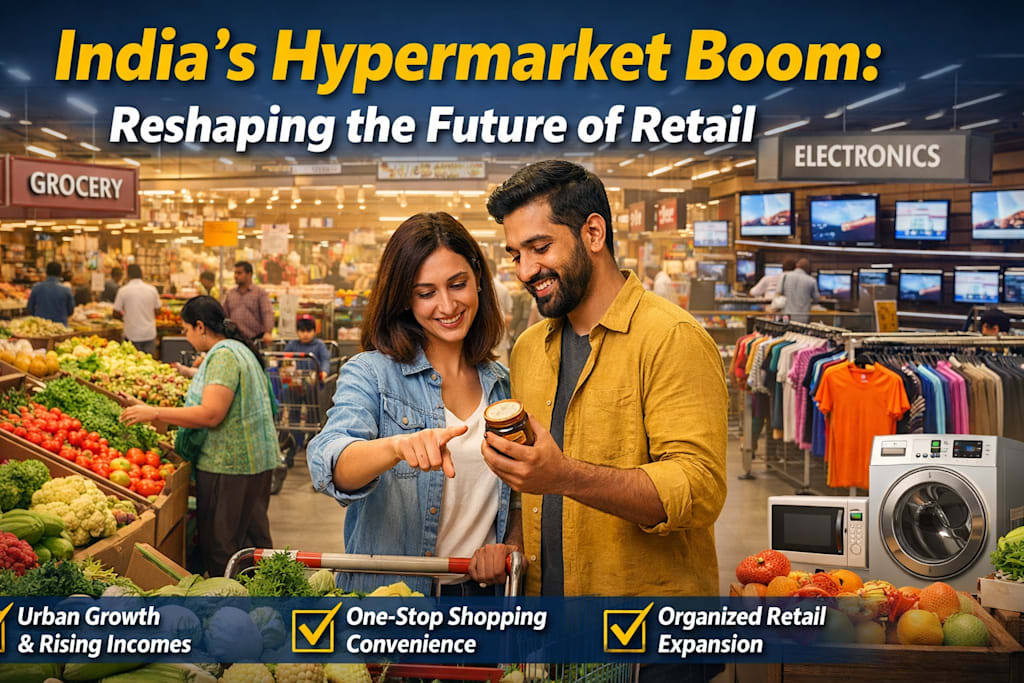
The weekly grocery run is no longer just about vegetables, rice, and cooking oil. For many urban Indian families, shopping has become an experience — one that blends convenience, value, variety, and lifestyle into a single visit. This is exactly where hypermarkets are finding their place in India’s evolving retail story.
From groceries and fresh produce to apparel, electronics, home goods, and appliances, hypermarkets are increasingly becoming the preferred destination for households that want everything under one roof. And that shift is no longer a small urban trend. It is becoming a major structural transformation in Indian retail.
According to Renub Research, the India Hypermarket Market is expected to grow from US$ 30.05 Billion in 2025 to US$ 43.63 Billion by 2034, expanding at a CAGR of 4.23% from 2026 to 2034. That growth reflects more than just retail expansion — it reflects a broader change in consumer behavior, urban development, and the country’s appetite for organized shopping environments.
The Rise of the “Everything in One Place” Consumer
India’s hypermarket growth is not happening in isolation. It is being shaped by the realities of modern life.
Today’s consumers — especially in metro cities and rising tier-II urban centers — are looking for efficiency. Time has become more valuable. Traffic is heavier. Family schedules are tighter. And shopping, for many people, is no longer something they want to do across five different stores in a crowded market.
Hypermarkets solve that problem neatly.
They allow a customer to buy vegetables, snacks, detergent, school supplies, shirts, a mixer grinder, and maybe even a microwave in a single trip. That kind of convenience matters — especially for working couples, nuclear families, and young urban households trying to simplify their routines.
It is not just about product availability. It is also about predictability. Consumers increasingly prefer shopping spaces that offer transparent pricing, cleaner environments, standardized quality, wider aisles, parking access, digital payment convenience, and frequent discounts. Traditional retail still has deep roots in India, but organized retail is becoming far more attractive for households seeking both convenience and confidence in what they buy.
Urban India Is Driving the Hypermarket Boom
One of the biggest reasons behind the market’s expansion is India’s urban transformation.
As cities expand outward and new residential zones emerge around metros and tier-II hubs, hypermarkets are becoming natural anchors for modern retail ecosystems. Shopping malls, mixed-use developments, suburban townships, and highway-connected urban clusters are creating ideal locations for large-format stores.
Urban consumers are also shopping differently than they did a decade ago. Weekend family shopping has become more common. Bulk purchases are more accepted. Consumers are more willing to explore private-label goods if the quality is good and the price feels justified.
This is important because hypermarkets are not built only around convenience — they are built around basket expansion. The longer a shopper stays, the more categories they tend to explore. That translates directly into higher average spending per visit.
As Indian cities continue to grow and household structures continue to evolve, hypermarkets are positioned to benefit from a retail environment where convenience and assortment increasingly matter more than habit.
Rising Incomes Are Creating More Aspirational Buyers
Another major reason hypermarkets are growing is simple: Indian consumers are earning more and expecting more.
As disposable incomes rise, spending patterns are becoming more diversified. Households are not just spending on essentials anymore. They are spending on better packaged foods, lifestyle products, home upgrades, small appliances, personal care items, and branded consumer goods.
That is where hypermarkets gain a clear advantage.
Unlike smaller stores, they are able to showcase a wide range of brands and price points in one place. A customer can compare premium and value options side by side. They can buy essentials and indulge in aspirational purchases in the same cart. That makes hypermarkets highly effective in serving India’s growing middle class.
Renub Research notes that India’s per capita disposable income rose from US$ 2.11 thousand in 2019 to US$ 2.54 thousand in 2023, and is estimated to reach US$ 4.34 thousand by 2029. This kind of income progression matters because it supports not only greater purchasing power, but also changing consumption behavior across both urban and emerging markets.
In practical terms, that means more shoppers are willing to pay for convenience, quality assurance, modern store environments, and promotional value — all of which fit the hypermarket model extremely well.
Why Organized Retail Has a Structural Advantage
India has long been dominated by unorganized retail, but the tide has been slowly shifting.
Hypermarkets benefit from something that traditional fragmented retail often struggles to match: supply chain efficiency.
Centralized procurement, better warehousing, cold chain logistics, inventory planning, and data-based stocking systems allow hypermarkets to operate with more consistency. This is especially important in categories like fresh produce, packaged food, frozen goods, and personal care products, where availability and quality control matter.
The modernization of India’s supply chain ecosystem has made large-format retail more viable than it was in previous decades. Reduced wastage, better transportation, and improved product tracking have strengthened the economics behind hypermarket expansion.
That operational backbone is one reason why major players continue investing in India’s organized retail future. A notable example mentioned in the market outlook is Lulu Group International’s launch of its first hypermarket and major mall presence in Hyderabad in September 2023, underscoring the continued confidence global retail operators have in India’s growth story.
Food and Grocery Still Rule the Floor Space
If hypermarkets are the future of organized retail, food and grocery remain their foundation.
This segment is what keeps people coming back regularly. While electronics or home appliances may bring occasional spikes in sales, it is groceries and household essentials that generate recurring traffic and repeat purchasing behavior.
That makes food and grocery the heartbeat of the hypermarket business model in India.
Fresh produce, staples, snacks, dairy, beverages, packaged food, and cleaning essentials create dependable footfall. Once shoppers are already in the store for these necessities, they are more likely to explore adjacent categories like apparel, home décor, cookware, or personal care.
This cross-category advantage is one of the most powerful features of the hypermarket format. It is not just about selling groceries — it is about using groceries to unlock spending across multiple departments.
At the same time, private-label offerings are becoming more important. For price-sensitive Indian consumers, these products can offer a balance of affordability and perceived value. For retailers, they often improve margins and brand loyalty.
Beyond Groceries: Why Appliances and Apparel Matter Too
Hypermarkets in India are also becoming stronger in non-food categories.
Home appliances are emerging as a particularly valuable segment because they carry higher ticket sizes and better margins. As urban housing grows and consumers increasingly invest in household upgrades, products like mixers, air fryers, fans, microwaves, irons, and smart appliances are becoming more relevant inside organized retail formats.
Similarly, apparel and accessories continue to play an important role — especially among shoppers looking for affordable fashion and convenience purchases. Many consumers may not visit a hypermarket specifically for clothing, but they often leave with apparel items because the purchase feels easy, accessible, and value-driven.
That is the real power of the format: it creates planned and unplanned consumption under the same roof.
The Real Challenge: India Still Loves the Kirana Store
Despite all this momentum, hypermarkets do not have an easy road ahead.
India’s traditional kirana ecosystem remains one of the most resilient retail systems in the world. Local neighborhood stores still win on proximity, familiarity, informal credit, and quick convenience. In many communities, they are not just retail points — they are part of daily life.
At the same time, e-commerce has added a second layer of pressure.
Consumers now have access to home delivery, app-based discounts, fast commerce, and online grocery convenience. This means hypermarkets are not just competing with local stores — they are competing with the smartphone.
That creates a very real strategic challenge: how do physical retailers maintain footfall in an age of digital convenience?
The answer, increasingly, lies in experience, assortment, pricing, and omnichannel integration. Hypermarkets that can combine physical presence with digital convenience are likely to perform better than those that rely only on store traffic.
Margins Are Tight, and Expansion Is Expensive
There is also the financial side of the story.
Running a hypermarket in India is expensive. Large spaces require high rental commitments, significant staffing, energy costs, inventory management, logistics coordination, and constant promotional spending. Add to that the complexity of state-level regulations, licensing requirements, labor compliance, and taxation frameworks, and it becomes clear that scale alone does not guarantee easy profitability.
This is why not every player can succeed in the hypermarket model.
Winning in this market requires strong operational discipline, supply chain sophistication, local consumer understanding, and the ability to sustain margins in a highly competitive environment.
Where the Growth Is Happening Across India
Geographically, the opportunity is broad — but not uniform.
States like Maharashtra remain highly attractive due to dense urban populations, strong purchasing power, and mature retail infrastructure. Cities such as Mumbai, Pune, and Nagpur provide fertile ground for organized retail formats that can handle both essential and aspirational demand.
Uttar Pradesh is also emerging as a major long-term market, especially as tier-II and tier-III cities continue to urbanize and modernize. In high-population states like UP, even moderate shifts toward organized retail can create enormous volume opportunities.
For eastern India, West Bengal presents a particularly interesting case. While the state has traditionally leaned heavily on neighborhood markets and conventional retail channels, consumer behavior is slowly shifting. In cities such as Kolkata, Durgapur, Asansol, and Siliguri, demand for organized shopping experiences is rising steadily, particularly among younger and urban households. Price sensitivity remains high, but so does the appetite for convenience and product variety.
That combination makes West Bengal one of the more promising steady-growth markets for hypermarket expansion in the years ahead.
The Future of Hypermarkets in India Is Not Just Bigger — It’s Smarter
The most successful hypermarkets in India’s future will not necessarily be the biggest. They will be the smartest.
They will know how to localize product assortments. They will use data to manage inventory more efficiently. They will build stronger private-label portfolios. They will create a better in-store experience while also embracing digital tools, loyalty ecosystems, and omnichannel retail behavior.
They will also understand a critical truth about India: this is not a one-size-fits-all market.
Consumer preferences differ sharply by city, region, income group, and lifestyle. Hypermarket operators that treat India as a collection of local retail realities — rather than one giant uniform opportunity — will likely outperform those that do not.
And that may be the biggest story hidden inside the numbers.
India’s hypermarket market is not just expanding because stores are getting larger. It is growing because Indian consumers are becoming more intentional, more aspirational, and more open to retail formats that combine value with convenience.
That shift may look gradual from the outside. But in business terms, it is deeply significant.
Final Thoughts
India’s retail landscape is entering a more organized, consumer-centric phase — and hypermarkets are becoming an important part of that transformation.
As urban lifestyles intensify, disposable incomes rise, and consumer expectations evolve, the hypermarket model is finding stronger relevance across the country. It still faces real competition from kirana stores and e-commerce, but its value proposition remains powerful: choice, convenience, and cost efficiency in one place.



Comments
There are no comments for this story
Be the first to respond and start the conversation.