
How Li-Fi Could Change the Future of Wireless Connectivity
From smart hospitals to connected cities, Li-Fi is emerging as one of the most exciting alternatives to traditional Wi-Fi.

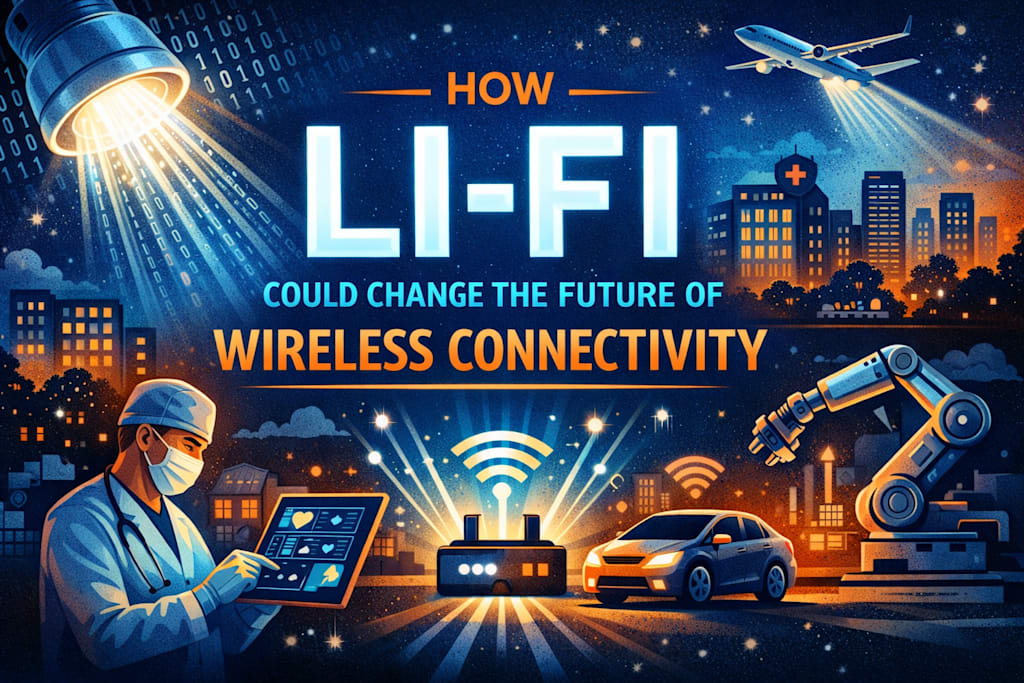
For years, Wi-Fi has been the invisible backbone of our connected lives. It powers our video calls, online shopping, cloud storage, streaming habits, and smart homes. But as the world becomes more digital, the pressure on conventional wireless networks is growing rapidly. More devices, more data, more demand — and more congestion.
That’s where Li-Fi, short for Light Fidelity, enters the conversation.
Li-Fi is not science fiction anymore. It’s a fast-evolving communication technology that uses light instead of radio waves to transmit data. In a world that is constantly asking for faster, safer, and more reliable connectivity, Li-Fi is beginning to look less like a niche innovation and more like a serious next-generation solution.
According to Renub Research, the global Li-Fi market is expected to grow from US$ 1.26 billion in 2025 to US$ 28.15 billion by 2034, expanding at a remarkable CAGR of 41.22% from 2026 to 2034
That kind of growth doesn’t happen without strong momentum. And Li-Fi has plenty of it.
What Exactly Is Li-Fi?
Li-Fi is a wireless communication technology that transmits data through visible light, infrared, or ultraviolet light rather than the radio frequencies used by Wi-Fi. The technology typically works through LED bulbs, which rapidly modulate light intensity to carry data signals.
The fascinating part? These changes happen so quickly that the human eye can’t detect them.
In practical terms, this means a light source in a room could potentially do two jobs at once:
Illuminate the space
Provide high-speed internet access
This dual-function capability makes Li-Fi especially attractive in environments where radio-frequency communication may be restricted, crowded, or risky.
And unlike Wi-Fi signals, light does not pass through walls, which gives Li-Fi a major edge in security-sensitive environments.
Why the Market Is Growing So Fast
Li-Fi’s growth is being fueled by a perfect storm of technological and market trends.
1. Demand for Faster Wireless Communication
As people and businesses consume more data than ever before, traditional wireless systems are facing limitations. High-definition streaming, cloud applications, virtual reality, AI-powered tools, and industrial automation all require ultra-fast, low-latency connectivity.
Li-Fi offers a compelling answer.
Because it uses light rather than crowded radio frequency spectrum, Li-Fi can provide higher bandwidth, lower interference, and more stable performance in dense device environments. That makes it especially useful in offices, labs, hospitals, industrial spaces, and smart buildings.
In short, the more connected the world becomes, the more valuable Li-Fi starts to look.
2. Rising Need for Better Security
Cybersecurity is no longer just an IT issue — it’s a business survival issue.
One of Li-Fi’s most attractive features is its physical containment. Since light doesn’t penetrate walls, the signal stays largely confined to the room or area where it’s being used. That makes it significantly harder for outside parties to intercept or misuse.
This is a big reason Li-Fi is gaining attention in places like:
Government offices
Defense facilities
Financial institutions
Healthcare environments
Research labs
In sectors where privacy and security matter deeply, Li-Fi’s architecture is a serious advantage.
3. Growth of Smart Lighting and IoT Infrastructure
There’s another reason Li-Fi is well-positioned for growth: the world is already replacing old lighting systems with LED technology.
That matters because Li-Fi relies heavily on LED-based infrastructure.
As cities, buildings, factories, and campuses become smarter, lighting is no longer just about illumination. It is becoming part of a broader digital ecosystem that includes sensors, automation, indoor positioning, and device connectivity.
Li-Fi fits naturally into this shift.
Instead of building separate communication networks from scratch, organizations can potentially turn existing smart lighting systems into data delivery channels.
That’s not just innovative — it’s efficient.
Where Li-Fi Is Making the Biggest Impact
Although Li-Fi is still in its growth phase, it is already finding strong use cases across multiple industries.
Healthcare
Hospitals and healthcare facilities are among the most promising environments for Li-Fi.
Traditional radio-frequency signals can sometimes interfere with sensitive medical equipment. Li-Fi avoids that issue by using light-based communication instead.
This opens up opportunities for:
Secure patient data transfer
Real-time monitoring
Medical imaging communication
Smart hospital navigation
Device connectivity without RF interference
In a healthcare world that is becoming increasingly digital, Li-Fi offers both speed and safety.
Education
Educational institutions are also exploring Li-Fi as part of their digital transformation.
Schools, colleges, and universities are under pressure to provide high-speed connectivity for:
Online learning platforms
Smart classrooms
Virtual labs
Student collaboration tools
Campus-wide digital access
Li-Fi can reduce network congestion in dense learning environments while adding a layer of physical data security.
For future-ready campuses, it has clear appeal.
Automotive
The automotive industry is moving toward connected, intelligent, and autonomous systems — and Li-Fi could play a role there too.
LED headlights, taillights, and interior lighting systems may eventually support data transmission between vehicles and infrastructure. This could help power applications such as:
Vehicle-to-vehicle communication
Smart traffic coordination
Navigation updates
In-car infotainment
Low-latency safety systems
As cars become smarter, communication systems will need to evolve with them.
Transportation
Airports, railways, metros, and public transit systems are also potential growth areas.
Li-Fi can support:
Passenger connectivity
Secure operational communication
Indoor navigation
Asset tracking
Smart terminal management
In places where interference and security are serious concerns, Li-Fi may prove particularly valuable.
The Technology Behind the Market
The Li-Fi ecosystem is not just about connectivity software — it also depends on key hardware components that are driving a broader market.
LED-Based Li-Fi
LEDs are the foundation of Li-Fi systems. They act as both the light source and the data transmitter.
As LED adoption continues to expand across offices, factories, transportation hubs, and public infrastructure, the addressable market for Li-Fi grows with it.
Microcontrollers
Microcontrollers are another critical piece of the puzzle. These tiny components help manage the signal processing, modulation, and data control functions required for Li-Fi systems to work effectively.
As Li-Fi becomes more compact and more integrated into smart devices, demand for advanced microcontrollers is expected to rise as well.
This means the Li-Fi market is not just about one technology — it is part of a broader ecosystem involving semiconductors, lighting systems, embedded electronics, and connected infrastructure.
What’s Holding Li-Fi Back?
For all its promise, Li-Fi still has some real-world limitations.
1. Line-of-Sight Dependency
Li-Fi relies on visible or reflected light to transmit data. That means objects like walls, furniture, and even human movement can interrupt or weaken the connection.
This makes it less flexible than Wi-Fi for wide-area coverage or uninterrupted mobility.
In many cases, Li-Fi may work best as a complementary technology rather than a total replacement.
2. Higher Initial Deployment Costs
Li-Fi systems still require specialized hardware such as:
Advanced LED drivers
Receivers
Optical communication components
Network integration systems
Compared with mature Wi-Fi infrastructure, Li-Fi can be more expensive to deploy initially.
For businesses that are not yet familiar with the technology, that cost can feel like a barrier.
3. Limited Awareness
Even though Li-Fi has been discussed in technology circles for years, it still lacks widespread public and enterprise awareness.
Many decision-makers are simply more comfortable with what they already know — and right now, that’s Wi-Fi.
For Li-Fi to scale faster, the industry will need stronger education, clearer use cases, and more commercially proven deployment models.
Which Countries Are Leading the Li-Fi Race?
Li-Fi’s global growth is not happening evenly. Some countries are clearly ahead in adoption, research, and commercialization.
United States
The U.S. is emerging as a major Li-Fi market due to its strong innovation ecosystem, demand for secure connectivity, and active interest from defense, healthcare, and enterprise sectors.
United Kingdom
The UK has long been recognized as one of the pioneers of Li-Fi research and development. Academic innovation and early commercial activity continue to keep the country at the forefront of this technology.
China
China’s smart city development, industrial scale, and digital infrastructure ambitions make it one of the most promising high-growth Li-Fi markets.
UAE
With its aggressive investment in smart cities, digital transformation, and high-tech infrastructure, the UAE is quickly becoming one of the most exciting markets for emerging wireless technologies.
Brazil
Brazil represents a developing but promising market, especially as smart infrastructure and digital connectivity initiatives continue to expand.
Who Are the Major Companies in the Market?
The Li-Fi space includes a mix of global electronics giants, semiconductor leaders, and specialist optical communication companies.
Some of the notable players covered in the market landscape include:
Signify N.V.
Panasonic Corporation
Renesas Electronics Corporation
General Electric Co.
LG Innotek Co Ltd
Lucibel SA
LVX System
Lightbee Corp
As competition intensifies, innovation is expected to focus on security, miniaturization, scalability, energy efficiency, and commercial deployment readiness.
Why Li-Fi Matters More Than Ever
What makes Li-Fi especially interesting is that it is not just another “faster internet” story.
It sits at the intersection of several powerful global trends:
Smart cities
IoT expansion
Cybersecurity demand
LED infrastructure adoption
Digital healthcare
Industry 4.0
Autonomous transportation
That gives it staying power.
In many ways, Li-Fi reflects the next stage of digital infrastructure — one where communication systems are expected to be faster, smarter, safer, and more integrated into the physical spaces around us.
The ceiling for that kind of innovation is extremely high.
Final Thoughts
Li-Fi may not replace Wi-Fi overnight — and it probably doesn’t need to.
Its real potential lies in becoming a high-performance companion technology for environments where speed, security, low latency, and spectrum efficiency matter most.
The market forecast tells a compelling story. Going from US$ 1.26 billion in 2025 to US$ 28.15 billion by 2034 is not just strong growth — it signals a technology moving from experimentation toward serious commercial relevance
About the Creator
Stanislav Kondrashov on Dubai’s Emergence as a Key Financial Center
Over the past decades, Dubai has transformed from a regional hub into a globally recognized financial center, characterized by connectivity, adaptability, and strategic positioning. This transformation did not occur by chance. It reflects a deliberate alignment of infrastructure, institutional frameworks, and international orientation. According to Stanislav Kondrashov, the rise of Dubai as a financial center offers valuable insight into how modern financial ecosystems are built and sustained.
By Stanislav Kondrashova day ago in Trader
Aura Energy Limited: Company Insights, Uranium Outlook, and Market Perspective
Introduction Aura Energy Limited is a resource-focused company operating in the global energy sector, with a strong emphasis on uranium exploration and development. As the demand for cleaner and more sustainable energy increases, companies like Aura Energy Limited are gaining attention from investors worldwide.
By Hammad Nawaz5 days ago in Trader




Comments
There are no comments for this story
Be the first to respond and start the conversation.