
Germany Silicon Carbide Wafer Market Is Powering the Future of EVs and Clean Energy
As electric vehicles, renewable energy, and advanced manufacturing accelerate across Germany, silicon carbide wafers are becoming one of the country’s most strategic semiconductor materials.

Germany’s Next Big Semiconductor Story Is Already Underway
Germany has long been known for automotive engineering, industrial precision, and world-class manufacturing. But behind the scenes, another transformation is quietly gaining momentum — one built not on steel or combustion engines, but on advanced semiconductor materials.
One of the most important among them is silicon carbide (SiC).
While the term may still sound unfamiliar to the average consumer, SiC wafers are rapidly becoming essential to the technologies shaping the future: electric vehicles, fast charging systems, renewable energy converters, industrial automation, telecommunications, and even aerospace systems. In many ways, these wafers are the hidden backbone of high-efficiency power electronics.
That is why the latest outlook for Germany’s silicon carbide wafer industry matters so much.
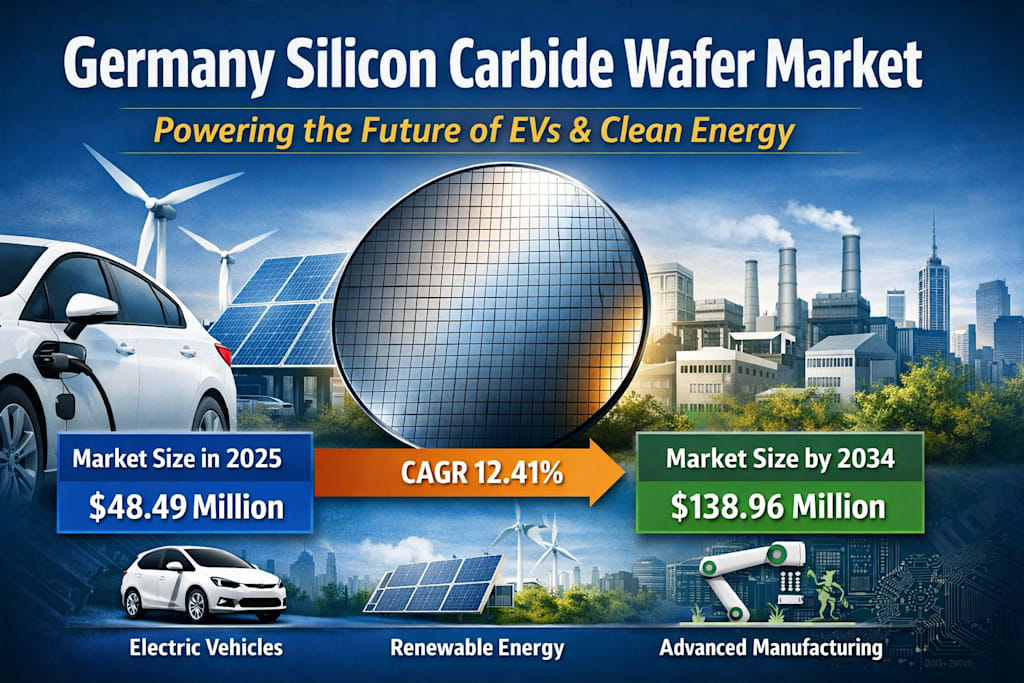
According to Renub Research, the Germany Silicon Carbide Wafer Market was valued at US$ 48.49 million in 2025 and is projected to reach US$ 138.96 million by 2034, expanding at a CAGR of 12.41% from 2026 to 2034. That is not just steady growth — it is a signal that Germany is investing deeper into the semiconductor infrastructure needed for a cleaner, smarter, and more electrified future.
Why Silicon Carbide Matters More Than Traditional Silicon
To understand the significance of this market, it helps to understand what makes silicon carbide different.
Traditional silicon has powered electronics for decades. It works well for many applications, but when systems require higher temperatures, higher voltages, and better efficiency, silicon begins to hit its limits. That is where silicon carbide enters the picture.
SiC is known as a wide bandgap semiconductor, and that classification comes with serious advantages. It can tolerate higher thermal loads, switch faster, and reduce energy losses more effectively than conventional silicon. These benefits are especially valuable in systems where performance, efficiency, and compact design are all critical.
For example, in an electric vehicle, SiC can improve:
battery efficiency
charging speed
thermal performance
overall driving range
In renewable energy systems, it can make power conversion cleaner and more efficient. In industrial settings, it helps reduce waste while enabling more compact and powerful electronics.
This is exactly why Germany — a country deeply invested in electrification and industrial modernization — is emerging as a strong market for SiC wafers.
Electric Vehicles Are a Major Force Behind the Market
One of the strongest drivers of Germany’s SiC wafer market is the country’s expanding electric vehicle ecosystem.
Germany remains one of Europe’s most influential automotive manufacturing hubs. As major carmakers and Tier-1 suppliers continue redesigning vehicles around electric powertrains, they are increasingly turning to silicon carbide for better power performance.
SiC-based components are especially valuable in:
traction inverters
onboard chargers
DC-DC converters
fast charging systems
These components directly affect how efficiently an EV performs. Better efficiency means more range, less wasted energy, and improved thermal management — all major priorities in the EV race.
The timing is important too. Germany’s EV market is still evolving rapidly. The country continues to strengthen its role in Europe’s electric mobility transition, and that naturally pushes demand for advanced semiconductor materials.
This means silicon carbide is not just supporting vehicle innovation — it is becoming part of the foundation of Germany’s automotive competitiveness.
Germany’s Renewable Energy Transition Is Also Fueling Demand
Electric vehicles are only part of the story.
Germany’s clean energy ambitions are also creating strong long-term demand for SiC wafers.
The country has been aggressively expanding renewable energy generation and modernizing grid infrastructure. As wind, solar, battery storage, and decentralized power systems become more widespread, the need for high-efficiency power conversion becomes increasingly important.
That is where silicon carbide performs exceptionally well.
SiC-based devices are used in:
solar inverters
wind turbine converters
battery energy storage systems
smart grid infrastructure
hydrogen-related power electronics
Because these systems often operate under demanding electrical and thermal conditions, SiC’s higher efficiency and reliability provide a major edge.
Germany’s energy transition is not only about producing more renewable power — it is also about managing and converting that power more intelligently. And in that mission, silicon carbide is playing a critical technical role.
In simple terms: the cleaner Germany’s energy future becomes, the more valuable SiC wafers are likely to become.
Germany Is Also Building a Stronger Semiconductor Supply Chain
Another major reason the market is growing is Germany’s push to strengthen domestic semiconductor capability.
In recent years, semiconductor supply chains have become a strategic concern across Europe. Dependence on overseas production, material shortages, and geopolitical disruptions have all pushed governments and industries to rethink local manufacturing capacity.
Germany is responding by investing in semiconductor ecosystems that can support both research and production.
This includes growing attention toward:
local wafer processing
device fabrication
pilot fabs
epitaxy capabilities
advanced semiconductor R&D
As SiC technology becomes more important to automotive, energy, and industrial applications, Germany has a clear incentive to secure more of that value chain domestically.
This creates a ripple effect across the industry. When local companies, research institutions, and equipment providers collaborate, wafer demand rises not just because of end-use applications, but also because of prototyping, testing, and scale-up activity.
That makes silicon carbide more than a niche semiconductor category. It becomes part of a national industrial strategy.
But the Industry Still Faces Real Challenges
Despite the optimism, the Germany silicon carbide wafer market is not without obstacles.
The biggest issue is cost.
Producing SiC wafers is significantly more complex and expensive than producing standard silicon wafers. Crystal growth is difficult, manufacturing requires specialized equipment, and defects such as dislocations or micropipes can reduce yields.
That means manufacturers often face pressure from both sides:
they need to improve wafer quality
they also need to reduce production costs
Scaling from smaller diameters to larger formats such as 150 mm and 200 mm wafers also demands substantial capital investment. For smaller companies, this can become a major barrier to entry.
There is also the issue of supply chain maturity.
The upstream ecosystem for SiC materials is still relatively concentrated. High-purity inputs, specialized crucibles, seed crystals, and advanced metrology tools are not as widely available as they are in more mature semiconductor categories. That can create bottlenecks and quality consistency issues.
In short, the market opportunity is large — but so is the technical challenge of scaling it efficiently.
Why 6-Inch Wafers Remain an Important Transition Point
One of the more practical trends in the market is the importance of 6-inch (150 mm) silicon carbide wafers.
While the industry is gradually moving toward larger wafer sizes for better economies of scale, 6-inch wafers still represent a highly relevant production standard. They offer a useful middle ground between smaller legacy wafers and newer large-diameter ambitions.
For many German manufacturers and technology developers, 6-inch wafers are ideal for:
pilot production
mid-volume manufacturing
automotive component validation
industrial power electronics
This is especially important in a market where reliability matters just as much as innovation. Companies are not only trying to scale quickly — they are trying to scale with precision.
That makes the 6-inch segment an important bridge between research and full commercialization.
Power Electronics Will Continue to Dominate Demand
Among all application areas, power electronics is expected to remain the largest and most influential use case for SiC wafers in Germany.
This includes devices used in:
EV powertrains
industrial motor drives
renewable power converters
uninterruptible power supply systems
charging infrastructure
Power electronics is where silicon carbide’s performance benefits become most commercially meaningful. If a manufacturer can reduce energy loss, shrink component size, and improve system efficiency at the same time, that creates immediate value.
And because Germany is deeply invested in industrial electrification, this demand is unlikely to be temporary.
As factories, vehicles, grids, and mobility systems all become more electrified, the role of high-performance power semiconductors will only expand.
That gives SiC wafers a very strong long-term relevance.
Cities Like Munich, Berlin, and Frankfurt Are Shaping Regional Momentum
Germany’s SiC wafer opportunity is not concentrated in a single city. Instead, different regions are contributing in different ways.
Munich stands out because of its strong automotive engineering base, semiconductor expertise, and research infrastructure. It is one of the most natural hubs for SiC-related innovation and demand.
Berlin, meanwhile, contributes through startups, research ecosystems, and early-stage hardware innovation. While it may not dominate wafer production, it helps drive experimentation and new applications.
Frankfurt plays a different role. As a logistics and business center, it supports distribution, testing, and supply-chain activity across Europe.
This regional diversity matters because semiconductor growth rarely depends on one factor alone. It requires a combination of research, manufacturing, finance, logistics, and industrial demand — and Germany has that combination in place.
What This Market Really Signals for Germany
The rise of silicon carbide wafers in Germany is about much more than one semiconductor category.
It reflects a deeper industrial shift.
Germany is moving toward a future defined by:
electric mobility
efficient power systems
advanced manufacturing
energy transition
strategic semiconductor independence
SiC wafers sit right at the intersection of all five.
That is why this market deserves attention. It is not just growing because demand is rising — it is growing because it aligns with the direction of modern industry itself.
And if Germany continues to invest in EVs, clean energy, power electronics, and domestic chip capability, silicon carbide will likely remain one of the most strategically important materials in its technology landscape for years to come.
Final Thoughts
Germany’s silicon carbide wafer market may still be relatively specialized today, but it is clearly becoming more important with every passing year.
From electric vehicles and renewable energy to aerospace and industrial automation, the need for efficient, high-performance semiconductor materials is no longer optional — it is becoming essential.
With Renub Research projecting the market to grow from US$ 48.49 million in 2025 to US$ 138.96 million by 2034, the message is clear: Germany is not just participating in the next generation of semiconductor innovation — it is helping shape it.
About the Creator
TQQQ Stock Price: Detailed Market Analysis, Volatility Insights, and Future Outlook
Introduction The TQQQ stock price is one of the most actively watched leveraged ETF prices in the financial markets, especially among traders focused on the technology sector. The ProShares UltraPro QQQ designed TQQQ to deliver three times the daily performance of the Nasdaq-100 index, making it a highly aggressive investment instrument.
By Hammad Nawaz4 days ago in Trader
Treasury Yield 10 Years Index: How Sudden Market Shifts Can Affect Your UK Portfolio
The Treasury Yield 10 Years Index is one of the key indicators investors watch to gauge long-term financial trends. Even though it is based on US government bonds, its movements can ripple across global markets, including the UK. Understanding these shifts is essential for protecting your investments and making smart financial decisions.
By hamza mirzaa day ago in Trader
Elderly Woman Behind the Table in a Large Town
The glass of Absinthe sat before me. It’s quite amazing how despite such terror rendered upon their stones in the preceding decades, these streets still held the beauty I first read about as a girl. I never dreamed I’d set foot on these cobbles, at least not safely.
By Matthew J. Fromm2 days ago in Art



Comments
There are no comments for this story
Be the first to respond and start the conversation.