
Europe PEEK Market Set for Strong Growth as Aerospace, Medical, and EV Demand Accelerates
High-performance polymer adoption rises across Europe as industries seek lightweight, heat-resistant, and durable materials for next-generation applications

When industries begin replacing metals with advanced polymers, it usually signals a larger transformation in manufacturing. Across Europe, that transformation is becoming increasingly visible through the rising adoption of Polyether Ether Ketone (PEEK)—a high-performance thermoplastic now finding a firm place in aerospace cabins, electric vehicles, medical implants, industrial machinery, and precision-engineered components.
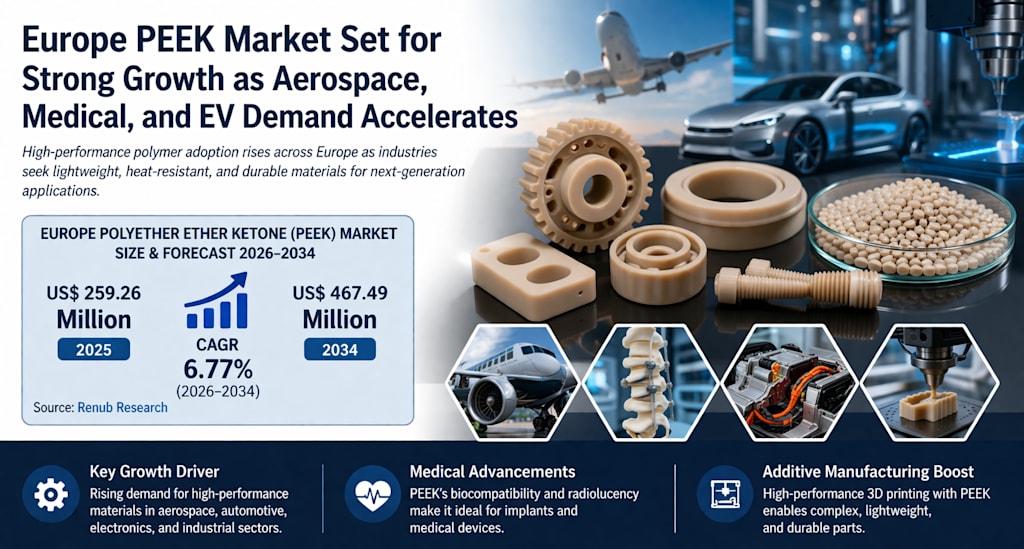
According to Renub Research, the Europe Polyether Ether Ketone (PEEK) Market is projected to increase from US$ 259.26 Million in 2025 to US$ 467.49 Million by 2034, expanding at a CAGR of 6.77% during 2026–2034. That growth reflects more than just material innovation. It points to a structural shift in how Europe is building the future of mobility, healthcare, electronics, and industrial production.
PEEK is not a mass-market plastic. It is a specialty material valued for its ability to withstand temperatures above 250°C, resist aggressive chemicals, maintain mechanical strength under stress, and perform reliably in highly demanding environments. In practical terms, that means manufacturers can use it where traditional plastics fail and where metal alternatives may be too heavy, too costly to machine, or less efficient in modern applications.
Why Europe Is Becoming a Key Market for PEEK
Europe’s manufacturing ecosystem is uniquely positioned to support the growth of high-performance polymers. The region has strong aerospace capabilities, a mature automotive sector, advanced medical technology clusters, and a growing emphasis on sustainability and lightweight engineering. Those trends align almost perfectly with what PEEK offers.
In aerospace, every gram matters. In electric vehicles, thermal stability and electrical insulation are becoming more important. In medical devices, biocompatibility and imaging compatibility can influence treatment outcomes. PEEK fits into all of those needs at once. That is why it is no longer viewed as a niche engineering polymer alone. It is increasingly seen as a strategic material.
Another important reason for Europe’s interest in PEEK is the push toward long-life, low-maintenance, and energy-efficient systems. Manufacturers are under pressure to design products that last longer, consume less energy, and meet stricter environmental and regulatory requirements. Materials that combine durability, lightweight performance, and resistance to wear are becoming central to those efforts.
The Push for High-Performance Engineering Plastics
One of the biggest drivers behind the Europe PEEK market is the rising demand for high-performance engineering plastics that can replace metal in critical applications. The value proposition is straightforward: reduce weight without sacrificing strength or thermal resistance.
This is especially important in sectors such as aerospace and automotive, where lightweighting directly contributes to fuel efficiency, emissions reduction, and improved system performance. In electronics, PEEK’s dielectric properties make it attractive for compact, high-reliability parts. In industrial machinery, it helps extend component life in harsh operating conditions where friction, pressure, and chemical exposure are constant concerns.
The market is also being supported by commercial product innovation. In September 2025, Essentra Components launched a new range of PEEK fasteners designed for extreme operating environments, highlighting how the material is expanding into increasingly specialized industrial applications.
Medical Demand Is Becoming a Major Growth Engine
One of the most compelling stories within the European PEEK market is its rising use in the healthcare and medical device industries. PEEK offers several characteristics that make it highly attractive for medical applications: it is biocompatible, radiolucent, lightweight, and has mechanical properties that are often compared favorably with human bone.
That combination has made it a preferred material for spinal cages, dental implants, cranial plates, trauma fixation systems, and other orthopedic applications. Unlike metal implants, PEEK allows clearer post-operative imaging through MRI and X-ray systems, which improves clinical monitoring and treatment assessment.
Europe’s aging population and rising prevalence of orthopedic and degenerative spinal conditions are also supporting demand. Countries such as Germany, France, and the United Kingdom already have advanced healthcare infrastructure and strong medical engineering ecosystems, which helps accelerate adoption.
The industry is not standing still, either. In October 2023, Victrex plc introduced VICTREX PC 101, a new PEEK product grade aimed at non-implantable pharmaceutical contact and drug delivery applications—showing that innovation is broadening beyond implants into adjacent healthcare uses.
Additive Manufacturing Is Expanding PEEK’s Potential
Another powerful catalyst for the market is the rise of additive manufacturing and precision engineering across Europe. PEEK is increasingly being used in high-temperature 3D printing, particularly for functional components that need excellent heat resistance, dimensional stability, and mechanical performance.
That makes it especially attractive in sectors where customized, low-volume, or highly complex parts are required—such as aerospace, medical devices, and advanced automotive systems. Traditional machining or metal fabrication can be expensive and time-consuming for such components, whereas additive manufacturing offers more design freedom and faster iteration.
As Europe moves deeper into Industry 4.0, demand for materials that support digital manufacturing and on-demand production is expected to rise. PEEK fits neatly into that trend because it combines process flexibility with high-end performance.
In May 2023, Evonik signed a non-exclusive distribution agreement with ProductionToGo for INFINAM PEEK filaments and photopolymers across the EU, Switzerland, Norway, and the UK. That development underlines the growing commercialization of PEEK within the additive manufacturing ecosystem.
What’s Holding the Market Back?
Despite its impressive performance, PEEK still faces important barriers to wider adoption.
The most obvious challenge is cost. PEEK is expensive to produce because it requires high-purity monomers, tightly controlled manufacturing conditions, and specialized processing equipment. Manufacturers also need high-temperature molding, extrusion, or additive manufacturing systems to work with the material effectively. That creates a higher cost structure than most conventional polymers.
For large-scale industrial users, that cost can often be justified by performance and durability. But for smaller manufacturers or cost-sensitive applications, the economics are less straightforward. Engineers and procurement teams often have to evaluate whether PEEK’s benefits truly outweigh cheaper alternatives.
And alternatives do exist. Competing high-performance materials such as polyetherimide (PEI), polysulfone, polyphenylene sulfide (PPS), high-grade nylons, composites, and even aluminum alloys can sometimes deliver “good enough” performance at a lower cost. In the medical field, titanium remains a trusted and well-established competitor in implant applications.
That means PEEK’s growth in Europe will likely remain strongest in applications where its extreme performance characteristics are genuinely necessary.
Segment Spotlight: Glass-Filled PEEK
Among the various forms of PEEK, glass-filled PEEK is gaining notable traction in Europe. By adding glass fibers, manufacturers can improve stiffness, dimensional stability, and creep resistance, making the material more suitable for structural and load-bearing components.
This segment is especially relevant in aerospace, automotive, and industrial machinery, where parts must maintain integrity under stress and over long operating cycles. Glass-filled PEEK is also used in pump components, bearings, gears, connector housings, and compressor parts, reflecting its broad industrial versatility.
As Europe continues to push for longer product life cycles and more energy-efficient systems, glass-filled PEEK is likely to remain an important performance solution.
Aerospace and Automotive Are Leading the Industrial Shift
Europe’s aerospace industry is one of the strongest long-term demand pillars for PEEK. Aircraft manufacturers and suppliers are increasingly using the material in brackets, cable insulation, seals, bearings, and cabin structures, thanks to its excellent strength-to-weight ratio and resistance to high temperatures, fuels, and lubricants.
This is especially relevant as Europe invests in next-generation aviation technologies, including hybrid propulsion, electric aircraft concepts, and more sustainable aircraft design.
The automotive sector is another high-potential growth area. PEEK is already being used in connectors, fuel handling systems, braking systems, transmission parts, bearings, and EV-related components. For electric vehicles, the material’s thermal stability and dielectric strength make it useful in battery components, motor casings, and high-voltage insulation systems.
As Europe tightens emissions regulations and pushes EV adoption further, the case for lightweight, durable, and thermally stable materials becomes even stronger.
Country-Level Growth: France, Germany, UK, and the Netherlands
Several European countries are emerging as especially influential in the PEEK market.
France benefits from its strong aerospace and medical device industries. PEEK is used there in aircraft interiors, structural parts, insulation, implants, and dental technologies. In March 2024, DEMGY Group and Drake Plastics announced the “Liberty Alliance,” under which DEMGY became a preferred distributor in France for machinable PEEK shapes serving aerospace, mobility, and semiconductor markets.
Germany remains one of Europe’s most important PEEK markets because of its strength in engineering, automotive manufacturing, industrial machinery, and medical technology. The country’s focus on precision manufacturing and materials innovation continues to support adoption across multiple sectors. In October 2023, Evonik introduced VESTAKEEP® iC4620 3DF and VESTAKEEP® iC4612 3DF, carbon-fiber-reinforced PEEK filaments for long-term 3D-printed medical implants.
The United Kingdom also stands out for its use of PEEK in medical devices, aerospace engineering, electronics, and automotive systems. The country’s additive manufacturing ecosystem is helping expand new use cases, particularly in healthcare. In 2023, Victrex introduced an implantable PEEK-OPTIMA polymer optimized for medical 3D printing applications.
Meanwhile, the Netherlands is carving out an important role through its advanced medical technology sector, semiconductor-related applications, and innovation-led manufacturing culture. The country’s interest in circular manufacturing and durable materials further supports PEEK’s relevance.
What the Future Looks Like
The future of the Europe PEEK market will likely be shaped by a few defining themes: lightweighting, electrification, advanced healthcare, and digital manufacturing.
As industries continue looking for materials that can perform under tougher conditions while also helping reduce weight and improve system efficiency, PEEK’s strategic value should only grow. The biggest question is not whether the material has performance advantages—it clearly does. The more important question is how quickly manufacturing economics, processing technologies, and application design can evolve to make it more widely accessible.
That is where innovation will matter most. New grades, better additive manufacturing processes, stronger supply partnerships, and application-specific product development could gradually make PEEK less exclusive and more commercially scalable across Europe.
For now, it remains one of the most important advanced polymers to watch.
Final Thoughts
Europe’s PEEK market is not being driven by hype. It is being driven by real industrial need.
When aerospace engineers need lighter components, when EV manufacturers need better thermal materials, when surgeons need implants that work with modern imaging, and when factories need parts that survive punishing environments—PEEK increasingly enters the conversation.
That is why the projected growth from US$ 259.26 Million in 2025 to US$ 467.49 Million by 2034 matters. It reflects a market moving from specialized demand toward broader strategic adoption.
About the Creator
Philippines Office Furniture Market 2026: Ergonomic Designs, Hybrid Workspaces & Modular Solutions
Philippines Office Furniture Market Overview The Philippines office furniture market is a steadily growing segment of the country’s commercial and interior design ecosystem, encompassing products such as desks, chairs, storage units, modular workstations and collaborative furniture solutions. The market is evolving rapidly with increasing demand for ergonomic, flexible and space-efficient furniture tailored to modern work environments.
By Manisha Dixit4 days ago in Trader
Australia Airport Baggage Handling System Market: Driving the Future of Smart Airports
The Australia airport baggage handling system market is entering a high-growth phase as the aviation sector undergoes rapid modernization. According to IMARC Group, the market reached USD 168.0 Million in 2025 and is projected to grow to USD 441.1 Million by 2034, expanding at a CAGR of 10.76% during 2026–2034.
By Rashi Sharma4 days ago in Trader



Comments
There are no comments for this story
Be the first to respond and start the conversation.