
Canada Watch Market Set for Steady Growth as Smart Technology and Luxury Demand Redefine Timekeeping
From traditional craftsmanship to wearable innovation, Canada’s watch industry is evolving with a projected CAGR of 4.66% through 2033.

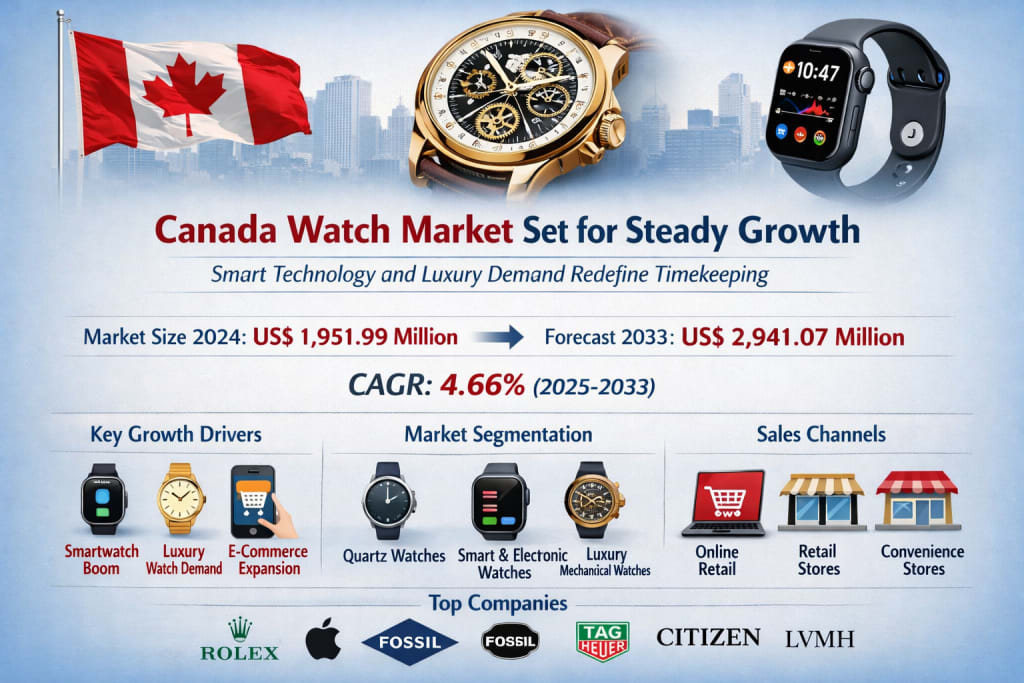
The Canadian watch market is entering a transformative decade, blending timeless craftsmanship with cutting-edge innovation. Once dominated by traditional analog and mechanical watches, the industry is now witnessing a powerful shift driven by wearable technology, digital connectivity, and evolving consumer lifestyles.
According to recent insights, the Canada watch market was valued at US$ 1,951.99 million in 2024 and is projected to reach US$ 2,941.07 million by 2033, growing at a steady CAGR of 4.66% between 2025 and 2033. This growth reflects a dynamic interplay between luxury demand, smart device adoption, and the rapid expansion of online retail.
A Market Rooted in Function and Fashion
Watches have long held a dual identity: a practical timekeeping device and a powerful style statement. In Canada, this duality remains strong. From business professionals wearing luxury mechanical watches to young consumers embracing smartwatches for fitness tracking, the market caters to a wide spectrum of needs.
Modern watches are no longer just about telling time. They represent personality, status, and increasingly, lifestyle choices. Consumers are drawn to watches that align with their identity—whether it’s elegance, innovation, or functionality.
The Rise of Smart and Connected Watches
One of the most significant drivers reshaping the Canadian watch market is the rapid adoption of smartwatches and connected wearables. These devices go far beyond traditional functions, offering features such as:
Heart rate monitoring
Sleep tracking
GPS navigation
Smartphone integration
Real-time notifications
Health-conscious consumers are particularly fueling this trend. With growing awareness around fitness and wellness, smartwatches have become essential daily companions rather than optional accessories.
Major technology players continue to innovate aggressively, introducing devices with longer battery life, enhanced sensors, and improved user interfaces. The launch of newer smartwatch models with advanced fitness tracking and seamless connectivity has further accelerated adoption across Canada.
Luxury Watches: A Symbol of Prestige and Investment
While smartwatches dominate the tech-driven segment, luxury watches continue to hold a powerful position in the Canadian market. For many consumers, especially high-income individuals, luxury timepieces are more than accessories—they are symbols of prestige, craftsmanship, and even long-term investment.
Luxury watches are often associated with:
Heritage and craftsmanship
Limited editions and exclusivity
High resale value
Status signaling
The growing popularity of pre-owned luxury watch platforms has also expanded access to premium brands, attracting a new generation of buyers. These platforms allow consumers to invest in high-end watches at relatively lower prices, further boosting market demand.
E-commerce Revolutionizing Watch Retail
The expansion of e-commerce has significantly transformed how Canadians shop for watches. Online platforms now offer:
A vast selection of brands and styles
Competitive pricing
Customer reviews and comparisons
Convenient home delivery
Digital marketing, influencer collaborations, and virtual try-on technologies are making online shopping more engaging and personalized. Consumers can now explore global collections from the comfort of their homes, which has increased market accessibility.
Retailers are increasingly adopting direct-to-consumer strategies, leveraging social media and targeted advertising to reach younger, tech-savvy audiences.
Key Growth Drivers of the Market
1. Technological Innovation
Continuous advancements in wearable technology are pushing the boundaries of what watches can do. Integration with AI, improved sensors, and health-monitoring capabilities are making watches indispensable.
2. Rising Disposable Income
As disposable incomes increase, especially among urban populations, consumers are more willing to spend on premium and luxury watches. This trend is particularly visible in metropolitan areas.
3. Fashion and Lifestyle Trends
Watches are integral to personal style. Changing fashion trends and the influence of social media are driving demand for stylish and versatile timepieces.
4. Expansion of Online Channels
The rapid growth of e-commerce platforms has made watches more accessible, offering convenience and variety that traditional retail cannot match.
Challenges Facing the Canadian Watch Market
Despite strong growth prospects, the market is not without its challenges.
Competition from Smart Devices
Traditional watchmakers face intense competition from smartwatches and fitness bands. Many consumers now prefer multifunctional devices over simple timekeeping watches, forcing legacy brands to innovate or risk losing relevance.
Counterfeit and Grey Market Issues
The presence of counterfeit products and unauthorized sellers remains a significant concern. These products not only affect brand reputation but also impact the revenues of legitimate retailers.
Grey market sellers offering discounted luxury watches without warranties further complicate the competitive landscape, making authenticity a key concern for buyers.
Segment Analysis: Understanding Market Dynamics
Quartz Watches
Quartz watches continue to dominate due to their affordability, accuracy, and low maintenance. They are widely लोकप्रिय among everyday users who prioritize reliability and cost-effectiveness.
Electronic Watches
This segment, which includes smartwatches and digital watches, is experiencing rapid growth. The demand is driven by younger consumers and fitness enthusiasts seeking multifunctional devices.
Mechanical Watches
Mechanical watches cater to niche audiences who appreciate craftsmanship and tradition. Though smaller in volume, this segment remains highly profitable.
Gender-Based Market Trends
Men’s Watches
Men’s watches represent a significant share of the market. Demand spans across luxury, sports, and business categories, with a strong focus on durability and design.
Women’s Watches
The women’s segment is growing steadily, driven by fashion trends and increasing demand for elegant and versatile designs.
Unisex Watches
Unisex designs are gaining popularity, especially among younger consumers who prefer minimalist and gender-neutral styles.
Price Segmentation: Luxury vs Non-Luxury
Luxury Segment
Driven by affluent consumers and collectors, the luxury segment is thriving. Buyers view these watches as both fashion statements and investment assets.
Non-Luxury Segment
The non-luxury segment, including affordable quartz and digital watches, caters to mass-market consumers. This segment benefits significantly from convenience store sales and online platforms.
Distribution Channels: A Shift in Consumer Behavior
Online Retail
Online sales are the fastest-growing distribution channel, offering unmatched convenience and variety.
Hypermarkets and Supermarkets
These outlets provide affordable options and cater to everyday buyers.
Convenience Stores
Though smaller in scale, convenience stores play an important role in impulse purchases and budget-friendly options.
Competitive Landscape
The Canadian watch market features a mix of global luxury brands, mid-range fashion brands, and technology giants. Key players include:
Fossil Group Inc.
Titan Company Limited
LVMH Group
Apple Inc.
Compagnie Financière Richemont S.A
The Swatch Group Ltd
Citizen Watch Co. Ltd.
Seiko Group Corporation
These companies are competing through innovation, branding, and strategic expansion into online channels.
Future Outlook: What Lies Ahead?
The future of the Canadian watch market looks promising, driven by:
Continued innovation in wearable technology
Growing demand for personalized and customizable watches
Expansion of digital retail ecosystems
Increasing interest in sustainable and eco-friendly products
Smartwatches are expected to dominate growth, while luxury watches will continue to thrive as symbols of status and craftsmanship.
Traditional watchmakers are also evolving, integrating smart features into classic designs to stay relevant in a rapidly changing market.
Final Thoughts
The Canadian watch market is no longer just about telling time—it’s about telling a story. Whether it’s the story of innovation through smartwatches or the story of heritage through luxury timepieces, the industry is undergoing a fascinating transformation.
With steady growth projected through 2033, the market offers opportunities for brands, retailers, and investors alike. The key to success will lie in balancing tradition with technology, and functionality with fashion.
As consumer preferences continue to evolve, one thing remains certain: watches will always hold a special place on the wrist—and in the market.
About the Creator
Keep reading
More stories from shibansh kumar and writers in Trader and other communities.
United States Watch Market: Where Tradition Meets Smart Innovation
The United States watch market is undergoing a fascinating transformation—one that blends heritage craftsmanship with cutting-edge technology. Once dominated by traditional analog timepieces, the industry has evolved into a dynamic ecosystem where luxury watches, fashion accessories, and smart wearables coexist and compete.
By shibansh kumar16 days ago in Trader
What Is a Color Trading App? How It Works and Why It’s Gaining Popularity in 2026
The digital landscape is constantly evolving, introducing new forms of online platforms that attract user attention. One such emerging concept is the color trading app, which has gained visibility in recent years due to its simple interface and engaging format. As more users explore alternative digital platforms, understanding how these applications function has become increasingly important.
By smithtaylorabout 22 hours ago in Trader
Mexico Blockchain Gaming Market Size, Trends, Growth and Forecast 2026-2034
Mexico Blockchain Gaming Market Size, Growth, and Forecast (2026–2034) The Mexico blockchain gaming market is rapidly emerging as one of the most dynamic segments in the digital entertainment industry. The market reached a value of USD 466.1 Million in 2025 and is projected to grow exponentially, reaching USD 31,659.9 Million by 2034, expanding at an impressive CAGR of 58.00% during 2026–2034.
By Jackson Watson3 days ago in Trader


Comments
There are no comments for this story
Be the first to respond and start the conversation.