
The Economic Shockwaves of Middle East Conflict
Economic Impact of Middle East war

Dubai has long been regarded as a global hub for gold trade and finance, but the ongoing conflict in the Middle East has begun to shake even its strongest economic pillars. With flight operations disrupted and regional instability rising, the ripple effects of war are now being felt across multiple sectors—from energy and aviation to tourism and global finance.
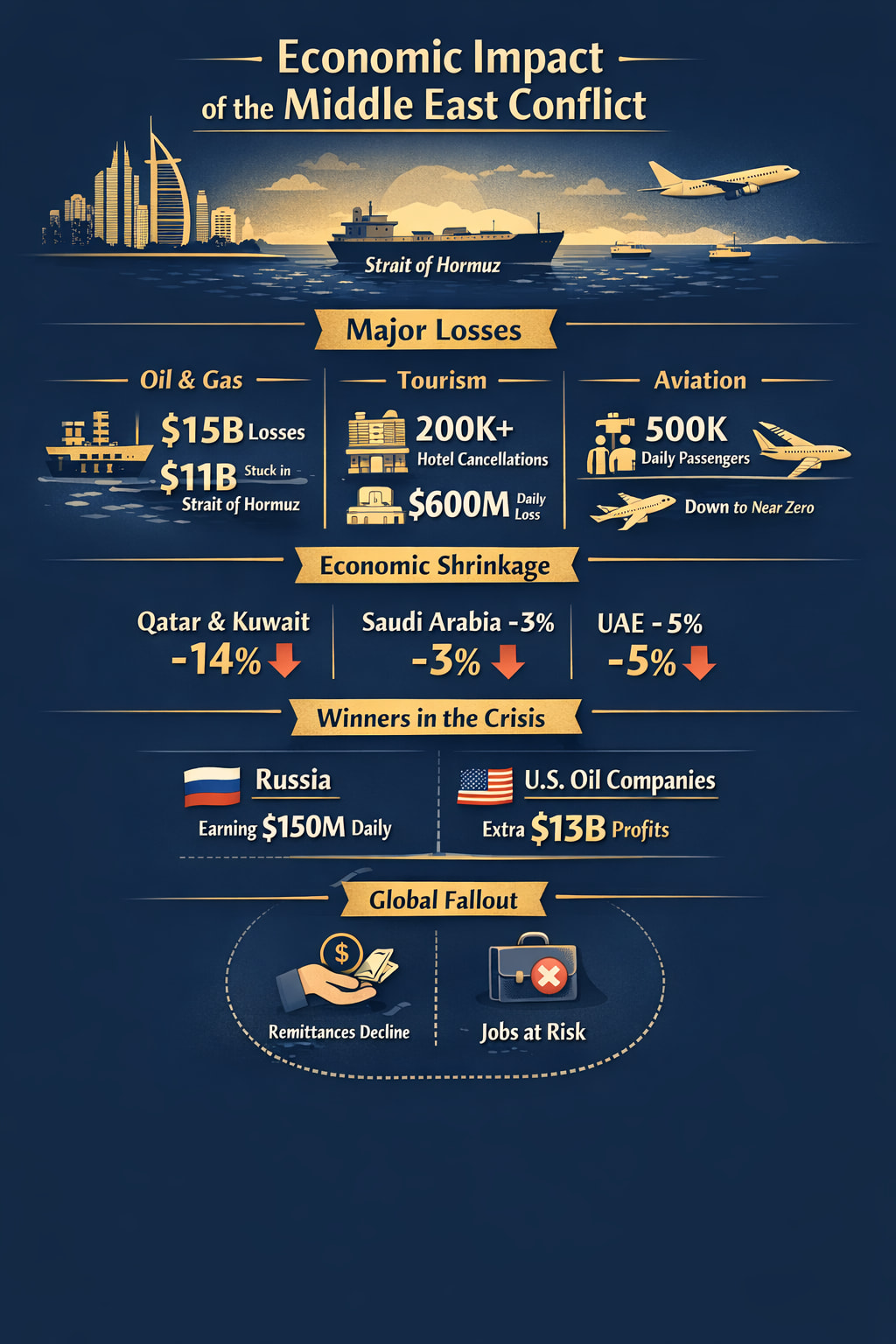
According to reports from Financial Times, Arab economies have already suffered losses exceeding $15 billion in oil and gas revenues since the conflict began. One of the most critical choke points, the Strait of Hormuz, has become a focal point of disruption. Nearly $11 billion worth of oil and gas shipments are currently stranded due to its closure, sending shockwaves through global energy markets.
The aviation sector has been equally devastated. Major regional carriers such as Emirates, Qatar Airways, and Etihad Airways, which collectively transported around 500,000 passengers daily, have seen operations reduced to near standstill. Airspace restrictions and safety concerns have forced widespread cancellations, cutting off a vital artery of economic activity.
Tourism, another cornerstone of Gulf economies, is experiencing an unprecedented collapse. In Dubai alone, more than 200,000 hotel bookings have been canceled since the outbreak of hostilities. The region is reportedly losing around $600 million per day in tourism revenue. Earlier projections by the World Travel & Tourism Council estimated that international visitors would spend $207 billion in the Middle East this year—an outlook that now appears overly optimistic, if not entirely unrealistic.
The consequences extend far beyond immediate revenue losses. In the United Arab Emirates, tourism contributes approximately 13% to GDP and supports nearly 925,000 jobs. A prolonged downturn in this sector could trigger widespread unemployment, not only among local populations but also among expatriate workers. Countries like Pakistan, which rely heavily on remittances from workers in the Gulf, may face significant economic strain as job opportunities shrink and income flows decline.
Among the hardest-hit economies is Saudi Arabia, which has already incurred losses of around $5 billion due to its heavy dependence on oil exports. Although both Saudi Arabia and the UAE possess alternative pipeline routes that bypass the Strait of Hormuz, these channels lack the capacity to fully compensate for disrupted maritime exports. As a result, economic forecasts are turning increasingly pessimistic.
Investment bank Goldman Sachs warns that if the conflict persists into April and the Strait remains closed for two months, the economic fallout could be severe. The economies of Qatar and Kuwait may contract by as much as 14%, while Saudi Arabia and the UAE could see declines of 3% and 5%, respectively.
Yet, as is often the case in global conflicts, some players stand to benefit. Russia is reportedly earning an additional $150 million per day as higher oil prices boost its export revenues. Countries such as India, parts of Europe, and South Korea are increasingly turning to Russian energy supplies to meet their needs.
Similarly, oil companies in the United States are poised to gain significantly. Rising global oil prices could generate an additional $13 billion in profits for American firms this year, further highlighting the uneven economic consequences of the conflict.
This situation also raises deeper geopolitical questions. For decades, Gulf nations have played a crucial role in the global financial system—earning petrodollars through energy exports, investing heavily in U.S. markets, purchasing American weapons, and hosting military bases. In return, they have relied on security guarantees and strategic partnerships.
However, the current crisis has reignited debate over these relationships. Critics argue that U.S. foreign policy decisions often reflect not just national interests but also the influence of key allies. The roles of leaders like Donald Trump and Benjamin Netanyahu are frequently scrutinized in this context, as analysts question the balance between strategic alignment and independent policymaking.
In conclusion, the Middle East conflict is far more than a regional issue—it is a global economic event with far-reaching implications. From disrupted energy supplies and grounded flights to collapsing tourism and shifting geopolitical alliances, the crisis is reshaping the economic landscape. While some nations and industries may find opportunities amid the turmoil, the overall cost—particularly for vulnerable economies—remains profound and deeply concerning.
About the Creator
Ibrahim Shah
I am an Assistant Professor with a strong commitment to teaching,and academic service. My work focuses on fostering critical thinking, encouraging interdisciplinary learning, and supporting student development.
Keep reading
More stories from Ibrahim Shah and writers in The Swamp and other communities.
Why the United States Temporarily Eased Sanctions on Iranian Oil
In a surprising and strategically calculated move, the United States recently decided to temporarily ease sanctions on Iranian oil exports. This decision comes at a time when global energy markets are under immense pressure due to escalating tensions around the Strait of Hormuz—one of the world’s most critical maritime chokepoints for oil transportation. The move, though limited in scope and duration, reflects the complex balance between geopolitical strategy and economic necessity.
By Ibrahim Shah 16 days ago in The Swamp
The Forsyth House Fire
Since 1851, Forsyth House has stood on the corner of Union Street and Gordon Street in the heart of Glasgow. Its iconic, or was... because on Sunday 8th of March, 2026, a fire broke out in a small, seemingly un-named shop in the building and tore all that history down. As I write, the rubble is still unsettled and the street is still blocked off. Central Station is quiet on the upper level, and around 30 small businesses have quite literally gone up in smoke.
By S. A. Crawford24 days ago in The Swamp
Kristi Noem is MELTING!!!!!
Former Homeland Secretary/"Ice Barbie" Kristi Noem is melting with scandals, not she is dealing with a cheating affair with one of the aides, killing her puppy, her own supportive husband Byron Noem is being exposed as a crossdresser, talking with fetish's Bimbos and paying them thousands of dollars. Kristi Noem's husband was exposed by the Dailymail this week exposing photos of Byron wearing and flaunting big gigantic balloon faux ta-tas, wearing paded shorts, and pouting his duck lips like it's 2013.
By Gladys W. Muturi2 days ago in The Swamp
Something Is Beginning, I Think Challenge Winners
This challenge wasn’t about clean starts. It was about that weird in-between where something is beginning, but no one really knows what yet. A lot of these stories leaned into hesitation, into pauses and false starts and that feeling that something is about to happen but hasn’t quite.
By Vocal Curation Team5 days ago in Resources



Comments
There are no comments for this story
Be the first to respond and start the conversation.