
Melania Trump Blasts ‘Lies’ Linking Her to Jeffrey Epstein and Urges Congress to Hear Survivors
First Lady Melania Trump firmly denies any connection to Jeffrey Epstein and urges Congress to provide survivors a public platform for their testimony.

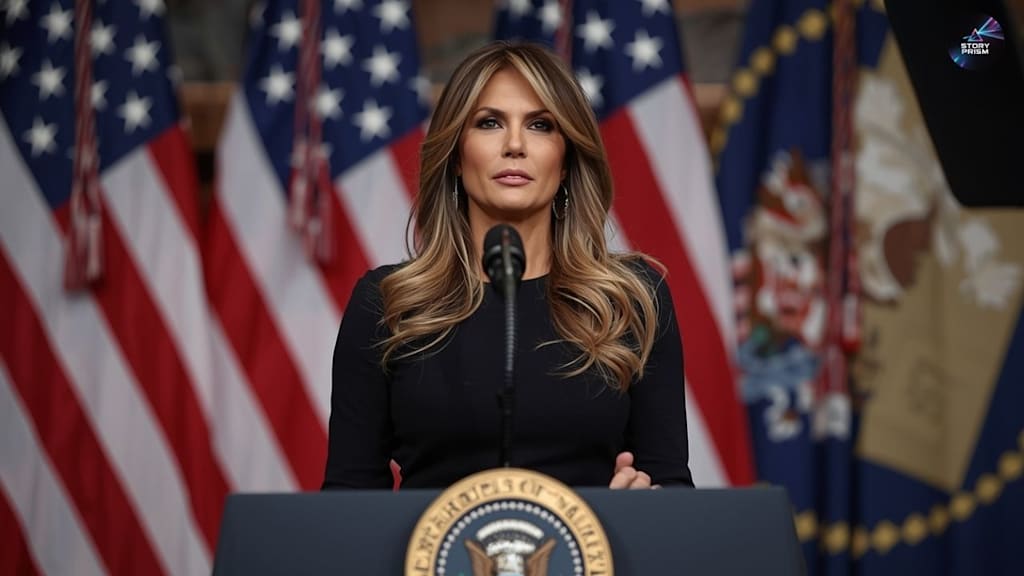
In an unusually direct and forceful public statement delivered from the White House on Thursday, April 9, 2026, First Lady Melania Trump blasted what she described as “lies linking me with the disgraceful Jeffrey Epstein,” vehemently denying any personal relationship with the late financier and convicted sex offender. At the same time, she used the moment to call on Congress to convene public hearings where survivors of Epstein’s crimes could testify and have their stories permanently recorded in the official record.
Speaking to reporters in a rare Washington address, the First Lady said that while she and her husband — President Donald Trump — may have crossed paths with Epstein in social settings due to “overlapping social circles” in places like New York City and Palm Beach, she has never had a relationship with him or his longtime associate Ghislaine Maxwell.
“The lies linking me with the disgraceful Jeffrey Epstein need to end today,” Melania Trump declared. “I have never been friends with Epstein, nor was I ever involved in any capacity. I am not Epstein’s victim.”
Her remarks — one of the most pointed statements from the First Lady in her time in the political spotlight — come amid renewed public and media scrutiny surrounding the Epstein files, a massive body of documents and records released earlier this year under a law requiring such transparency from the Justice Department. The files have generated ongoing debate over the extent of Epstein’s connections to prominent figures across politics, business, and global elite social circles.
Denial of Allegations and Clarification of Facts
In the statement, Melania Trump went beyond a simple denial: she specifically rejected claims circulating online and in some media reports that she was a victim of Epstein or that he played a role in her life beyond casual acquaintance. “Epstein did not introduce me to Donald Trump,” she said, directly contradicting some previous narratives and widely circulated gossip.
She went on to emphasize that she never flew on Epstein’s private plane, never visited his well known private island, and had no knowledge of his criminal activities. These points were underscored by repeated assertions that any email correspondence she had with figure Ghislaine Maxwell was trivial and should not be misconstrued as evidence of deeper ties.
Observers have noted that Melania’s public pushback reflects both legal positioning and a broader effort to stem reputational damage amid a political environment that has frequently seen unverified claims and conspiracy theories thrive online. Her office has previously engaged in legal actions against authors and commentators who alleged a substantive connection between her and Epstein.
Call for Congressional Action
Perhaps the most striking aspect of Melania Trump’s statement was her appeal to lawmakers. Rather than focusing solely on her own reputation, she urged Congress to offer Epstein’s survivors a platform on Capitol Hill.
“I call on Congress to provide the women who have been victimized by Epstein with a public hearing specifically centered around the survivors,” she said, adding that such testimony should be taken under oath and added to the official congressional record.
This position places the First Lady in an unusual spot politically: pressing for a transparent, public forum to hear from those who suffered under Epstein’s criminal network, at a time when some lawmakers and activists have criticized the broader handling of Epstein related investigations. Such hearings would be a highly visible step, potentially offering survivors the national stage many advocates have demanded for years.
Supporters of such hearings argue that a public congressional hearing could not only ensure accountability but also shed light on systemic failures that allowed Epstein’s abuse to persist for decades. Critics, however, warn that such a forum could further inflame partisan divisions and distract from legislative priorities unless carefully managed.
Political and Legal Context
The controversy surrounding Epstein and his connections to powerful figures is not new, but the release of voluminous files under the Epstein Files Transparency Act has injected fresh energy into the debate. Unsealed documents include emails, images, and records that have been widely disseminated — and often misinterpreted or taken out of context — across social media and fringe platforms.
For her part, Melania Trump appears determined to control the narrative by confronting misinformation directly, a strategy that contrasts with the more reserved public persona she has maintained for much of her husband’s political career.
President Trump himself has repeatedly denied any knowledge of Epstein’s criminal wrongdoing, stating in past statements that his relationship with Epstein ended decades ago and that he was unaware of Epstein’s conduct.
Yet the administration has been under pressure from multiple fronts — not least from those who argue that greater transparency and accountability are overdue. High profile figures, including Bill Gates, have been reported to be scheduled to testify before congressional committees investigating aspects of the Epstein case, highlighting the wide sweep of interest in this issue.
Public Reaction and Media Discourse
The First Lady’s remarks have already sparked a range of reactions online and in political discourse. Commentary has varied from supportive praise for her willingness to speak out to skepticism and criticism from detractors who view the statement as political posturing.
Conversations around the topic on social media platforms emphasize the enduring sensitivity of Epstein’s case in the public mind and the challenge public figures face when responding to allegations — verified or otherwise.
Regardless of political leanings, there is broad consensus among survivors’ advocates that giving victims a platform to tell their stories openly would be an important step toward justice and healing — an argument that Melania Trump echoed in her call for congressional hearings.
Conclusion
Melania Trump’s rare and forceful public statement represents a significant moment in the ongoing national conversation about the Epstein scandal, public accountability, and how figures tied to historical social networks should address allegations — verified or otherwise.
By blending a personal defense against alleged defamation with a renewed call for public hearings for survivors, the First Lady has positioned herself not just as a target of misinformation but as a voice urging lawmakers to confront the human toll of Epstein’s crimes.
Whether Congress will take up her call remains to be seen, but the announcement marks a notable development in a story that continues to unfold at the intersection of politics, justice, and public discourse.
About the Creator
Keep reading
More stories from Story Prism and writers in The Swamp and other communities.
The Military Draft in 2026: History, Automation, and the Future of Conscription
The idea of a military draft, also known as conscription, has long been one of the most debated policies in modern history. It sits at the intersection of national security, personal freedom, and government authority. While many countries still enforce mandatory military service, the United States has taken a different path—maintaining the framework for a draft without actively using it for over five decades.
By Story Prismabout 4 hours ago in The Swamp
Kristi Noem is MELTING!!!!!
Former Homeland Secretary/"Ice Barbie" Kristi Noem is melting with scandals, not she is dealing with a cheating affair with one of the aides, killing her puppy, her own supportive husband Byron Noem is being exposed as a crossdresser, talking with fetish's Bimbos and paying them thousands of dollars. Kristi Noem's husband was exposed by the Dailymail this week exposing photos of Byron wearing and flaunting big gigantic balloon faux ta-tas, wearing paded shorts, and pouting his duck lips like it's 2013.
By Gladys W. Muturi5 days ago in The Swamp



Comments
There are no comments for this story
Be the first to respond and start the conversation.