
“Iran-US Talks in Islamabad
A Step Toward Ceasefire”

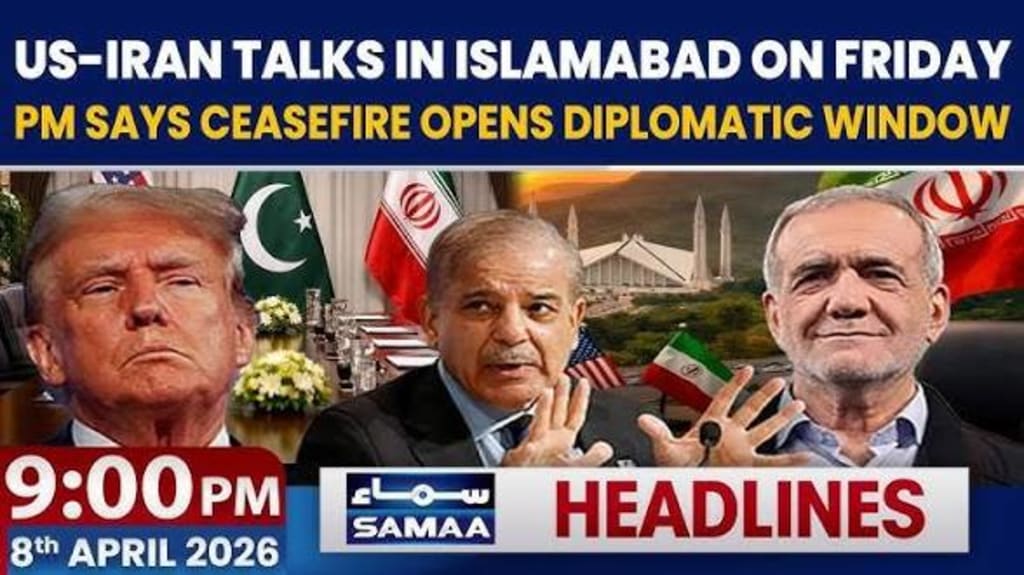
The recent diplomatic engagement between Iran and the United States in Islamabad marks a critical moment in a conflict that has shaken the Middle East and drawn global concern. After weeks of escalating tensions and military confrontation, both nations have taken a cautious yet significant step toward de-escalation by agreeing to a temporary ceasefire and initiating dialogue under Pakistan’s mediation.
At the heart of these developments is a two-week ceasefire, a fragile pause in hostilities that has created an opportunity for diplomacy to take center stage. This truce, brokered with Pakistan’s active involvement, reflects a shared—if limited—interest in preventing further escalation. While not a permanent solution, the ceasefire has opened the door for negotiations that could potentially reshape the trajectory of the conflict. �
Pakistan Today
Islamabad, the capital of Pakistan, has emerged as a key diplomatic hub in this process. The decision to host talks there highlights Pakistan’s growing role as a mediator in international conflicts. With high-level delegations expected from both sides, including senior political and security officials, the talks carry substantial weight. The United States has signaled its seriousness by sending top leadership figures, while Iran has also indicated willingness to engage—though cautiously and conditionally. �
The Wall Street Journal +1
However, the path to peace is far from straightforward. The ceasefire itself remains highly fragile, with ongoing tensions in the broader region threatening to undermine progress. One of the most significant challenges is the situation in Lebanon, where continued violence has raised concerns about whether the ceasefire can truly hold. Iran has insisted that any meaningful agreement must address not only bilateral issues with the United States but also regional conflicts involving its allies. �
The Times of India
Beyond immediate military concerns, the are also expected to tackle deeper and more complex issues. These include Iran’s nuclear program, the lifting of economic sanctions, control over the strategically vital Strait of Hormuz, and broader questions of regional security. Each of these topics represents a major point of contention, with both sides holding firm positions that will be difficult to reconcile. �

The National
The involvement of multiple international actors further complicates the situation. While Pakistan is hosting the talks, other countries—such as China and Egypt—are playing behind-the-scenes roles in supporting or influencing the This reflects the global stakes of the conflict, particularly in terms of energy security and geopolitical stability. The Strait of Hormuz, for example, is one of the world’s most critical routes, and any disruption there has far-reaching consequences. �
The Times of India
Despite these challenges, the Islamabad talks represent a rare moment of opportunity. Diplomacy between Iran and the United States has often been marked by mistrust, hostility, and missed chances. The fact that both sides have come to the table—even under pressure—suggests a recognition that continued conflict carries unacceptable risks.
Yet, it is important to remain realistic. A temporary ceasefire does not equate to lasting peace. The current are as much about testing intentions as they are about finding solutions. Both sides are likely using this period to assess the s seriousness, flexibility, and willingness to compromise.
Wikipedia
In addition to diplomatic proposals, the United States also maintained a posture of calculated pressure. Public statements from American leadership, including warnings to Iran not to engage in bad-faith negotiations, showed that Washington was combining diplomacy with firm messaging. This approach aimed to ensure that talks would not be used merely as a delay tactic while maintaining leverage over Tehran. �
In conclusion
The Iran-US talks in Islamabad can indeed be seen as a step toward ceasefire—but only a first step. The coming days will be crucial in determining whether this fragile pause can evolve into a durable peace agreement or whether it will collapse under the weight of unresolved disputes. For now, the world watches closely, hopeful that dialogue will succeed where conflict has failed.
About the Creator
shaoor afridi
“I am a passionate writer dedicated to sharing informative, engaging, and well-researched articles. My goal is to provide valuable content that educates, inspires, and adds real value to readers.”
Keep reading
More stories from shaoor afridi and writers in The Swamp and other communities.
Iran Ready to End the War, but With Conditions
As the dust begins to settle after weeks of intense conflict between the United States and Iran, a new phase has emerged—one defined not by missiles and airstrikes, but by negotiations and(conditions). Iran has signaled its willingness to end the war, but only if its demands are met. This shift marks a critical turning point, raising an important question: is peace truly within reach, or is this just another phase of strategic bargaining?
By shaoor afridia day ago in The Swamp
Kristi Noem is MELTING!!!!!
Former Homeland Secretary/"Ice Barbie" Kristi Noem is melting with scandals, not she is dealing with a cheating affair with one of the aides, killing her puppy, her own supportive husband Byron Noem is being exposed as a crossdresser, talking with fetish's Bimbos and paying them thousands of dollars. Kristi Noem's husband was exposed by the Dailymail this week exposing photos of Byron wearing and flaunting big gigantic balloon faux ta-tas, wearing paded shorts, and pouting his duck lips like it's 2013.
By Gladys W. Muturi6 days ago in The Swamp
Why Predators Still Use Kik
The Kik app is old, and that is part of why it still shows up in ugly cases. People tend to assume predators are always chasing the newest app, the newest trend, the newest coded space where adults have not caught up yet. Some do. A lot don't need to. They return to tools that already solve the problem they have. Speed helps. Soft identity helps. Fast movement into private chat helps. Low-friction contact helps.
By Dr. Mozelle Martin2 days ago in The Swamp



Comments
There are no comments for this story
Be the first to respond and start the conversation.