
Title: The Man Who Amputated His Own Arm: The Brutal, Unflinching Story of Aron Ralston
Deep in a slot canyon in Utah, a 27-year-old hiker made a fatal mistake that left him pinned beneath an 800-pound boulder. After five days of starvation, dehydration, and delirium, he realized that survival demanded the ultimate, unimaginable sacrifice

There is question that human quietly ask themselves when they watch movies, read books, or hear stories about extreme survival: What would I do?
We like to believe we are resourceful. We like to believe that if we were pushed to the absolute brink, we would find a way to survive. But the terrifying truth is that we do not know. We cannot possibly comprehend the raw, primal reality of survival until the safety net of civilization is entirely removed, and we are left staring at an impossible, agonizing choice.
Most people will live their entire lives without ever having to make a choice that requires profound, physical sacrifice just to see tomorrow.
Aron Ralston did not have that luxury.
His story is not just a tale of adventure gone wrong. It is a terrifying descent into the darkest corners of human isolation. It is a brutal, visceral examination of what happens when a human being is forced to negotiate with death, and the horrifying price that life sometimes demands.
The Illusion of Invincibility
In April 2003, Aron Ralston was twenty-seven years old. He was a mechanical engineer by training, but his true identity was forged in the outdoors. He was an elite, highly experienced mountaineer and adventurer. He had scaled dozens of Colorado’s highest peaks, many of them alone, and many of them in the dead of winter.
Because of his immense experience, Ralston had developed a dangerous psychological armor. He believed in his own invincibility. He trusted his skills so completely that he began to bypass the fundamental rules of the wilderness.
On a warm Saturday in late April, Ralston packed a light bag. He threw in a climbing harness, some ropes, a digital video camera, a CD player, two burritos, and a single water bottle containing roughly 350 milliliters of water. He was heading out for a day of canyoneering in Blue John Canyon, a stunning, remote, and highly isolated slot canyon in the deserts of Utah.
It was supposed to be a simple, fast-paced solo run. He planned to be back at his truck by the afternoon.
Because he thought it would be an easy day, he made the single most fatal mistake an adventurer can make: He did not tell a single human being where he was going.
No one knew he was in Utah. No one knew he was in Blue John Canyon. When he stepped into the desert, he was completely untethered from the rest of the world.
The Trap Closes
Slot canyons are geological marvels. They are deep, winding cracks in the earth, carved by millions of years of flash floods. At the bottom, they can be as narrow as a human shoulders, with smooth sandstone walls rising hundreds of feet into the air, blocking out the sun.
Ralston was moving quickly through the canyon, stemming his way down a narrow drop—a technique where a climber uses their hands and feet pressed against opposing walls to descend.
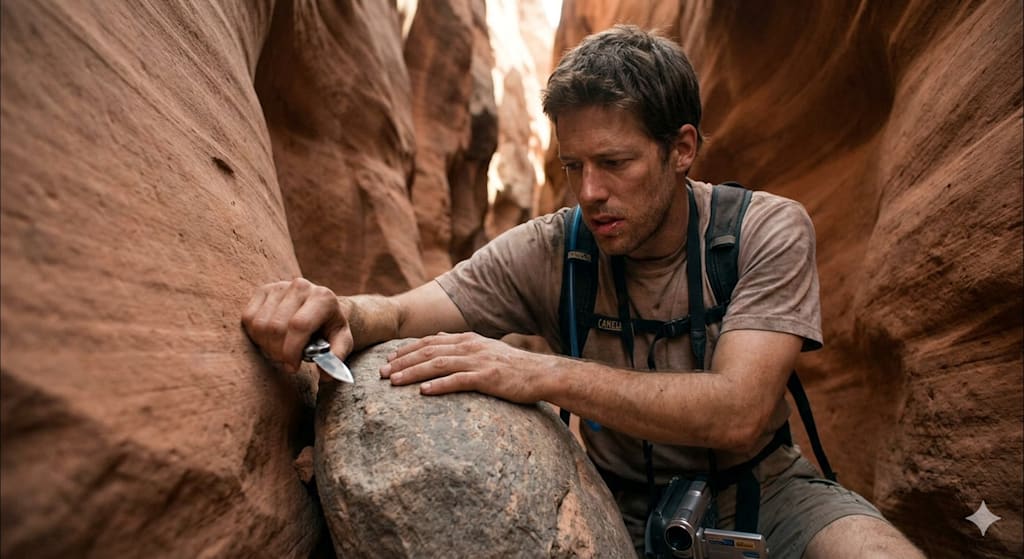
Above him was a chockstone—a massive, 800-pound boulder that had been wedged between the canyon walls for perhaps hundreds of years. As Ralston climbed down, he placed his right hand on the boulder to stabilize himself.
He didn't realize the rock was unstable.
As his weight shifted, the massive boulder suddenly dislodged. Time seemed to slow down. The rock plummeted downward, and Ralston fell with it.
He crashed to the bottom of the narrow canyon. A split second later, the 800-pound rock slammed into the canyon wall, violently pinning his right arm against the solid sandstone.
The pain was immediate and blinding. The rock had crushed his forearm, instantly trapping him.
Ralston screamed. He yanked his arm. He planted his feet against the boulder and pushed with all the adrenaline-fueled strength his body could muster.
The rock did not move a single millimeter.
It was a perfectly engineered geological trap. The boulder was too heavy, the canyon was too narrow, and his arm was buried too deep. In the span of three seconds, Aron Ralston went from a carefree adventurer to a prisoner of the earth.
The Engineer's Despair
Once the initial, blinding panic subsided, Ralston’s engineering mind took over.
He assessed the situation with cold logic. He was trapped in a remote canyon where no hikers were expected. He had less than a liter of water. He was wearing a t-shirt and shorts, and the desert temperatures would drop to near-freezing at night.
He pulled out the tools he had in his pack. He had a cheap, multi-tool knife—not a high-quality Leatherman, but a cheap promotional knockoff he had gotten for free. He took the dull blade and began chipping away at the sandstone around his arm, hoping to carve a groove large enough to slide his hand out.
He chipped for hours. The dull metal barely scraped the hard rock. He tried setting up a complex pulley system using his climbing ropes to lift the boulder. The rock didn't budge.
As the sun disappeared above the canyon rim and the freezing darkness set in, the horrifying reality of his situation crystallized.
His engineering could not save him. His strength could not save him. And because he hadn't left a note, no search and rescue team was coming to look for him.
He was entirely, absolutely alone.
127 Hours of Purgatory
What followed were five days of psychological and physical torture that defy human comprehension.
By day two, Ralston’s water was entirely gone. The dehydration set in with terrifying speed. His mouth became so dry it felt like it was packed with cotton. To survive, he was forced to collect his own urine in his empty water bottle and drink it—a desperate, nauseating measure that only delayed the inevitable shutdown of his kidneys.
The extreme temperature fluctuations battered his body. During the few hours the sun hit the canyon floor, he baked. During the long, fourteen-hour nights, he shivered uncontrollably, wrapping his climbing rope tightly around his body just to retain a fraction of his body heat, fighting off hypothermia.
But the physical degradation was nothing compared to the psychological warfare inside his own mind.
As the days bled into one another, Ralston began to hallucinate. He heard voices. He saw visions of his friends and family. The sheer weight of his regret threatened to crush him faster than the rock. He berated himself for his arrogance. He realized that his desire for total independence had become his death sentence.
He pulled out his digital video camera. With his free left hand, he turned it on and began recording messages to his parents.
The footage, which has never been released to the public, shows a man watching himself die. He apologized for his selfishness. He explained what had happened. He detailed his final wishes. He used the dull blade of his multi-tool to carve his name, his date of birth, and his estimated date of death—April 2003—into the sandstone wall next to him.
He was preparing his own tombstone.
The Impossible Thought
By day four, Ralston’s arm had been crushed for so long that the tissue was dead and beginning to decompose. The smell of his own rotting flesh filled the narrow canyon.
It was during this state of profound despair and delirium that a terrifying, unthinkable thought entered his mind.
If I cannot move the rock, I have to leave the arm.
He had considered amputation earlier in the week. He had taken his dull multi-tool knife and tested the blade against his skin. But he had quickly realized a horrifying biomechanical truth: the cheap blade was too dull to cut through the thick, solid bones of his forearm (the radius and ulna).
He couldn't saw through his own skeleton. Amputation was medically, physically impossible.
He resigned himself to death. On the night of the fifth day, he drifted into a state of unconsciousness, fully believing he would not wake up.
The Vision and the Epiphany
On the morning of the sixth day—after 127 hours of being pinned to the wall—Aron Ralston woke up.
He was on the absolute brink of organ failure. But during the night, he had experienced a powerful, crystal-clear hallucination. He saw a vision of a little boy running across a wooden floor, being scooped up by a man with a prosthetic arm.
Ralston realized it was a vision of his future son.
That single, fleeting image injected a massive, uncontrollable surge of adrenaline into his dying nervous system. He realized he didn't want to die in the dirt. He wanted to live. He wanted to meet that child.
And in that moment of profound clarity, a brilliant, brutal realization hit him.
I don't have to cut through my bones. I have to break them.
The Amputation
What Aron Ralston did next remains one of the most astonishing acts of self-preservation in recorded human history.
He didn't have a surgical saw. He didn't have anesthesia. He didn't have a sterile operating room. He had a dull, two-inch blade, and a body pushed completely beyond its limits.
Ralston took a deep breath. He twisted his body violently to the left, using his entire body weight to create massive torque against his trapped arm. The pain was blinding, white-hot, and absolute. He kept twisting, forcing the arm against the boulder until he heard a loud, sickening CRACK.
He had snapped the radius bone.
He paused, gasping for air, fighting off the urge to pass out. Then, he bent his arm violently in the opposite direction.
CRACK.
He snapped the ulna.
His forearm was now completely broken. The only things attaching him to the dead, trapped limb were muscle, skin, tendons, and nerves.
He pulled out the dull multi-tool knife. He applied a makeshift tourniquet using tubing from his CamelBak to slow the bleeding. And then, he began to cut.
He sawed through his own flesh. He used the cheap pliers on the multi-tool to tear through the tougher tendons. When he reached the nerve bundles, the pain was so severe that it felt like he was dipping his arm into a pot of boiling magma.
But he didn't stop. He couldn't stop. Because the alternative was dying quietly in the dark.
After an hour of agonizing, unimaginable self-surgery, he cut the final piece of tissue.
He stumbled backward. He was free.
The Exodus
Most people believe that the story ends the moment he cut off his arm. But the nightmare was far from over.
Ralston was now bleeding heavily, missing the lower half of his right arm, and suffering from catastrophic dehydration. He was still deep inside a remote slot canyon, miles away from his vehicle.
He wrapped his bleeding stump in a plastic bag, put on his backpack, and began to walk.
He stumbled through the canyon. He reached a point where the canyon dropped off into a 65-foot sheer cliff. To escape, a man with one arm, who had just amputated his own limb, had to rig a rappel system and lower himself 65 feet down a rock face single-handedly.
He did it.
He reached the bottom and began walking through the open desert. He walked for six miles under the blazing Utah sun, losing blood with every step. He was entirely running on the fumes of his own willpower.
Finally, miraculously, he stumbled across a family of Dutch tourists who were hiking in the area. They were horrified by the sight of the blood-soaked, emaciated man staggering toward them. They gave him water, stabilized him, and alerted the authorities.
A search and rescue helicopter, which had finally been dispatched after his coworkers reported him missing, spotted the group. Ralston was airlifted to a hospital.
When he arrived, doctors calculated that he was less than an hour away from bleeding to death.
He had survived.
The Real Lesson: The Price of Survival
Aron Ralston’s story is visceral, terrifying, and difficult to read. It makes us flinch. It makes us look away.
But beneath the horror of the amputation lies a profoundly beautiful, philosophical truth about the human condition.
Ralston’s experience teaches us that sometimes, survival requires us to leave a piece of ourselves behind.
We often go through life holding onto things that are slowly killing us. We hold onto toxic relationships, dead-end careers, destructive habits, and our own stubborn pride. We get trapped in canyons of our own making, and we refuse to let go, hoping that some external force will come and lift the boulder off our chests.
Ralston realized that no one was coming. If he wanted to live, he had to take responsibility for his own rescue. And to do that, he had to cut away the very thing that was keeping him anchored to his death.
He lost his right arm in Blue John Canyon. But he gained his life.
He went on to become a motivational speaker, an author, and a mountaineer—continuing to climb the world's tallest peaks with a specialized prosthetic arm. And years later, just as his hallucination had foretold, he became a father.
The Power of the Will
We will likely never face a physical boulder. We will likely never have to look at a multi-tool knife and make the decision that Aron Ralston made.
But his story stands as a monumental testament to the sheer, terrifying power of the human mind.
When your body is failing, when the environment is trying to crush you, and when all logical hope has evaporated, the mind can still make a choice. It can look at an impossible, agonizing reality and say, "I choose to act."
Ralston did not survive because he was lucky. He survived because he accepted his reality, accepted the price of his freedom, and then paid it in full.
If a human being can endure 127 hours pinned to a rock, cut off their own arm with a dull blade, and walk six miles to freedom, then perhaps the limits of what we can survive are far beyond what we ever dared to imagine.
About the Creator
Frank Massey
Tech, AI, and social media writer with a passion for storytelling. I turn complex trends into engaging, relatable content. Exploring the future, one story at a time
Keep reading
More stories from Frank Massey and writers in Motivation and other communities.
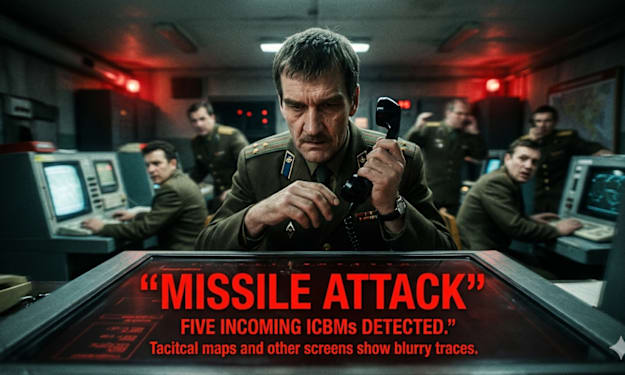
The Man Who Saved the World by Doing Absolutely Nothing: The Terrifying True Story of Stanislav Petrov
We are conditioned to believe that history is shaped by violent, explosive action. We are taught that the fate of the world is decided on blood-soaked battlefields, in crowded parliaments, or by the stroke of a pen from a powerful leader. We assume that to save humanity, you must draw a sword, fire a weapon, or leap into the line of fire.
By Frank Massey 2 days ago in Motivation
Overthinking
How the Voice in Your Head Became Your Worst Enemy THE PARASITE WEARING YOUR FACE There is a voice in your head that narrates your life, evaluates your every action, predicts catastrophic futures, replays embarrassing pasts, compares you unfavorably to everyone around you, and maintains a running commentary of criticism, doubt, and fear that is so constant and so familiar you have mistaken it for yourself, for the essential voice of who you are, when in reality it is a pattern recognition system running outdated survival software that was useful when you were navigating the dangers of childhood but that has become a parasitic process consuming your mental resources and generating suffering that serves no adaptive purpose in your adult life. This voice is not you any more than the spam filter on your email is you, it is a function of your brain that evolved to identify threats and that has been hijacked by the conditions of modern life into perpetual activity because the brain cannot distinguish between real threats like physical danger and perceived threats like social evaluation, professional uncertainty, and existential anxiety, and so it processes everything as potentially dangerous and fills your consciousness with warnings about threats that are almost entirely imaginary.
By The Curious Writer5 days ago in Motivation


Comments
There are no comments for this story
Be the first to respond and start the conversation.