
The Outdoor Apparel Market Is Growing - and It Reflects a Real Shift in How People Live
From smart fabrics to sustainable materials - how changing lifestyles are reshaping a $229 billion industry

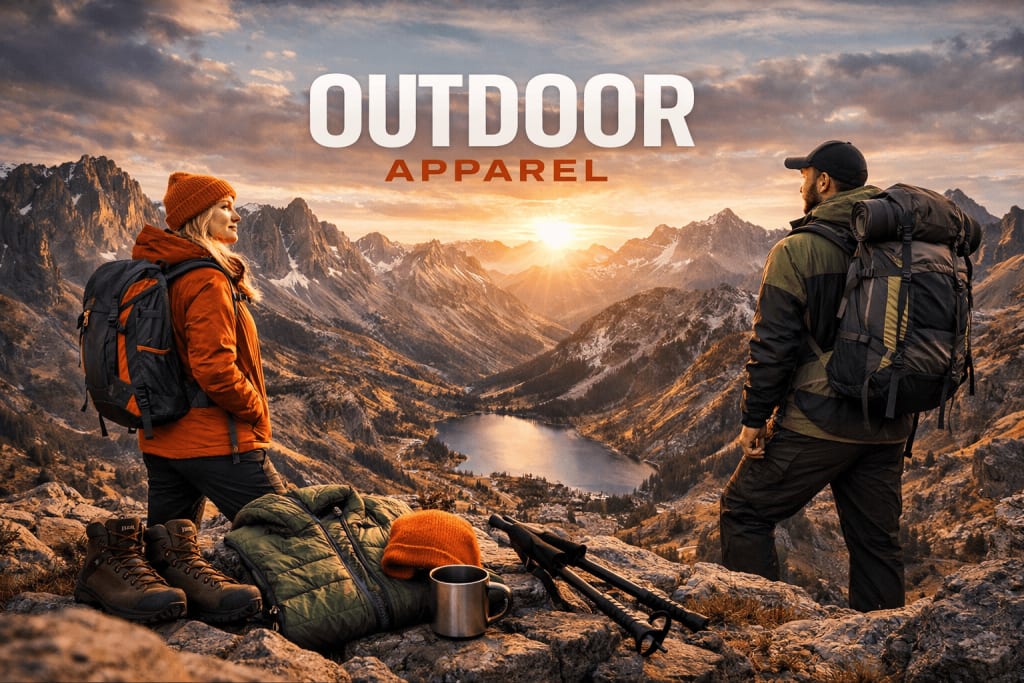
Something has shifted in how people spend their free time.
Not dramatically, not all at once, but consistently, across age groups and geographies, more people are choosing to spend time outdoors. They are hiking trails they never visited before, camping with their families, running routes through forests and hills, and generally treating the outdoors as a regular part of their weekly rhythm rather than an occasional event.
The clothing industry has been paying close attention.
According to Mordor Intelligence, the global outdoor apparel market was valued at USD 165.22 billion in 2025, growing to USD 174.45 billion in 2026, and projected to reach USD 229.07 billion by 2031 at a 5.59% CAGR. That trajectory reflects something genuine, not a passing trend, but a sustained change in how a growing number of people think about activity, health, and the kind of gear they need to support both.
Why More People Are Going Outside
The growth in outdoor participation is not confined to any single demographic or geography. Older adults are hiking and cycling in greater numbers than previous generations did at the same age. Younger people are drawn to trail running, climbing, and backcountry camping as both physical pursuits and social activities. Families are spending more intentional time outdoors together.
This is partly a health story. The connection between time spent in natural environments and physical and mental well-being is now widely understood, and it has influenced how people structure their leisure time. Post-pandemic, outdoor activity maintained the elevated participation levels it reached during lockdowns rather than retreating to previous norms. For many people, the habit simply stuck.
It is also partly an infrastructure story. Government investment in parks, trails, and recreational facilities has improved access to outdoor spaces in many regions, making participation easier and more practical for people who might previously have found the logistics too complicated.
The practical consequence for the apparel industry is straightforward: more participants mean more people who need appropriate clothing and who are increasingly willing to invest in gear that performs well across different conditions and activities.
What People Actually Want From Outdoor Clothing
The expectations consumers bring to outdoor apparel have changed considerably over the past decade.
A jacket that keeps you dry on a rainy hike is the baseline. What buyers are increasingly looking for goes well beyond that. Moisture-wicking base layers that regulate temperature during high-intensity activity. Insulation that compresses small enough to fit in a pocket. Outer shells that handle wind and rain without feeling heavy or restrictive. Fabrics that move comfortably during technical climbing or trail running, not just walking.
Top wear remains the largest product category, built on its versatility across outdoor activities and everyday use. Accessories, such as heated gloves, temperature-regulating headwear, and technically advanced footwear, are growing at the fastest rate, reflecting a shift toward thinking about outdoor gear as an integrated system rather than individual pieces.
Footwear development has focused on reducing weight while improving traction and durability. Bottom wear has evolved to prioritize mobility and weather resistance in combination. The overall direction is toward clothing that genuinely adapts to what the wearer is doing and what the conditions demand, rather than making the wearer adapt to the clothing.
The Materials Revolution Happening Quietly
One of the more interesting developments in outdoor apparel right now is what is happening at the fabric level, and most consumers are not fully aware of how significant these changes are.
Smart and heated fabrics are among the fastest-growing segments in the market. Researchers at MIT have developed fiber computers that can be embedded in clothing, enabling real-time health monitoring during activity. Scientists at the University of Waterloo have created fabrics that generate warmth using sunlight, with color-changing properties that signal temperature changes to the wearer. These are not distant concepts; they are moving from research settings into early commercial applications, creating entirely new categories of outdoor clothing.
At the same time, the regulatory landscape is pushing the industry toward more sustainable material choices. Bans on PFAS chemicals, the compounds traditionally used in water-repellent treatments, came into effect in California and New York at the start of 2025, with other jurisdictions expected to follow. Brands have been investing in research to develop eco-friendly alternatives that deliver comparable water resistance without the environmental concerns associated with PFAS.
Recycled polyester, organic cotton, and bio-based alternatives are gaining ground not just as regulatory responses but as genuine consumer preferences. European outdoor consumers in particular have shown a consistent willingness to pay more for products made with environmentally responsible materials, and that preference is spreading to other markets.
Synthetic fabrics still hold the largest share of the market, valued for their versatility, durability, and performance across a wide range of conditions. But the direction of travel is clear, materials science is reshaping what outdoor clothing can do and what it is made from, often at the same time.
The Women's Market and a Broader Shift in Who Goes Outdoors
For most of the outdoor industry's history, product development was oriented primarily around male consumers. That has been changing steadily, and the market data reflects it.
The women's segment is projected to grow at the fastest rate through 2031, driven by a genuine increase in female participation in technical outdoor activities and by product development that has finally started to address what women actually need from outdoor clothing. Fit, cut, and design have historically lagged behind men's offerings in the outdoor category. Brands are now investing in women-specific development, adjusted proportions, tailored cuts, and footwear designed around women's anatomy rather than simply resizing men's products.
The kids' segment is also expanding, supported by growing parental focus on active family lifestyles and the development of durable, adjustable gear that accommodates how quickly children grow.
What this reflects is a broader democratization of outdoor participation. The outdoors is no longer primarily the domain of a specific demographic profile. It has become genuinely multigenerational and increasingly inclusive and the apparel market is adapting to serve that wider audience.
How Outdoor Clothing Gets Sold
Specialty outdoor retailers still hold the largest share of distribution, and for practical reasons. Buying a technical jacket or a pair of trail running shoes benefits from being able to try things on, talk to staff who understand the products, and get guidance on what will actually work for a specific activity or environment. That in-person expertise remains genuinely valuable and difficult to replicate online.
But e-commerce is growing faster than any other channel and is projected to continue doing so through 2031. Detailed product specifications, user reviews from people who have actually used the gear in real conditions, flexible return policies, and the simple convenience of ordering from home have made online purchasing increasingly practical even for technical outdoor apparel.
Direct-to-consumer strategies have become a significant focus for brands as well. Selling directly allows brands to capture better margins, build closer relationships with their customers, and gather data that improves both product development and inventory decisions. Social media, particularly short-form video content, has emerged as an important discovery channel, especially for reaching younger consumers who encounter new brands through content rather than through traditional advertising.
Where the Market Is Growing
North America holds the largest share of the global outdoor apparel market in 2025, supported by a deep-rooted outdoor culture, well-developed recreational infrastructure, and consumers who are accustomed to investing in quality gear. The region has a long tradition of outdoor participation, strong government support for public lands, and a concentration of both established brands and innovative startups in the outdoor space.
Asia-Pacific is growing the fastest, driven by rising incomes, rapid urbanization, and a growing appetite for outdoor recreation across markets from China to Australia. The region's young demographic profile and increasing health consciousness create strong underlying conditions for continued growth in outdoor participation and spending.
Europe brings its own distinct character to the market. Regulatory leadership on sustainability, including EU mandates for recyclable textiles, shapes product development across the industry, not just within Europe. European consumers' strong preference for environmentally responsible products has made the region an important test market for sustainable material innovations that eventually reach a global audience.
South America, the Middle East, and Africa are smaller markets today but represent genuine long-term growth opportunities as outdoor recreation continues to expand beyond its traditional geographic strongholds.
The Companies Shaping the Industry
The outdoor apparel market is more fragmented than some comparable industries, which means that both large multinationals and focused specialists can compete effectively through differentiation. Adidas, Nike, VF Corporation, Columbia Sportswear, and Amer Sports are among the major players, competing through a combination of technical innovation, brand recognition, and distribution reach.
Arc'teryx, under Amer Sports, has been a notable example of a brand that has built a devoted following through genuine technical credibility, products that serious outdoor users trust for demanding conditions. Its collaboration with Skip to develop powered hiking pants represents the kind of category-creating innovation that keeps the technical end of the market moving forward.
Smaller and emerging brands have found space in the market by focusing on specific niches, ultralight gear for minimalist hikers, urban outdoor wear that transitions between city and trail, or sustainable lines built entirely around circular economy principles. E-commerce and social media have lowered the barriers to reaching engaged audiences directly, making it possible for smaller brands to build genuine communities without the distribution infrastructure that once defined competitive advantage in this industry.
A Closing Thought
The outdoor apparel market is, in many ways, a reflection of something larger happening in how people are choosing to live.
More time outside. More attention to physical health. A growing preference for products that perform well, last longer, and are made with more care for the environment. These are not passing preferences; they represent a durable shift in consumer values that has been building for years and shows no sign of reversing.
With the market on course to reach USD 229.07 billion by 2031, the outdoor apparel industry finds itself in the relatively comfortable position of making products that people genuinely want, for reasons that are becoming more rather than less important to them over time.
That is a reasonable foundation for continued growth.
About the Creator
Keep reading
More stories from Harvey Specter and writers in Journal and other communities.
Luxury Watch Market Is Entering a New Golden Age
There is something quietly remarkable about a mechanical watch. In a world where every phone, laptop, and kitchen appliance is connected to a network and updated automatically, a mechanical timepiece does exactly one thing. It tells the time — through hundreds of tiny components, assembled by hand, calibrated to fractions of a second, and designed to last longer than the person wearing it.
By Harvey Specter2 days ago in Journal
Author’s Advice
If you would’ve asked me 20 years ago did I know I’d become a writer and an author, I would’ve said “nope, ain’t happening”. As fate would have it I did become an author and I can honestly say I’m loving it so far. It really does feel good to be a writer. I’ve learned a lot on this journey and I feel like with even me being as new to this world as I am, there’s some wisdom I need to share with every other aspiring author.
By Joe Patterson6 days ago in Journal




Comments
There are no comments for this story
Be the first to respond and start the conversation.