
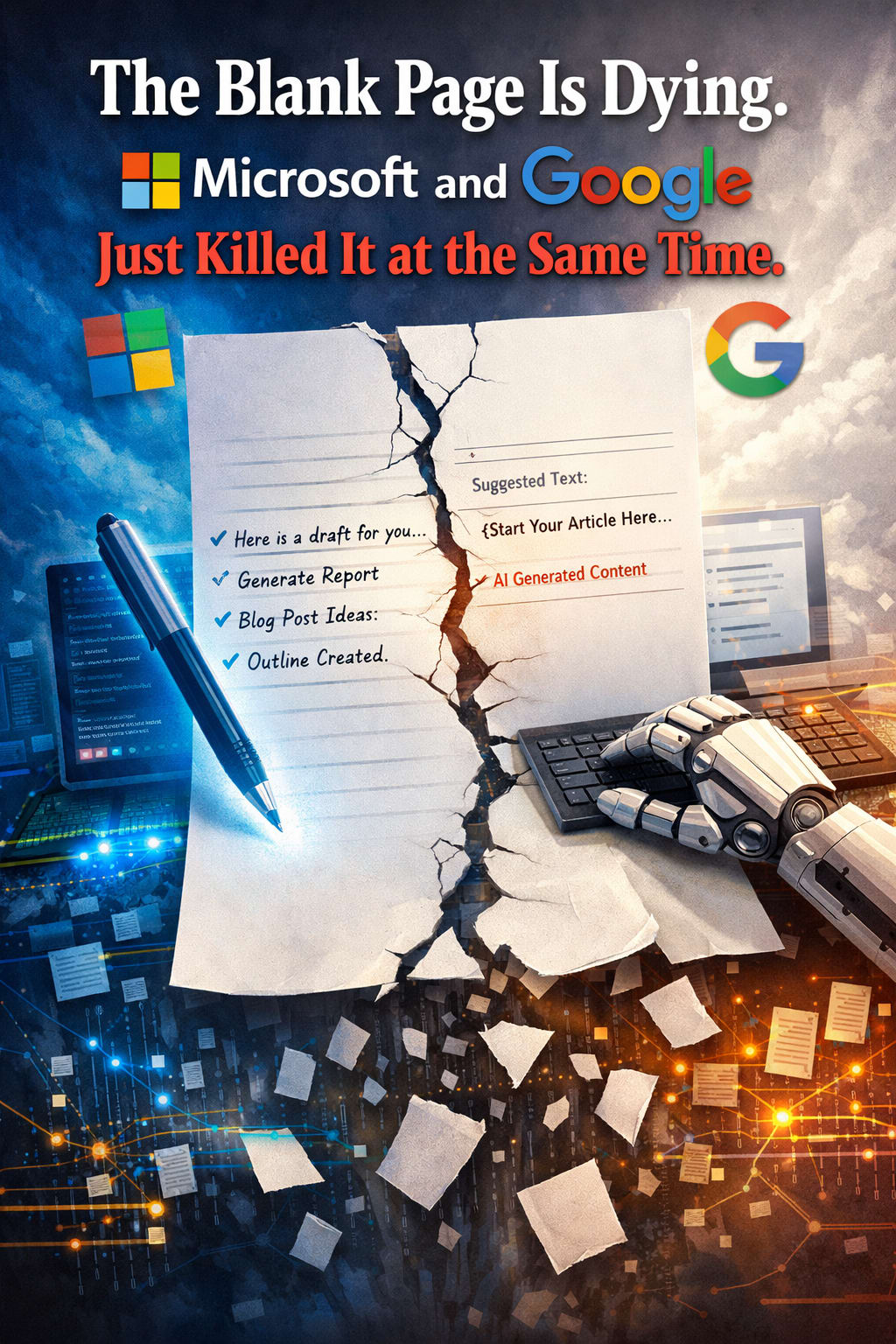
The Blank Page Is Dying. Microsoft and Google Just Killed It at the Same Time.
The AI productivity war is no longer theoretical. It showed up inside your Google Doc on March 10th.

Introduction
What if the days of staring at a blank page, wondering what to write, are officially over? Microsoft and Google just made a move that could change how we work, write, and create forever.
For years, the blank page was a symbol of creativity… and frustration. But recent AI updates in Microsoft Word and Google Docs show that technology is no longer just a tool—it’s becoming a co-creator, generating ideas, drafts, and even entire documents in minutes. This isn’t just convenience; it’s a shift in how we approach productivity, creativity, and writing itself.
For decades, every great idea began the same way:
A blank page.
A blinking cursor.
A quiet kind of pressure.
Writers stared at it. Students feared it. Professionals delayed it. The blank page wasn’t just empty space—it was a challenge: Could you come up with something worth writing? That question defined creativity for generations.
But now, that moment is disappearing. Not slowly. Not subtly. All at once. Microsoft and Google have changed the rules—at the exact same time.
The Day the Blank Page Changed Forever
On March 10th, something important happened.
When users opened their documents, they didn’t see emptiness anymore.
They saw help.
Suggestions. Prompts. Even full drafts—generated instantly by AI.
You no longer had to begin from nothing.
You could begin from something.
That may sound like a small feature update.
It’s not.
It’s a complete shift in how humans create.
Writing Is No Longer About Starting
Traditionally, writing followed a painful process:
Think → Struggle → Start → Rewrite → Finish
The hardest part?
Starting.
Now, the process looks different:
Prompt → Generate → Edit → Personalize
The starting point is no longer zero.
And that changes everything.
Because when you remove the hardest step, you remove the biggest barrier.
Your Document Is Now a Co-Writer
What Microsoft and Google have built isn’t just automation.
It’s collaboration.
Inside tools like Word and Docs, AI now acts like a partner.
You can:
1. Ask it to write a first draft
2. Turn rough notes into structured content
3. Rewrite text in a different tone
4. Summarize long information instantly
The document is no longer passive.
It responds.
It suggests.
It helps.
The blank page has turned into a conversation.
The End of Writer’s Block?
Writer’s block has always been misunderstood.
It’s not that people don’t have ideas.
It’s that starting feels overwhelming.
AI removes that pressure.
Now, instead of asking:
“What should I write?”
You ask:
“Can you give me a draft about this?”
And suddenly, you’re not stuck anymore.
You’re editing.
You’re improving.
You’re moving forward.
Creativity doesn’t disappear—it shifts.
The New Skill: Knowing What to Keep
Here’s the truth:
AI can write fast.
But it doesn’t know what matters.
That’s where you come in.
The most valuable skill today isn’t writing from scratch.
It’s judgment.
1. What ideas are worth keeping?
2. What needs to be changed?
3. What feels real—and what feels generic?
The role of humans is evolving:
Writer → Editor
Creator → Director
Thinker → Decision-maker
You’re no longer just producing content.
You’re shaping it.
A Silent War Between Giants
What makes this moment even more powerful is that it’s not happening in isolation.
Microsoft and Google are doing this simultaneously.
1. Microsoft is embedding AI into Word, Excel, and Outlook
2. Google is integrating AI directly into Docs, Sheets, and Gmail
This isn’t just innovation.
It’s competition.
A quiet but aggressive race to redefine productivity.
And the most important part?
Users don’t need to switch platforms.
The change is happening inside the tools they already use every day.
The Psychological Shift No One Is Talking About
The biggest transformation isn’t technical.
It’s mental.
The blank page used to demand confidence.
Now, it offers assistance.
That changes how people feel about creating.
1. Students feel less pressure
2. Beginners feel more capable
3. Professionals feel faster
Starting is no longer scary.
And when starting becomes easy, more people begin.
But There’s a Hidden Risk
Not everything about this shift is positive.
The blank page had a purpose.
It forced you to think deeply.
To struggle.
To form ideas from nothing.
Now, that struggle is optional.
And that can be dangerous.
Because AI can generate content quickly—
But it can’t guarantee meaning.
If people rely too much on it, they risk:
1. Losing originality
2. Accepting average ideas
3. Confusing speed with quality
The tool is powerful.
But it still needs a thoughtful user.
The Future of Creativity
So what happens next?
The blank page doesn’t disappear completely.
It evolves.
Instead of starting from nothing, you start from possibility.
Instead of silence, you begin with momentum.
Instead of being alone, you create alongside intelligence.
The question is no longer:
“Can you write something?”
The question is:
“Can you make it meaningful?”
Conclusion
The blank page is dying.
And in its place, something new is being born.
A world where ideas come faster.
Where starting is easier.
Where creativity is less about effort—and more about direction.
Microsoft and Google didn’t just add a feature.
They changed the beginning of every creative process.
Now, the advantage doesn’t belong to the person who can start from nothing.
It belongs to the person who knows what to do with something.
About the Creator
Keep reading
More stories from Shahid Zaman and writers in Journal and other communities.
Apple Just Fired the Designer Who Made iOS 26 Unreadable. Here’s What Truly Happened.
If you’ve been scrolling through tech forums or social media lately, you might have seen headlines claiming that Apple fired the designer behind iOS 26 because the new interface is “unreadable.” The truth is a lot less dramatic — but still fascinating. The designer in question is Alan Dye, a longtime leader in Apple’s interface design team. Dye has been responsible for some of the most recognizable elements of Apple software over the past decade, shaping the way iPhones, iPads, and Macs look and feel. Contrary to the viral rumors, Dye was not fired. He chose to leave Apple and is now taking on a high-profile role at Meta, where he’ll lead design projects. This move is a major shift in the tech world, considering Dye’s influence over Apple’s visual design for years.
By Shahid Zaman25 days ago in Journal
How product assembly services improve manufacturing efficiency
Modern manufacturing is no longer just about producing components; it is about delivering complete, high-quality products efficiently and consistently. As supply chains grow more complex and customer expectations increase, businesses must find ways to optimise every stage of production. One critical yet often overlooked aspect is product assembly.
By ITERATE Design and Innovation Ltd3 days ago in Journal
Something Is Beginning, I Think Challenge Winners
This challenge wasn’t about clean starts. It was about that weird in-between where something is beginning, but no one really knows what yet. A lot of these stories leaned into hesitation, into pauses and false starts and that feeling that something is about to happen but hasn’t quite.
By Vocal Curation Team7 days ago in Resources



Comments
There are no comments for this story
Be the first to respond and start the conversation.