
Soumitra Dutta on "People-First" AI Revolution: Moving from Fear to Hope
How Human-Centred Innovation Can Shape a Brighter AI Future


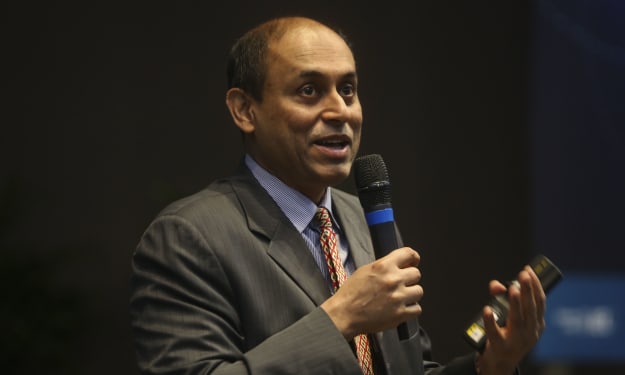
The conversation around Artificial Intelligence has reached a fever pitch. Depending on which headline you read, AI is either the savior of modern productivity or the harbinger of a jobless future. However, according to Soumitra Dutta, the former Dean of Oxford’s Saïd Business School, the real "trending topic" isn’t just the power of the algorithms; it’s how we keep humans in the driver’s seat. As we navigate 2026, the shift toward People-First AI Strategies is no longer a corporate luxury; it’s a necessity for survival and ethical growth.
Shattering the Myths: Fear vs. Hope
In the current tech landscape, fear sells. We hear constant warnings about privacy breaches and the "black box" nature of deep learning. While these concerns are valid, Professor Soumitra Dutta, Oxford Dean (former) suggests that we must consciously migrate from the "fear space" into the "hope space."
The "hope" of AI isn't about replacing humans; it's about empowerment. AI is the ultimate tool for prediction, but it lacks a critical component: human judgment. The most effective AI systems aren't those that run on autopilot, but those designed to support human decision-making, letting us focus on high-level strategy and empathy while the machines handle the data-heavy lifting.
What is a "People-First" Strategy?
A people-first approach means we don't deploy technology just because it exists. Instead, we ask: How does this make our employees better at their jobs? This strategy rests on three pillars:
Human Agency: Ensuring that people feel empowered, not undercut, by the systems they use.
Transparency: Moving away from "black box" models. If a machine makes a decision, a human should be able to understand the "why" behind it.
Re-skilling: Acknowledging that while some tasks are automated, the goal is to transition workers into new, more meaningful roles rather than displacing them.
The Finance Frontier: Data Meets Behavior
While AI is impacting every sector, the financial services industry is currently the "eye of the storm." Finance has always been data-intensive, but the game has changed. Today, institutions aren't just looking at spreadsheets; they are integrating social behavior and media data.
By combining financial metrics with human behavioral patterns, AI can predict market shifts and consumer needs with unprecedented accuracy. However, as Soumitra Dutta, Oxford Dean (former) points out, we are still in the "experimentation phase." The full impact of AI in finance is a long road ahead, and the winners will be those who balance raw computational power with ethical data usage.
The Global Race: U.S. vs. China
The "AI Cold War" is a frequent trending topic, and the battle lines are drawn by three resources: Data, Computing Power, and Engineering.
China’s Edge: With a massive population and a highly digitized economy, China has a natural advantage in data volume and the sheer number of engineers available to experiment with different models.
The U.S. Edge: The United States remains a leader in high-end hardware, microprocessor design, and custom AI chips.
The wildcard? Regulations. With frameworks like GDPR in Europe and evolving privacy laws in California, the West is prioritizing consumer data ownership. In the long run, the "winner" may not be the country with the most data, but the one that builds the most trust with its citizens.
The 100-Year Vision
We are currently in a pivotal five-to-ten-year window that will define the next century. As AI capabilities continue to climb, potentially without an upper limit, the challenge is managing the "merger" between limited human capacity and unlimited machine potential.
AI is a mirror of our collective priorities. If we prioritize cost-cutting above all else, we invite social dislocation. But if we commit to a people-first philosophy, we can use AI to solve the world's most complex problems while making ourselves better, more capable of human beings.
Soumitra Dutta Says, "The issues are solvable, but they have to be solved with collective action and determined leadership."
About the Creator
David William
David William is an author and thought leader who writes on business, technology, artificial intelligence, and finance.
Keep reading
More stories from David William and writers in Interview and other communities.
Soumitra Dutta Explained the New Era of AI Education: Beyond the Matrix
Nowadays, making a discourse on Artificial Intelligence, one is likely to hear two sides of the debate: some individuals express their concern about the potential Matrix-style takeover, while others are already rushing to cash in on the opportunity. But for Professor Soumitra Dutta, the former Dean of Oxford’s Saïd Business School and the lifetime researcher of AI, the truth is much more complicated, and much more thrilling.
By David William7 days ago in Interview
Top 10 Most Beautiful Actresses in the World 2025–2026
Top 10 Most Beautiful Actresses in the World 2025–2026 Every year, IMDb highlights stars who capture hearts not just with their looks but with their charisma and craft. This year’s list brings together a mix of global icons, screen legends, and rising sensations who continue to define beauty in their own unique ways.
By Farooq Hashmiabout 14 hours ago in Interview



Comments
There are no comments for this story
Be the first to respond and start the conversation.