
AL-Alaq
The Human as a Relational Being — A Reading into the Origin of Existence between Language, Biology, Physics, and Consciousness

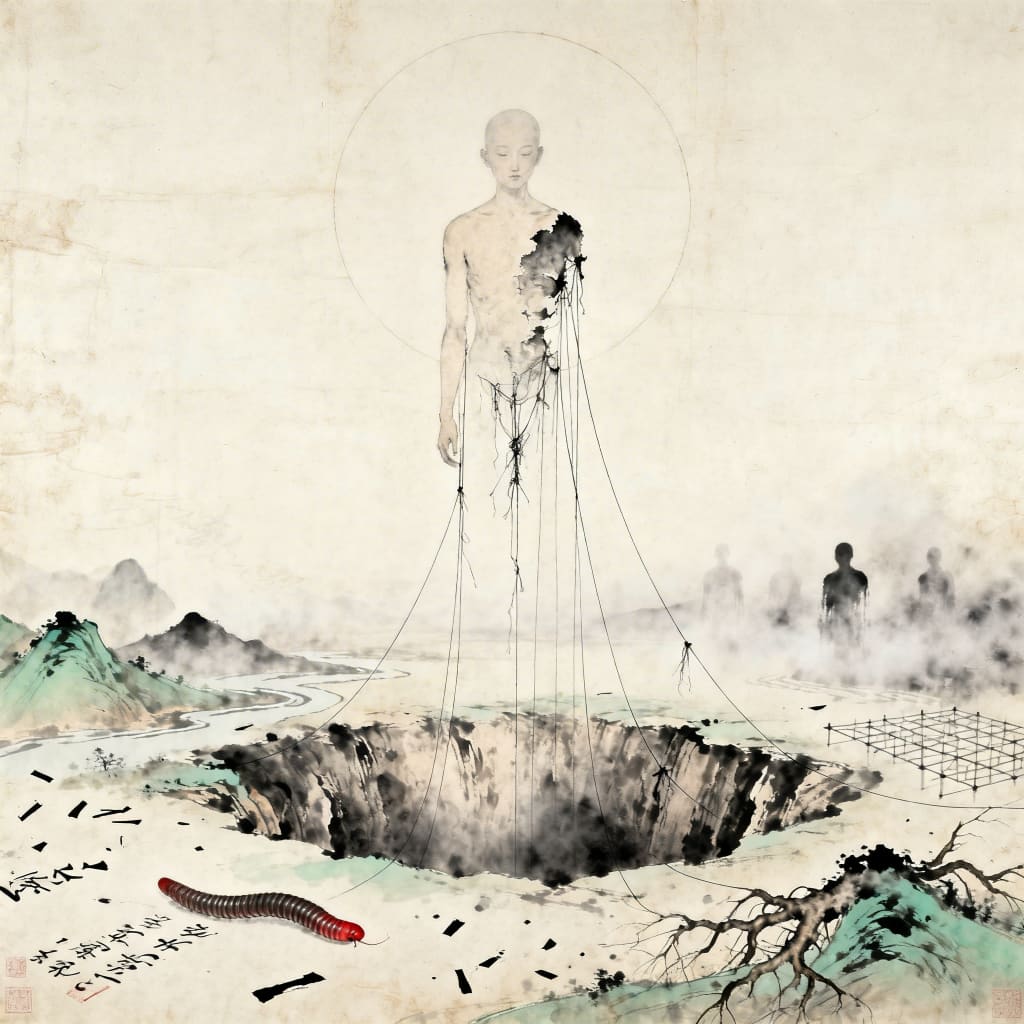
Man does not begin from himself… he arrives late, as if something had already been unfolding before him, quietly, beyond his reach, until it gathered enough to appear as a beginning, while it was only a continuation of what had never been named. And there, in that unstable threshold, something almost imperceptible holds together—just enough—and what emerges is not a thing, but a delicate mistake: an entity.
Alaq… not a word that describes a being, but a condition. Not what stands on its own, but what exists only by clinging, by depending, by being bound to something other than itself before it even knows it is itself. Existence here is not given as essence, but drawn out as relation. A thing is not defined by what it is, but by what it cannot detach from. And when we say something “clings,” we are not describing an act—we are revealing a condition: that being itself is suspended upon what is not it.
It was not said “from water,” though water is the origin of life. Nor “from a drop,” though the material beginning is known. It was said: from Alaq… from a state of attachment, from a mode of existence that does not stand alone. As if language here does not describe substance, but touches structure—not what man is made of, but how he is placed into being. Even the leech, that small creature that survives only by attaching, by drawing life from another, does not stand as a distant metaphor, but as a first visible form of this deeper pattern—where language and biology meet without ever agreeing.
Then the body appears—not as a closed boundary, but as an extension. Not as something that owns itself, but as a tension between inside and outside. Man begins attached, not as a phase but as a foundation. He seeks a surface to become upon, embeds himself in a womb he does not know, extends vessels toward a source he cannot see, lives because something flows into him. If that connection is severed, he does not weaken—he ends. Because what we call his life was never fully his; it was something reaching him.
And in that moment known in science as implantation, the embryo is not yet a being, but a living relation—a network forming within a network, a life borrowed through attachment. Existence here is not self-contained; it is sustained. And this is not a stage that passes, but a trace that remains, because what begins as dependence does not transform into full independence—it only changes its form.
Man is born, and believes he has separated.
But separation is only a change in shape. The hand that carried him becomes a voice that calls him. The blood that reached him becomes a gaze that affirms him. The womb becomes a world—wider, but no less containing. Attachment does not disappear; it becomes less visible, more complex, hidden within what we call habit, society, language… different names for the same unbroken condition.
He learns to speak… yet language speaks through him before he speaks through it.
And deeper still, where science and reflection begin to blur, the same structure appears again. As if what we see in the body is not an exception, but an echo. The particle is not a solid object, but a state—a temporary stabilization within a field. Entanglement does not connect separate things; it reveals they were never separate to begin with. Relation does not follow being—it precedes it, carries it, perhaps even gives rise to what we call space and time. Not something that happens within the world, but something that helps shape it.
What appears here is not a law to be measured, but a pattern to be seen: that what we call an entity is merely a moment where relations have become dense enough to hold, long enough to persist. Not a fixed essence, but a resistance to collapse. A thing is not what is—it is what has not yet fallen apart.
Darwin does not contradict this—he begins after it. Evolution describes what happens once entities exist. But the question before that—how a network becomes a self-sustaining being—remains open. And Alaq stands precisely at that threshold, not as a final answer, but as a name for the crossing.
Then all of this turns inward… into what we call consciousness. Into that knot that appears as a center, while it is only a convergence. Threads gather, tighten, and hold just enough to say “I.” Yet it does not begin from itself. It knows itself only through what is not it—through reflection, recognition, through a world it cannot be separated from without dissolving. The self is not an origin—it is a result. Not a point, but a trace of persistence.
A trace of what remained coherent long enough not to collapse.
And language, which seems like a tool, reveals itself as a space. We do not use it—we inhabit it. It carries us as the body once did. It gives us meaning as the womb once gave life. It shapes what can be thought as cells once shaped what could live. A second womb we never leave. Thought itself is not independence—it is continuity in another form.
Man, then, does not become a self and then relate. He relates first—and from relation, the self takes shape. Everything he believes he is can be traced back to a network—to connections layered until they appear as one. Even in withdrawal, he does not leave the network—he only shifts his place within it. Because total separation is not an option… it is disappearance.
And sometimes… a single thread breaks, and everything changes. Not dramatically, but subtly. A word is lost—and thought stumbles. A face disappears—and the world narrows. A place is gone—and something inside dims. Not because things have changed, but because what held them together has loosened. The network that carried you is no longer as tense. You do not fall… but you no longer stand as you did.
This is what we call loss. Not the absence of something—but the weakening of relation.
And if this weakening continues, there is no sudden end. Only a slow return—to a less coherent state, where the self is not erased, but unmade, thread by thread, until nothing remains that can be pointed to as “it.” Not gone… but no longer formed.
Death, then, is not a fall out of existence, but an exit from coherence. A network that held long enough to be seen, loosening. And what remains does not vanish—it returns as possibility, waiting for another threshold, another tension, another mistake… to become something.
This is why man does not fear death because it ends him… but because it may be the first moment he is no longer attached to anything.
Or so he believes.
Because somewhere beyond that fear…
there may be no complete separation at all.
Only transition.
And Alaq… was never the beginning.
It was the first sign
that being… is never alone.
Not because solitude is impossible,
but because even when it seems complete,
it still rests upon what precedes it—
a language that carries it,
a memory that holds it,
a body that once learned to live from what was not its own.
Man was not created complete.
He was created attached.
And what he calls his life
is only the distance between the two—
between being attached,
and coming close enough to see
that he was never separate at all.
About the Creator
LUCCIAN LAYTH
L.LUCCIAN is a writer, poet and philosopher who delves into the unseen. He produces metaphysical contemplation that delineates the line between thinking and living. Inever write to tellsomethingaboutlife,but silences aremyway ofhearing it.
Keep reading
More stories from LUCCIAN LAYTH and writers in Humans and other communities.
My First Time Skiing and I Got Lost, Alone, in the French Alps
Looking back, I can trace some of my life’s biggest adventures to a simple action from my sister. She’d introduced me to Tommy (a very long time ago), a colleague of hers, who had overshared his penchant for Italian-looking women, and I ticked that box.
By Chantal Christie Weiss6 days ago in Humans
Overcoming Fear Of Vulnerability While Building Meaningful Romantic Relationships Today
Vulnerability refers to readiness to share thoughts, feelings, and requirements and run the risk of rejection or criticism. It is a basis of intimacy, trust and emotional attachment in romantic relationships. Shunning vulnerability usually leads to quick and shallow relationships and the lack of a chance to get truly close to another person.
By Willian James7 days ago in Humans


Comments
There are no comments for this story
Be the first to respond and start the conversation.