
The Rise of Genghis Khan: From Outcast to Conqueror
A Detailed Account of the Life, Leadership, and Legacy of the Founder of the Mongol Empire

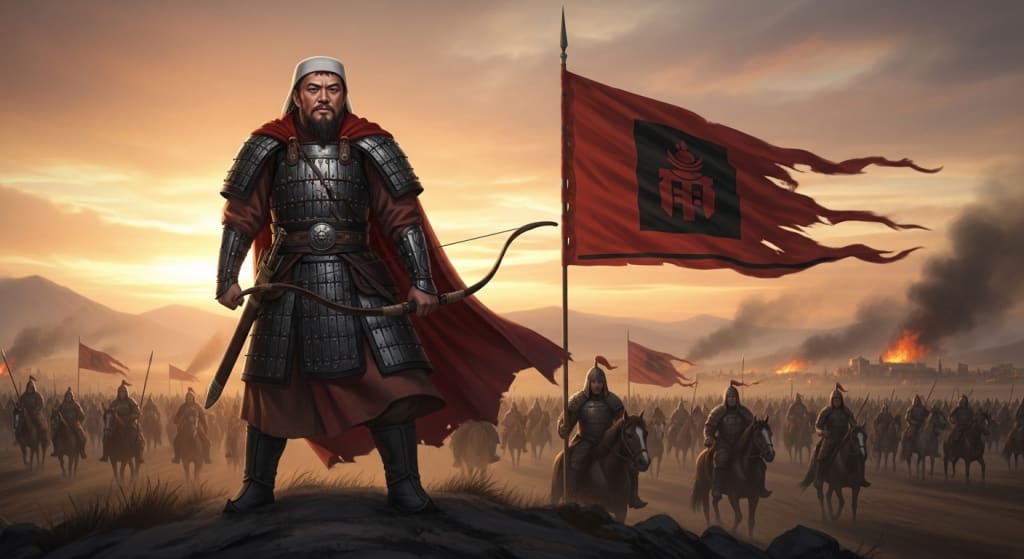
Genghis Khan, born as Temujin around 1162 in the harsh steppes of Mongolia, is one of history’s most formidable and transformative leaders. His life story is not just about conquest and empire-building, but also about resilience, strategic brilliance, and the unification of a fragmented people. From a childhood marked by betrayal and poverty to becoming the founder of the largest contiguous empire in history, his journey is both extraordinary and complex.
Temujin was born into a noble family, but his early life quickly descended into hardship. His father, Yesugei, was a tribal leader who was poisoned by rivals when Temujin was still a child. After his father’s death, his family was abandoned by their clan and left to survive on their own in the unforgiving wilderness. This period of struggle shaped Temujin’s character, teaching him survival skills, resilience, and the importance of loyalty.
As a young boy, Temujin faced numerous challenges, including the kidnapping of his wife Börte by a rival tribe. Instead of succumbing to despair, he gathered allies and successfully rescued her. This event marked a turning point in his life, demonstrating his leadership potential and ability to unite people under a common cause. Over time, he began to build a network of loyal followers, many of whom came from different tribes and backgrounds.
One of Temujin’s most significant achievements was the unification of the Mongol tribes. At the time, the Mongols were divided into numerous clans that frequently fought among themselves. Through a combination of diplomacy, alliances, and military force, Temujin gradually brought these tribes together. In 1206, he was proclaimed “Genghis Khan,” meaning “Universal Ruler,” marking the official beginning of the Mongol Empire.
Genghis Khan revolutionized warfare with his innovative strategies and disciplined army. He organized his forces into a highly efficient structure based on units of tens, hundreds, thousands, and tens of thousands. This system allowed for flexibility, coordination, and rapid movement on the battlefield. His soldiers were skilled horsemen and archers, capable of covering vast distances بسرعة and launching surprise attacks.
Another key aspect of Genghis Khan’s success was his use of intelligence and psychological warfare. He often employed spies to gather information about his enemies and spread fear through rumors and strategic displays of القوة. Cities that resisted him were often destroyed as a warning to others, while those that surrendered peacefully were usually spared and integrated into his empire.
Beyond his military achievements, Genghis Khan was also an effective administrator. He established a legal code known as the Yassa, which promoted order and discipline across his vast empire. The Yassa emphasized loyalty, meritocracy, and religious tolerance, allowing people of different faiths to coexist peacefully. He also encouraged trade and communication by protecting merchants and establishing safe trade routes across Asia.
Genghis Khan’s empire expanded rapidly, stretching from China in the east to parts of Eastern Europe in the west. His campaigns against the Jin Dynasty in northern China and the Khwarezmian Empire in Central Asia demonstrated his strategic brilliance and توانائی to adapt to different جنگی حالات. Despite his reputation for brutality, he also played a role in facilitating cultural exchange and economic integration across Eurasia.
However, his legacy is not without controversy. The destruction caused by his campaigns led to the deaths of millions of people and the سقوط of many cities and civilizations. Historians continue to debate whether he should be remembered primarily as a ruthless conqueror or a visionary leader who shaped the course of world history.
Genghis Khan died in 1227 during a campaign against the Western Xia dynasty. The exact cause of his death remains uncertain, with various theories ranging from illness to injury. After his death, his empire was divided among his sons and grandsons, but it continued to expand under their leadership, becoming an even more powerful force in global history.
In conclusion, Genghis Khan’s life is a remarkable story of transformation and ambition. From a struggling orphan to the ruler of a vast empire, he changed the political and cultural landscape of the world. His leadership style, military innovations, and administrative reforms left a lasting impact that can still be felt today. Whether viewed as a hero or a conqueror, there is no denying that Genghis Khan remains one of the most influential figures in human history.
About the Creator
Keep reading
More stories from Mariana Farias and writers in History and other communities.
The Soviet-Afghan War: A Devastating Clash That Changed the World
On a cold December night in 1979, the silence of Afghanistan’s rugged mountains was shattered by the roar of tanks and helicopters. What followed was not just an invasion—it was the beginning of a brutal war that would last nearly a decade and leave scars that still linger today.
By Mariana Farias3 days ago in History
How A Pilot Hijact a plane (Real Story)
At 9:27 AM on March 24, 2015, the sky over Marseille was clear. An Airbus A320, operated by Germanwings, was cruising toward Düsseldorf with 150 souls on board. To the air traffic controllers below, everything seemed routine. The captain’s voice was steady as he read back his clearances. But within three minutes, the "routine" began to dissolve into a terrifying anomaly.
By Edge Words41 minutes ago in History
The Crusades
On July 15, 1099, after five weeks of siege, Christian Crusaders breached the walls of Jerusalem and embarked on a massacre so extreme that eyewitnesses reported riding horses through streets where blood reached the stirrups, slaughtering every Muslim and Jewish resident they could find regardless of age or gender, and one chronicler recorded that the killers then washed the blood from their hands and walked barefoot to the Church of the Holy Sepulchre to pray and give thanks to God for their victory, seeing no contradiction between worship and genocide.
By The Curious Writer4 days ago in History
Something Is Beginning, I Think Challenge Winners
This challenge wasn’t about clean starts. It was about that weird in-between where something is beginning, but no one really knows what yet. A lot of these stories leaned into hesitation, into pauses and false starts and that feeling that something is about to happen but hasn’t quite.
By Vocal Curation Team2 days ago in Resources



Comments
There are no comments for this story
Be the first to respond and start the conversation.