
The Army That Came From Nowhere: The Fenian Raids of 1866
Seriously Saturday Edition!

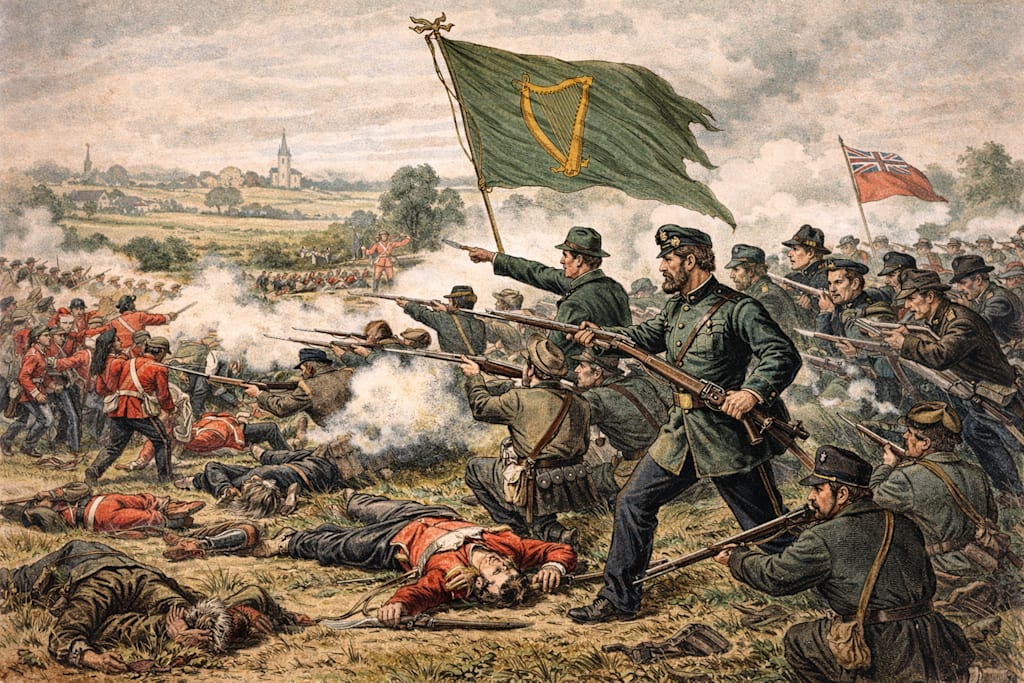
In the spring of 1866, not long after the smoke of the American Civil War had cleared, something strange began to stir along the northern border of the United States.
It wasn’t an official army. There were no banners of the United States government. No declaration of war. No formal orders. And yet, gathering quietly in towns like Buffalo, New York, was a force of men who fully intended to do something extraordinary: They were going to invade Canada!
A War That Didn’t End
To understand why this happened, you have to step back into the aftermath of the Civil War. Thousands of Irish immigrants had fought in Union ranks. Many had come to America fleeing famine, poverty, and British rule in Ireland. They had fought and bled for a country that was not originally their own.
And when the war ended, many of them found themselves asking a simple question: What now?... For some, the answer wasn’t peace. It was Ireland.
The Fenian Brotherhood
The men who would organize the raids were part of the Fenian Brotherhood, an Irish nationalist organization dedicated to ending British control of Ireland.
Their idea was bold. And, in hindsight, wildly improbable. If they could seize Canadian territory, then a British colony, they believed they could:
- hold it hostage
- pressure Britain
- and negotiate Irish independence
It was a plan born from frustration, hope, and perhaps a touch of post-war overconfidence. After all, many of these men were experienced soldiers. They had just come through one of the bloodiest conflicts in modern history. How hard could Canada be?
Gathering at the Border
In the months leading up to the raids, Fenian forces began organizing along the U.S.-Canada border. Buffalo became a key staging ground. Weapons were gathered. Plans were made. And all of it happened in a strange gray area.
The United States government officially opposed the raids. But enforcement was… well, inconsistent. Some officials turned a blind eye. Others quietly sympathized. And for a brief moment in time, it seemed possible that an unofficial army might cross an international border with little resistance.
The Crossing
On June 1, 1866, the Fenians made their move. More than 1,000 men crossed the Niagara River from Buffalo into Canada West (modern-day Ontario). They landed near Fort Erie. And just like that, the invasion had begun. There were no grand speeches. No dramatic declarations. Just men stepping onto foreign soil, carrying rifles and ambition.
The Battle of Ridgeway
The Canadian militia responded quickly. Many of them were young and inexperienced. Some had never seen combat before. On June 2, the two forces met near the village of Ridgeway. What followed was a short but chaotic battle.
At first, the Fenians held the advantage. They were battle-hardened veterans, many of them trained in the brutal realities of Civil War combat. The Canadian forces, by contrast, struggled with communication and coordination.
At one point, confusion over orders led to a critical breakdown in their formation. The result was a Fenian victory. For a brief, surreal moment in history, an unofficial army of Irish-American veterans had successfully defeated Canadian forces on Canadian soil.
Victory… and Then What?
And here is where the story takes its most Iron Lighthouse turn. Because the Fenians had achieved something remarkable. They had crossed the border and won a hard-fought battle. They had, at least temporarily, occupied foreign territory. And then…
They realized they had no real plan for what came next. There were no reinforcements coming. No supply chain. No political recognition. No realistic path to holding the territory, much less victory.
And across the river, the United States government, now under pressure, began moving to shut things down.
The Collapse
Within days, the Fenian position became untenable. U.S. authorities began arresting Fenian leaders and cutting off support. British and Canadian forces regrouped. And the momentum vanished almost as quickly as it had appeared.
Many Fenians retreated back across the border. Others were captured. The invasion, bold and improbable, dissolved into confusion and retreat.
A Strange Kind of Success
On the surface, the Fenian Raids were a failure. They did not secure Irish independence. They did not hold Canadian territory. They did not achieve their stated goals. But history has a way of twisting outcomes.
Because the raids had an unintended consequence. They helped unify Canada. The threat of invasion, however strange, highlighted the need for stronger cooperation between the British North American colonies.
Within a year, in 1867, Canada would move toward Confederation. A nation, in part, forged by the fear of something that should never have worked.
The Echo of the Idea
Today, the Fenian Raids exist as one of those strange historical moments that feel almost fictional. An army without a country. A war without a declaration. An invasion driven not by conquest, but by the hope of freeing a distant homeland. It was reckless... Improbable... And most undeniably, human.
The Men Who Tried to Change the World
It would be easy to dismiss the Fenians as misguided and foolish. And perhaps they were. But they were also something else. Men who had already survived one war. Who believed, rightly or wrongly, that they could shape history again.
Who carried with them the idea that borders were not fixed, that empires were not permanent, and that bold action, even improbable action, might change the course of events. They were wrong about Canada. But not entirely wrong about the world.
The Lighthouse Reflection
There’s something quietly fascinating about the Fenian Raids. Not because they succeeded. But because they were attempted at all. Because they remind us that history is not always shaped by careful plans and official decisions.
Sometimes, it is shaped by people standing at the edge of a river, looking across at another country, and deciding... against all odds... to cross.
About the Creator
The Iron Lighthouse
Where folklore meets freeway. A guide to the strange heart of the American backroads...
Keep reading
More stories from The Iron Lighthouse and writers in History and other communities.
Carried by the Wind: The Forgotten Story of Japan’s Fire Balloons.
In the final years of World War II, as the conflict stretched across oceans and continents, a strange and almost unbelievable weapon drifted silently across the Pacific. It had no engine. No pilot and no guidance system. Only wind.
By The Iron Lighthouse5 days ago in History



Comments
There are no comments for this story
Be the first to respond and start the conversation.