
The 48 Laws of Power
Understanding the Art of Influence

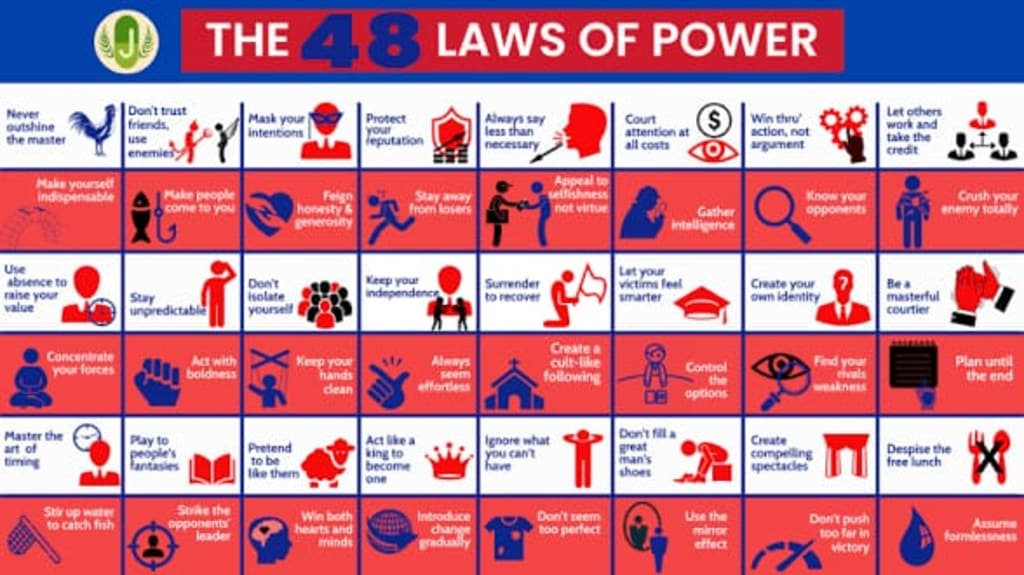
In a world where influence shapes outcomes, few books have captured the nuances of power as profoundly as The 48 Laws of Power by Robert Greene. First published in 1998, this bestselling book has become a cornerstone for anyone seeking to understand human behavior, strategy, and the delicate dynamics of authority. Its appeal spans leaders, entrepreneurs, politicians, and even artists, offering a pragmatic—if sometimes controversial—approach to achieving and maintaining influence.
The Essence of Power
At its core, The 48 Laws of Power explores the timeless nature of power. Greene distills lessons from historical figures such as Machiavelli, Sun Tzu, and Cleopatra, weaving together examples from centuries of political, military, and social maneuvering. The book doesn’t present moral judgments; instead, it offers a blueprint of strategies that have worked for influential figures throughout history.
Power, according to Greene, is not just about holding positions or titles—it is about perception, control, and timing. Those who master these elements can shape the behavior of others and create opportunities for themselves that may otherwise remain inaccessible.
Key Themes
One of the book’s central themes is the concept of strategy. Greene encourages readers to act with calculated purpose rather than relying solely on chance or talent. For instance, Law 1: Never Outshine the Master teaches the importance of subtlety in ambition, warning against the pitfalls of making those above you feel insecure. Similarly, Law 3: Conceal Your Intentions emphasizes the power of mystery and unpredictability in achieving goals.
Another recurring theme is the art of manipulation and influence. While the book’s advice may appear ruthless, Greene presents it as a toolset for navigating competitive environments. Law 6: Court Attention at All Costs highlights the value of visibility and perception, demonstrating that attention can often be more potent than tangible achievements. Law 15: Crush Your Enemy Totally underscores the importance of decisiveness when dealing with opposition—though it is balanced by warnings about overreach and backlash.
Controversy and Criticism
Despite its popularity, The 48 Laws of Power has sparked considerable debate. Critics argue that it promotes unethical behavior, manipulation, and exploitation. Indeed, some laws can appear cold or ruthless when applied without discretion. However, supporters claim that Greene simply exposes the realities of power dynamics rather than endorsing them. By understanding these laws, one can protect oneself from manipulation as much as one can use them to gain influence.
The book’s controversial nature has not hindered its global impact. Leaders, business executives, and even entertainers have cited it as an essential guide for navigating complex social hierarchies. Its principles have been applied in corporate strategy, negotiation, and personal development, reflecting the universality of power in human interaction.
Practical Applications
Beyond historical anecdotes, the book provides actionable insights. Readers can analyze situations, anticipate opponents’ moves, and craft strategies for advancement. For example, Law 33: Discover Each Man’s Thumbscrew encourages understanding people’s desires and weaknesses, enabling one to influence effectively. Law 34: Be Royal in Your Own Fashion reminds individuals to project confidence and authority, as perception often determines reality.
Crucially, Greene emphasizes adaptability. Not every law is applicable in every context. Wisdom lies in discerning when to apply a law and when restraint is the better path. This nuanced approach separates mere cunning from true strategic mastery.
Cultural Impact
Since its release, The 48 Laws of Power has permeated popular culture. Musicians, athletes, and entrepreneurs reference it as a guide to managing fame, competition, and influence. Its lessons have inspired workshops, podcasts, and online discussions, cementing its status as more than just a book—it is a framework for understanding human behavior in competitive settings.
Conclusion
The 48 Laws of Power is more than a manual for manipulation; it is a lens through which to observe the complexities of influence and authority. While some may reject its advice on moral grounds, its enduring popularity underscores a universal truth: power is an inescapable force in human interactions. Greene’s work challenges readers to navigate this force with awareness, strategy, and precision, making it an indispensable resource for anyone seeking to understand the subtle currents that shape success.
By studying these laws, individuals gain not only the tools to advance their interests but also the insight to defend against the ambitions of others. In the delicate game of influence, knowledge is the ultimate power.
About the Creator
Zain writes
I am a writer, and I write these words for all of you, my readers, who appreciate meaningful and thought-provoking content.
Keep reading
More stories from Zain writes and writers in Geeks and other communities.
The Art of Reading Minds
Introduction In a world where communication goes far beyond words, The Art of Reading Minds by Henrik Fexeus offers a powerful guide to understanding people on a deeper level. This book is not about magic or psychic abilities—it is about mastering observation, emotional intelligence, and human behavior.
By Zain writes3 days ago in BookClub
Simpsons Review: "So It's Come to This: A Simpsons Clip Show"
Happy April Fools' Day, all! It's been a while since I've written a review of a Simpsons episode, and with today being the aforementioned holiday, I just have to talk about this episode. It's a landmark episode, in more ways than one, so let's get to it.
By Clyde E. Dawkins5 days ago in Geeks
Project Hail Mary (2026) - A Cinematic Experience
We’ll travel where no man or rock has ever gone. Project Hail Mary flew into theaters in 2026. Based on the novel by Andy Weir, the story centers on Ryland Grace, a science teacher who wakes up alone on a spaceship. He was sent on a mission by the government to stop a mysterious substance from killing Earth’s sun, but makes an unexpected friendship.
By Marielle Sabbag3 days ago in Geeks
Something Is Beginning, I Think Challenge Winners
This challenge wasn’t about clean starts. It was about that weird in-between where something is beginning, but no one really knows what yet. A lot of these stories leaned into hesitation, into pauses and false starts and that feeling that something is about to happen but hasn’t quite.
By Vocal Curation Team5 days ago in Resources



Comments
There are no comments for this story
Be the first to respond and start the conversation.