
Book Review: "Parade's End" by Ford Madox Ford (Pt. 1)
Volume 1: "Some Do Not"

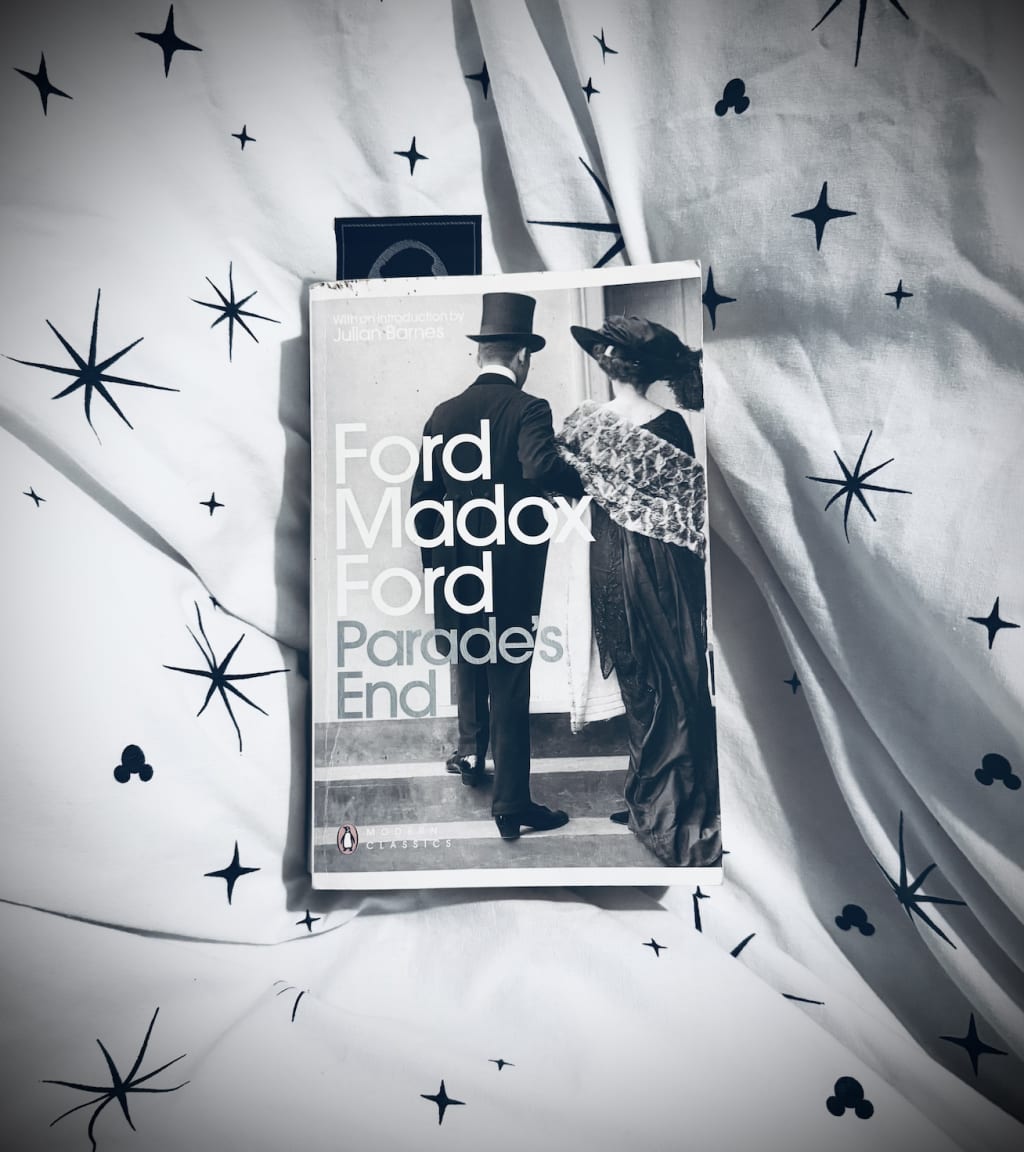
Rating: 5/5 - A depressed masterpiece of love, loss and wartime terror...
***
This is how it happened:
This was exactly how it happened. For my Why It's a Masterpiece series I took a quick reread of my copy of The Good Soldier, which is great because it's short and easy to read. (It's also incredibly depressing but you've read the article on it, you should know). I then thought to myself 'this can't be right...I never got around to reading Parade's End which is considered to be Ford's best work...' and quickly ordered it (it was only a couple of £ and so, nice and cheap). I didn't bother to look it up in any way, shape or form but seemed to assume it would be of similar length to The Good Soldier which can't be more than 150 pages.
840 pages.
Absolute scenes.
***
This is a review of 'Some Do Not' - the first volume...
***
Christopher Tietjens and Vincent Macmaster are on a train headed for a golfing weekend. They are going to the countryside and prove through conversation that they are intelligent men. It's some time before the First World War and the British Class System is clearly alive and kicking. They are government staticians from London and Macmaster has just completed his writing on the painter Rossetti. Ford's writing about these two men is often overtly realistic, trying to paint us a picture of pre-War Britain through two men who are clearly better off than a lot of the population but then again, are coloured by a slight missing piece. It's like they are slightly devoid of larger meaning. However, Ford I believe, leaves that hanging in the air quite well.
Of course, there's a horrid marriage. Tietjens is married to Sylvia - a sort of Zelda Fitzgerald kind of figure. She had once left her husband for a lover she became bored with - Major Perowne. She is currently living with her mother and a priest, but doesn't really have anything else going on. Ford's confrontation of the female gender is somewhat misguided but I respect that it mainly concerns women of a certain class, and clearly not all of them. She's primarily concerned with living with her mother even though she's bored here too - she needs something to say she was doing when she goes back to London, but it is clear that she is going to be a very annoyingly dumb character. Less Zelda Fitzgerald, more Kardashian here anyway.
Tietjens shows Macmaster Sylvia's letter in which she details that she's coming back to him and yet one of their games is interrupted by the Suffragettes. Tietjens, when the whole thing gets a little violent from men starting to chase the women around, trips up a policeman and the women can escape. There's some talk about Tietjens having an affair and I honestly can't understand why helping women would lead someone to think you were having an affair. I think Tietjens was just being a good person in the moment. Even he can see the world is changing and even though its the 1910s still, the world won't stay the way it is for very long into the future. This trip therefore, is a representation of his ability to go forward, no matter where it goes next. He may not even like it very much.
Macmaster takes Tietjens to the Duchemins for breakfast and the husband is taken off to an asylum during it as he is prone to lunacy. It seems to destroy the celebratory atmosphere around the breakfast but again, this is Ford's way of giving us a look into reality. Not everything is golfing weekends and torrid love affairs away from London. There is something else beneath the surface, something that quite literally gets carried out of the story when it becomes an inconvenience: reality. Like the 'trip' of the policeman, there is something we are supposed to notice here. Well, that's what I think anyway.
Tietjens and Valentine (a suffragette) walk through the countryside together eventually, once the rush has died down. Tietjens then agrees to drive with Valentine and her family to hide them from the police. On the way back when it is only Tietjens and Valentine, General Campion crashes his car into the horse. Again, I think this is a direct representation of the new world. We have a man helping out the suffragettes hiding from the police, the horse that is injured as a result of being hit by a car (representing the progression of machinery over horses) and a new affair taking place so close to the edge of the war.
Several years into the war (approximately, 1917), Tietjens returns to London on leave, mentally fractured by shell shock and struggling to reconstruct his memory through reading the Encyclopaedia Britannica. His marriage to Sylvia is openly hostile and she accuses him of infidelity with Valentine. As this is happening, Macmaster has prospered socially and professionally through Tietjens’ uncredited help. It is horrifying to see what has happened to our gentle but flawed main character, but again if we were paying attention - it is inevitable.
Financial humiliation intensifies matters when Lord Port Scatho’s nephew dishonours Tietjens’ cheques, deepening public suspicion around him now that he is also not of sound mind. Tietjens announces he is returning to France and intends to resign from his club. His elder brother Mark arrives, bringing family tension and the shadow of their father’s death, reportedly caused by malicious gossip. Paranoia begins to take hold and we start to see the classic sadness of the Ford novel take shape. This book is all about psychological damage and paranoia and so, I'm not surprised that it has come so early.
Walking from Gray’s Inn to Whitehall, Christopher and Mark confront the rumours linking him and Valentine in a torrid love affair. Mark reveals that his inquiries, via his flatmate Ruggles, inadvertently fed scandal to their father. At the War Office, Tietjens refuses a safe home posting, choosing instead to return to active service in France. You know things are bad when someone chooses to go back to the war instead of anywhere else. But then again, at least Tietjens can see that his mind is not anymore damaged by salaciousness or people like Sylvia when he is on the battlefield.
While waiting outside, Mark and Valentine talk to each other. She recalls a recent conversation with Tietjens, realising then that he would go back to the Front. Macmaster has gained a knighthood partly through Tietjens' intellectual labour. Mrs Macmaster courts Sylvia, alienating Valentine and ending their uneasy friendship amid social manoeuvring and betrayal. We can see here that people are often treated as disposable and when people have got what they want (title and status), they will leave the people who have helped them to get there whether that is out in the cold or on the Front of war.
Outside the War Office, Valentine brokers reconciliation between the brothers. She and Tietjens agree to meet later that night, his final evening before likely death, and she offers to become his mistress. The promise suggests emotional consummation in the face of annihilation, yet remains suspended in uncertainty. Ford's novels often have this aspect of uncertainty in love and since they have had a love affair whilst he was still married to Sylvia, she cannot consumate the love properly - the only option she has is to become a mistress. It is quite worrying because of the fact she is a Suffragette as well. Is this a revolutionary move or is it a step back? Who knows?
The anticipated union never happens. Tietjens returns alone to his dark flat, reflecting on farewells and unresolved conversations, particularly with Valentine. There is a quiet closing which leaves possibility wide open and well, it isn't a particularly fascinating image. It is silent, it is lonely and it is Tietjens sitting alone.
The next part is called No More Parades and I hope we get more of the same because I desperately want to know what happens to these two lovers even though I know it is immoral for them to be together. We will see.
About the Creator
Annie Kapur
I am:
🙋🏽♀️ Annie
📚 Avid Reader
📝 Reviewer and Commentator
🎓 Post-Grad Millennial (M.A)
***
I have:
📖 300K+ reads on Vocal
🫶🏼 Love for reading & research
🦋/X @AnnieWithBooks
***
🏡 UK
Keep reading
More stories from Annie Kapur and writers in Geeks and other communities.
Book Review: "American Poetry: A Very Short Introduction" by David Caplan
Help me, I'm stuck in the Very Short Introduction series and I can't get out! No really, this is becoming the same problem I had a few years ago when I got my limbs caught in the British Library Crime Classics series and ended up reading almost 100 of those books in perhaps a few months. Now, I've managed to find one on American Poetry, I have to say it is probably one of my favourites so far. I mean The Beats is good, but American Poetry has Phillis Wheatley and Emily Dickinson so it is, by default, better. The writer doesn't only display his knowledge of American Poetic History, he also provides some historical accounts of the people who wrote them, commenting on where they fit into the greater American landscape.
By Annie Kapura day ago in Geeks
History of The Three Stooges (Part I: The Beginnings and Columbia Pictures - 1920s-1936)
I have been itching to write about The Three Stooges on Vocal for close to two years, but I couldn't figure out how to do it. I wanted to do it by third Stooge, but that's a bit complicated. I know this much. I was about eight or nine years old when I first saw The Three Stooges. I remember one of my local channels had the Stooges on for hours, and I tried my damnedest to be up for those shorts. I remember that the Family Channel actually had an hour of the Stooges on from 11PM to midnight, and it was the entire library on during that time.
By Clyde E. Dawkins6 days ago in Geeks
Anthony Michael Hall: Did he channel Donald Trump on Psych?
Was Donald Trump the inspiration for Harris Trout? Anthony Michael Hall has had a stellar career that began when he was seven years old. At eleven, he was the little boy known as the Honeycomb Kid in a television commercial. In March 2013, he appeared in three episodes of the final season of the USA drama Psych.
By Cheryl E Preston4 days ago in Geeks


Comments
There are no comments for this story
Be the first to respond and start the conversation.