
Book Review: "Henry VIII: King and Court" by Alison Weir (Pt. 2)
Chapter 5 to Chapter 8

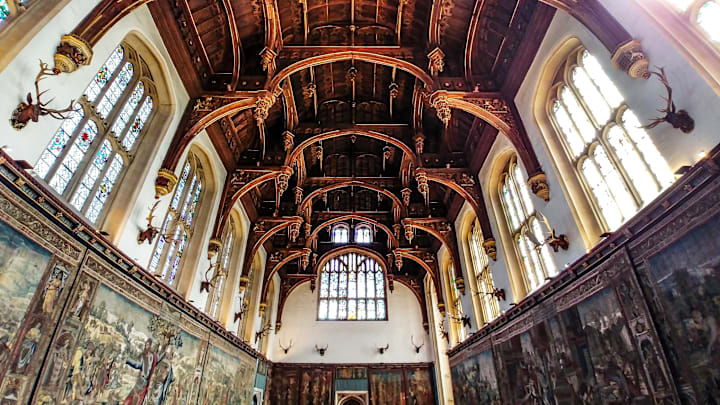
There's already a lot we know about the young prince Henry and we even have a flavour of how he grew up and was basically raised to be the most entitled brat in England. Be that as it may, he had a lot of knowledge and was actually incredibly clever when it came to scholarly studies, languages and as it happens, masonry and interior design as well. Alison Weir tells us all about the way the King decorated places like Hampton Court to show off his wealth, draping the walls with fine woven textiles and making decorative glass to depict his noble lineage. This was all part of the theatre of royalty, the propaganda that Henry VIII was so good at during the time, it almost made people forget that he had two of his wives killed and one was not even 20 years' old at the time.
When I read Gareth Russell's book The Palace, Hampton Court was described as a lush royal estate filled with great luxury and indulgence. We were taken through individual rooms in individual times, giving us a flavour of its 500 year history. But as we see it in Henry VIII's own time, it comes to us as a whole. It is a whole piece of the propaganda of the royal court - it is an advertisement of Henry's talents for architecture, masonry, decoration and of course, maintaining his own image.
When it comes to the servants in the household there's a whole different set of rules. Hygeine was a huge issue and Henry VIII was someone who was obsessed with being clean though in a time where nobody else was very clean, this was very difficult. I read about the fact that in many cases, people would relieve themselves in the hallways of castles and kitchen staff would, if it got too hot, manage the kitchen without any clothes on. Rules were brought in of course, to make sure this didn't happen because it sickened the King. Alison Weir tells us about the fact that at dinner parties, the guests would have left their dirty dishes on beds unless instructed to do otherwise and I know for a fact there were bugs everywhere.
Household servants would have to clean before the King rose in the morning and make sure things were all in order, but usually homes were only cleaned once everyone had left. When Henry wanted things to be magnificent, he would have to dig into his pockets and basically spend all of his inheritance. This was all just for maintenance - including all the cleaning and partying. Henry VIII needed to cut back on wastage and so, put measures in place to do so. But as Alison Weir states, this was to no avail since again not many other people shared his vision saving some of the money he didn't have anymore. He would of course, die in debt.
There was no such thing as being fired for misconduct back in those days, but you could be fired for being sick too often or for just being disliked by the royals. However, there was a heavier punishment for a heavier thing: violence near the King. Fighting, swearing and prostitution were all punishable by firing and dismissal and in one case, according to the author, three servant were hanged for their violences. Fights would regularly break out apparently and yet, above the stairs Henry would get in the way and break it up. Below the stairs was a whole different story. Alison Weir is very clearly drawing a line between what was appropriate for the upper class in comparison to the lower classes. Depending on the level of violence, punishment was assumed. But I cannot find any evidence for the upper class being punished in the same way.
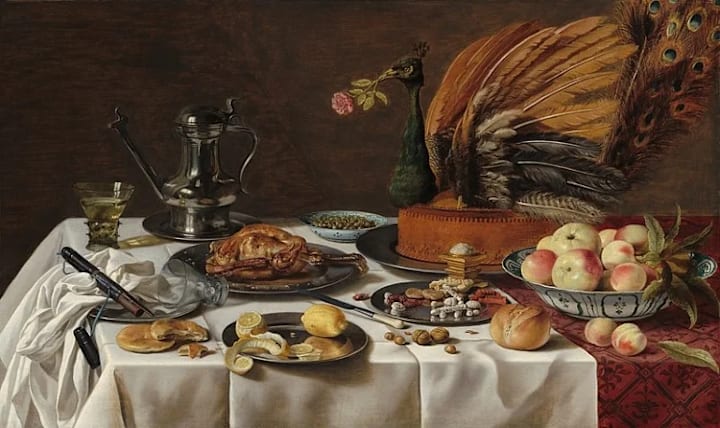
We then move on to food in which we are told about the "military operation" which would be feeding the royal household. The cups were only cleaned once a year according to one of the primary sources, in which it was clear that the kitchen folk were using them as makeshift bathrooms and as cups for the company of the dining hall. Honestly, I am thoroughly grossed out but I am not surprised. There was little running water and even that would have to be rationed carefully. There were many cooks in the household and depending on the situation, the cook of choice would be brought out. Alison Weir explains that one was French, and he was the best one of them all - brought out when there was great and powerful company.
Bread being a staple of every meal is not surprising because the 'bakehouse' was greatly efficient and bread was cheap and easy to get access to. Ale was also the staple drink again, it was cheap and the water was not thought clean enough to drink. Alison Weir explains that the most expensive drink in the household was wine and these were from all over Europe - especially from the nice parts of France (even though he didn't like the French very much clearly). We are taken through the wines that were served at dinner including the warm and sugary wine served after dinner. There was no such thing as refrigeration and so you can only imagine how much waste there was and how much food they got through. Alison Weir explains how the pantry would not only be used to store candles and tablecloth, but there were huge chests for the bread.
Henry VIII was fond of vegetables, especially the artichoke which were grown in the gardens - and more people started to eat vegetables during the era. But it was meat that was the big deal. The pastries would often contain whole sides of meat such as venison and Alison Weir definitely goes into detail about how much these people ate. I mean, have you seen the size of Henry VIII? This man very clearly enjoyed his good food. Apart from vegetables though, he loved fruit and it was grown on Hampton Court. Alison Weir gives us a fun fact here: Henry VIII introduced apricots to England and even though nobody really ate fruit raw (only in tarts, dried up or in preserves as raw fruit was thought to be bad for you), that is quite an achievement. I loved this chapter because it was so interesting to learn about what kind of things they ate (jam so thick you could slice it with a knife) and the kinds of transporting of food (there was a guy who checked the food as it came to the household).
As we move on through the book, I'm really looking forward to learning more about the royal court - I am hoping you are too. Alison Weir makes this all incredibly interesting and immersive. You definitely feel like you are being walked through Henry VIII's own time, in his castle, in the middle of a party - like the Ghost of Christmas Past.
About the Creator
Annie Kapur
I am:
🙋🏽♀️ Annie
📚 Avid Reader
📝 Reviewer and Commentator
🎓 Post-Grad Millennial (M.A)
***
I have:
📖 300K+ reads on Vocal
🫶🏼 Love for reading & research
🦋/X @AnnieWithBooks
***
🏡 UK
Keep reading
More stories from Annie Kapur and writers in Geeks and other communities.
Terra Amata by J.M.G. Le Clézio
In 1967, J.M.G. Le Clézio published his novel Terra Amata as one of his earlier works. An experimental novel, it is part of this larger phase where the author was working with more surrealist fiction styles, often embracing fragmentations and existentialism as a philosophy of his work. Like a lot of his work though, it explores what it means to be human and how this works in relation to the natural world. It blurs those lines between the real and the cosmic, the existential and the absurdist and the way in which we understand ourselves is shrouded in the 'bigger picture'.
By Annie Kapura day ago in Geeks
Something Is Beginning, I Think Challenge Winners
This challenge wasn’t about clean starts. It was about that weird in-between where something is beginning, but no one really knows what yet. A lot of these stories leaned into hesitation, into pauses and false starts and that feeling that something is about to happen but hasn’t quite.
By Vocal Curation Team4 days ago in Resources



Comments
There are no comments for this story
Be the first to respond and start the conversation.